
by ADAM BLANDEN
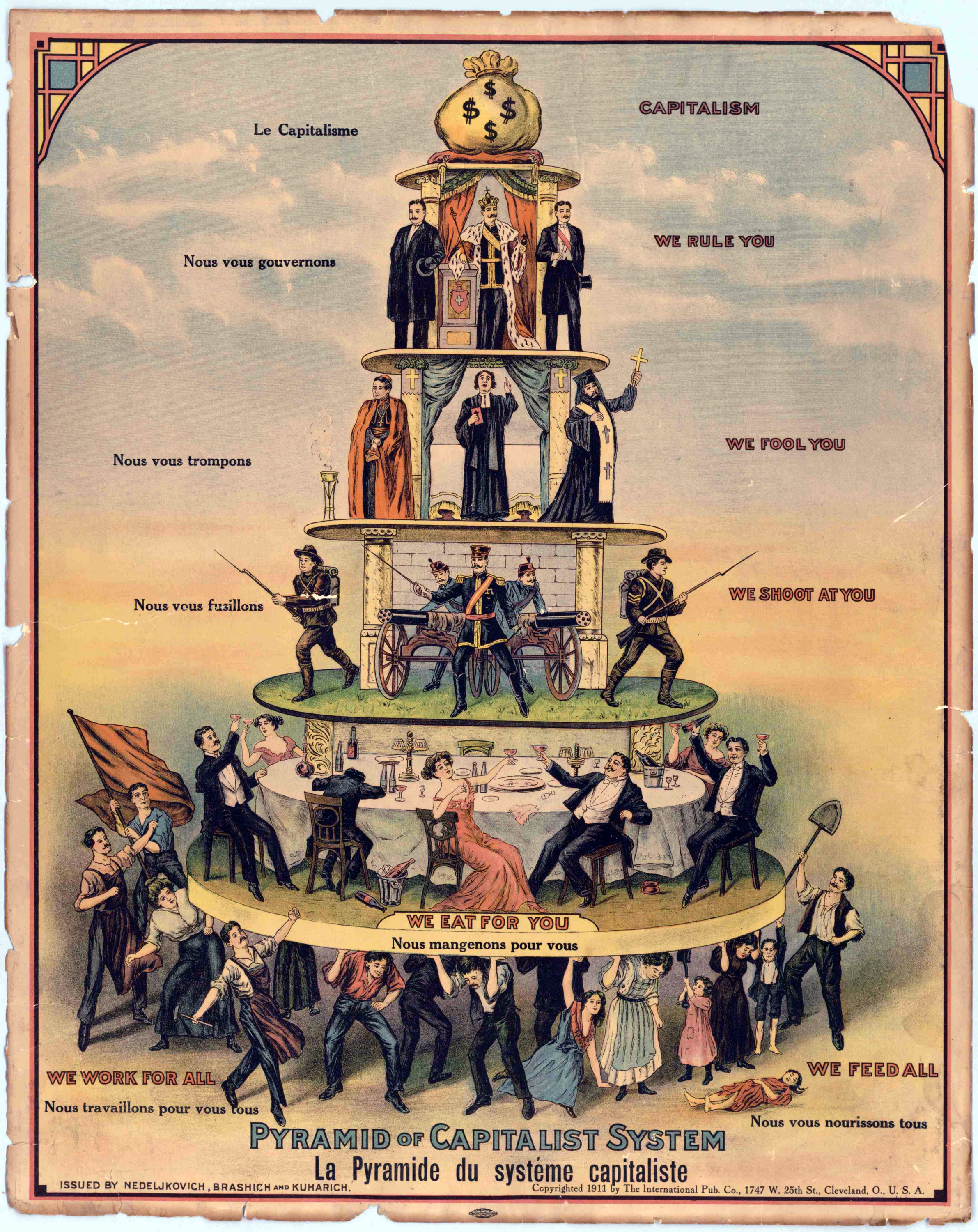 The Industrial Workers of the World poster “Pyramid of Capitalist System” (1911) IMAGE/Wikipedia
The spectres that haunt the minds of economists today – from authoritarian state capitalism to the growth of ‘welfare dependency’ – are conjured by the peculiar neuroses of the profession. Properly historical trends tend to pass economists by. Neoclassical economics tends to ignore this historical aspect of capitalism entirely, treating actors as strictly self-interested and rational.[1] Keynesianism, meanwhile, tends to psychologise the behaviour of capitalist investors, which can also limit our understanding of long-run developments.[2] Finally Marxist economics, though explicitly devoted to a historical materialist conception of capitalism, tends to fixate on certain ‘fundamental laws of motion’ at the expense of analysing what is new in the present historical moment of the system’s development.[3]
If there is to be an effective anti-capitalist politics there must be a serious effort to understand not just the essentials of the system, but also how capitalism is presently developing in novel ways. Without falling back on Marxist tropes like the ‘declining rate of profit’, I want to sketch here how the global economy is changing by drawing on a wide and heterogeneous literature, emphasising the dynamic, historical nature of capitalism. What are the key features and dynamics of global capitalism today? What are the epoch-defining changes to the global political economy that the left needs to understand?
4. Financialisation
Finance has always been an integral part of allocating resources in capitalist economies. But financialisation is an epochal change in the role financial capital plays in capitalism. A byproduct of the immediate postwar era, where a vast accumulation of money capital pushed at the margins of regulatory regimes until it was liberated in the 1970s, financialisation, as the Greek economist Costas Lapavitsas argues in his book Profiting Without Producing: How Finance Exploits Us All (2014), is a three-pronged process. Firstly, since the 1970s big companies have become less reliant on banks for their financing needs. Secondly, banks have engaged in more open market trading and increased lending to individuals and households, as opposed to making more traditional, long-term productive investments. Thirdly, individuals have become increasingly implicated in the operations of financial markets in order to fund day-to-day consumption and to plan for their futures.[4]
Financialisation is more than just the preponderance of finance over production.’ It ‘represents neither the escape of productive capital into the realm of finance in search of higher profits, nor the turn of finance at the expense of productive investment,’ Lapavitsas explains.’ ‘It stands, rather, for a transformation of the mix of financial and non-financial activities that are integral to the circuit of productive capital.’[5] He argues that the ‘protracted and continually evolving nature of the turmoil [since 2008]’ indicates the’ ‘proneness of financialised capitalism toward crisis’.[6] Lapavitsas’s point is that the latest stage of capitalist development is characterised by increasing financialisation of not only capitalist circulation, but also of production and consumption. Since finance is so dependent on liquidity (that is, flows of money), a heavily financialised economy will be more prone to liquidity crises. Moreover, during a liquidity crisis’ ‘cash becomes king’, Lapavitsas, says, citing Marx: in a capitalist crisis there is’ ‘a sudden transformation of the credit system into a monetary system.’ Financial crises are closely related to monetary crises, and therefore very rapidly put pressure on the states and central banks involved.
Take the 2008 credit crunch: a shortage of liquidity originated in the interbank money market as early as 2007. Banks holding, or obliged to support those holding, mortgage-backed securities were subject to declining liquidity as mortgage failures rose. Banks then preferred hoarding liquid (cash) funds in order to deleverage (that is, to pay down their debts). Since banks rely on increasing flows to sustain their activities, a liquidity freeze can be fatal; declining liquidity amounts to declining solvency rates. Stocks declined, meaning troubled banks struggled to attract capital to support their losses on securities.’ ‘The burst of the bubble led to the apparent contradiction of financial institutions being awash with loanable capital but extremely short of liquidity.’[7] As cash became king, the crisis inevitably developed into one of monetary weaknesses.
It is crucial to understand the era of financialisation if we are to grasp the nature of capitalist crises today. Financialisation of the global economy does not limit crises to financial bubbles. Indeed, the profound influence of processes of financial accumulation over productive accumulation and private consumption means that financial crises have a powerful effect not only on market activity but also on states, often via the crisis-reproducing mechanisms of the monetary system.
3. The Volatile Global Monetary System
New Left Project for more