
by DR SAUL DAVID
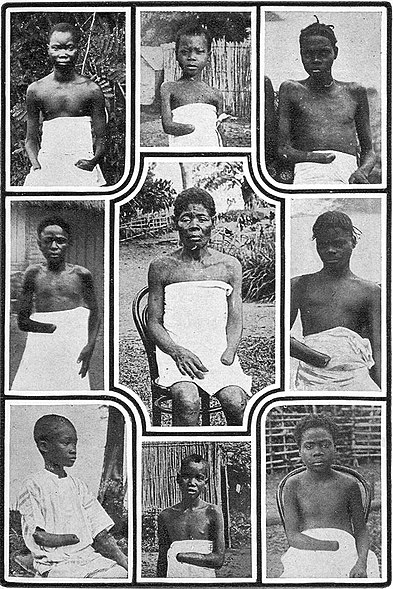 Native Congo Free State, labourers who failed to meet rubber collection quotas were often punished by having their hands cut off. Native Congo Free State was a large area in Central Africa that was privately controlled by Leopold II (1835-1909), King of the Belgians. PHOTO/Wikipedia
Between 1562 and 1807, when the slave trade was abolished, British ships carried up to three million people into slavery in the Americas. In total, European ships took more than 11 million people into slavery from the West African coast, and European traders grew rich on the profits while the population of Africa’s west coast was devastated.
As late as the 1870s, only 10% of the continent was under direct European control, with Algeria held by France, the Cape Colony and Natal (both in modern South Africa) by Britain, and Angola by Portugal. And yet by 1900, European nations had added almost 10 million square miles of Africa – one-fifth of the land mass of the globe – to their overseas colonial possessions. Europeans ruled more than 90% of the African continent.
One of the chief justifications for this so-called ‘scramble for Africa’ was a desire to stamp out slavery once and for all. Shortly before his death in May 1873 at Ilala in central Africa, the celebrated missionary-explorer David Livingstone had called for a worldwide crusade to defeat the slave trade controlled by Arabs in East Africa, that was laying waste the heart of the continent.
The only way to liberate Africa, believed Livingstone, was to introduce the ‘three Cs’: commerce, Christianity and civilisation.
…
As a result, during the last 20 years of the 19th century, Britain occupied or annexed Egypt, the Sudan, British East Africa (Kenya and Uganda), British Somaliland, Southern and Northern Rhodesia (Zimbabwe and Zambia), Bechuanaland (Botswana), Orange Free State and the Transvaal (South Africa), Gambia, Sierra Leone, Nigeria, British Gold Coast (Ghana) and Nyasaland (Malawi). These countries accounted for more than 30% of Africa’s population.
The other chief colonisers were France, Germany, Belgium, Italy, Portugal and Spain.
Germany had only been unified in 1871 and so was a late starter in imperial terms. Its first acquisition in 1884 was German South-West Africa (Namibia), which at the time was peopled by two semi-nomadic tribes, the Herero of the arid central plateau and the Nama of the still more arid steppes to the south.
…
The truth behind the Congo’s rubber trade – ‘legalised robbery enforced by violence’ – was finally exposed by Edmond Morel, an Anglo-French ex-shipping clerk, who wrote a series of accusatory articles in ‘The Speaker’ in 1900.
By arguing that Leopold’s illegal state monopoly was robbing British merchants as well as African peasants, Morel was able to enlist the support of both businessmen and humanitarians. A British consul, Roger Casement, was sent to investigate, and the publication of his damning report in 1904 was, for Leopold, the beginning of the end.
In 1908, in return for £3.8 million, Leopold handed over control of the Congo to the Belgian state. But even then, the forced labour system continued. It took a different form during World War One, when tens of thousands of Congolese were conscripted as porters for the Belgian army.
BBC for more