
by B. R. GOWANI
 Dilip Kumar (left) and Madhubala in stills from Mughal-e-Azam (The Great Mughal). PHOTO/The Hindu
 Waheeda Rehman (left) and Guru Dutt in Pyassa (Thirsty). PHOTO/IBN Live
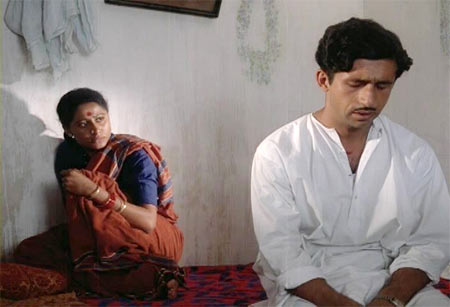 Smita Patil (left) and Naseeruddin Shah in Nishant (Night’s End). PHOTO/Rediff
 Shamim Ara (left) and Muhammad Ali in Aag ka Darya (River of Fire). PHOTO/Cineplot Gallery
In spite of the undeniable enjoyment of watching a movie in a darkened cinema hall, the charm and magic of doing so in olden times cannot be fully imagined or revived. The world did not have video players, movie channels, and instant online access to various forms of entertainment, commonplace today. Movies were the only form of visual entertainment where the final product was presented to the audience without the physical presence of the performers was quite a new concept then. It is great that, with advances in technology, movies can now be watched whenever desired and as frequently as we wish.
Between 1906 and 1916, all the inhabited continents had produced a feature film,,yet all were silent movies, (except one black African had a longer journey before allowed to make a movie in 1955, Afrique Sur Seine, only possible for him to make in France.)
In India, Dadasaheb Phalke, commonly accepted as the “father of Indian cinema”, conceived the idea to produce a movie while watching a Biblical film:
India, under the British colonial rule, produced its first feature film Raja Harishchandra in 1913 and the first talkie Alam Ara in in 1931.
As part of celebration for the 100 years of cinema, this and other weekly Friday articles will cover topics including progressive changes in secularism, status of women, etc. I will share my list of the 101 outstanding movies (2014 will clock in 101 years) worth watching. Of course, the number of good movies is much higher, but I restrict them to 101, for brevity and space and that as my exposure to non-Hindi/Urdu movies is limited, hence not covered here. Consequently, this is primarily a tribute to Hindi/Urdu cinema and a few good Bengali, Gujarati, and Punjabi films.
Pakistan
The list of 101 movies also includes few Pakistani films (from West Pakistan, now Pakistan, and East Pakistan, Bangladesh since 1971). Pakistan separated from India in 1947 and produced her first film Teri Yaad starring Nasir Khan (veteran Indian actor Dilip Kumar’s brother) and Asha Posley.
My reason for including Pakistani films is due to the uncertain times we are living in. History is not an independent entity but a mistress of a few powerful people, most of them insane, who push her the way they want her to go. Pakistan came out of India and Bangladesh emerged from what used to be East Pakistan. Who knows what more changes will occur in these countries, and whether Pakistan will live to see its centenary or not? She has one-third of the centenary to go before being eligible to celebrate her century. (Case in point: the European country of Poland disappeared in 1795 and reappeared in 1918.)
B. R. Gowani can be reached at brgowani@hotmail.com
To be continued