
by JOHN PILGER
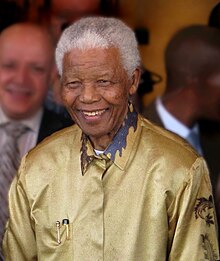 South Africa’s former President, Nelson Mandela PHOTO/Wikipedia
When I reported from South Africa in the 1960s, the Nazi admirer Johannes Vorster occupied the prime minister’s residence in Cape Town. Thirty years later, as I waited at the gates, it was as if the guards had not changed. White Afrikaners checked my ID with the confidence of men in secure work. One carried a copy of Long Walk to Freedom, Nelson Mandela’s autobiography. “It’s very eenspirational,” he said.
Mandela had just had his afternoon nap and looked sleepy; his shoelaces were untied. Wearing a bright gold shirt, he meandered into the room. “Welcome back,” said the first president of a democratic South Africa, beaming. “You must understand that to have been banned from my country is a great honour.” The sheer grace and charm of the man made you feel good. He chuckled about his elevation to sainthood. “That’s not the job I applied for,” he said drily.
Still, he was well used to deferential interviews and I was ticked off several times – “you completely forgot what I said” and “I have already explained that matter to you”. In brooking no criticism of the African National Congress (ANC), he revealed something of why millions of South Africans will mourn his passing but not his “legacy”.
I had asked him why the pledges he and the ANC had given on his release from prison in 1990 had not been kept. The liberation government, Mandela had promised, would take over the apartheid economy, including the banks – and “a change or modification of our views in this regard is inconceivable”. Once in power, the party’s official policy to end the impoverishment of most South Africans, the Reconstruction and Development Programme (RDP), was abandoned, with one of his ministers boasting that the ANC’s politics were Thatcherite.
“You can put any label on it if you like,” he replied. “ …but, for this country, privatisation is the fundamental policy.”
“That’s the opposite of what you said in 1994.”
“You have to appreciate that every process incorporates a change.”
Few ordinary South Africans were aware that this “process” had begun in high secrecy more than two years before Mandela’s release when the ANC in exile had, in effect, done a deal with prominent members of the Afrikaaner elite at meetings in a stately home, Mells Park House, near Bath. The prime movers were the corporations that had underpinned apartheid.
Counterpunch for more