
by DECCA AITKENHEAD
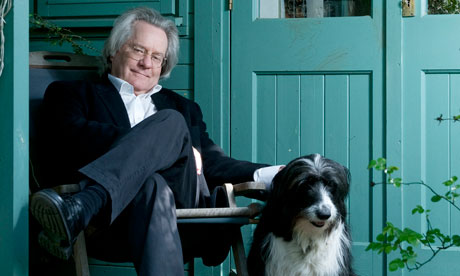 AC Grayling with his dog Misty. PHOTO/Christian Sinibaldi
In the unholy trinity of professional atheists, AC Grayling has always tended to be regarded as the good cop. Less coldly clinical in tone than Richard Dawkins, less aggressively combative than Christopher Hitchens, Grayling approaches the God debate with a gently teasing charm that could almost – but should never – be mistaken for conciliation. “Yes, I’m the velvet version,” he chuckles.
…
He is very cross, for example, with the question in the current census that asks: “What is your religion?” The British Humanist Society has just conducted a poll that asked those surveyed if they were religious – to which 65% said no. But when asked, “What is your religion?” 61% of the very same people answered Christian. “You see, they say, ‘Oh well, nominally I suppose I’m Christian.’ But two-thirds of the population don’t regard themselves as religious! So we have to try to persuade society as a whole to recognise that religious groups are self-constituted interest groups; they exist to promote their point of view. Now, in a liberal democracy they have every right to do so. But they have no greater right than anybody else, any political party or Women’s Institute or trade union. But for historical reasons they have massively overinflated influence – faith-based schools, religious broadcasting, bishops in the House of Lords, the presence of religion at every public event. We’ve got to push it back to its right size.”
Atheists, according to Grayling, divide into three broad categories. There are those for whom this secular objection to the privileged status of religion in public life is the driving force of their concern. Then there are those, “like my chum Richard Dawkins”, who are principally concerned with the metaphysical question of God’s existence. “And I would certainly say there is an intrinsic problem about belief in falsehood.” In other words, even if a person’s faith did no harm to anybody, Grayling still wouldn’t like it. “But the third point is about our ethics – how we live, how we treat one another, what the good life is. And that’s the question that really concerns me the most.”
Guardian for more