
by B. R. GOWANI
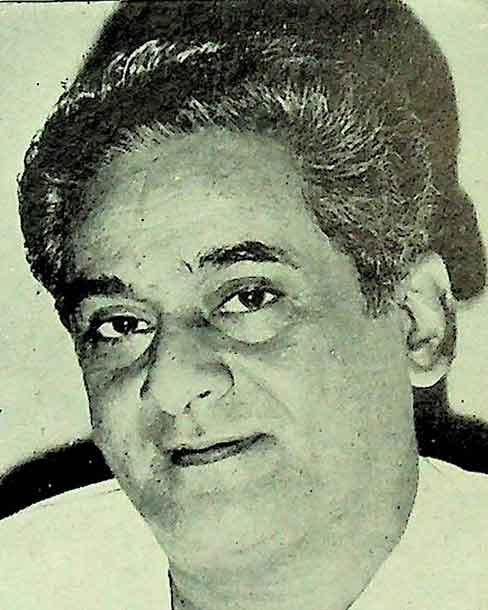
Barkat Ali Ghulam Hussain Virani (1923 – 1994) was born near Bhawnagar, Gujarat. He was a poet, playwright, and novelist who wrote in the Gujarati language. He wrote his first ghazal on September 1, 1941.
Barkat Virani was inspired by Qismat Qureshi who suggested two pen names: “Bezar” and “Befam”, Virani opted for the second and became “Befam”.
On poet/novelist Shayda‘s advise, he moved to Bombay. Befam met All India Radio’s (AIR) Z. A. Bukhari <1> at a mushaira, (gathering of poets where they recite their poems in front of an audience), Bukhari helped him to join AIR.
In 1952, he married Shayda’s daughter Ruqaiyya.
Befam was also associated with Gujarati cinema. He passed away in 1994. One of the couplets from his poem Nahoti:
raDyA “Befam” sauv mArA maraN per ej kAraN thi
hato mAro.j ae avsar ne mAri hAjri nahoti
on my death, all cried “Befam” just for this reason <2>
it was an event about me and I was not present
Manhar Udhas in the above video, began with Befam’s couplet from his poem Sapna rupay aap na aavo najar sudhi:
“Befam” toy keTluN thAki javuN paDyuN
nahiN to jivanno mArg chhe ghar thi qabar sudhi
how much “Befam”, I had to get tired
tho life’s road is only from home to grave
Then Udhas recited “Befam”‘s famous poem Nayan ne bandh raakhine mein jiyare tamne joya chhe with a muktak. Many poets use Muktak which is a four line introduction to the poem.
Udhas doesn’t recite all the couplets but has added two new couplets in his rendition. The ghazal on Rekhta Gujarati website has more couplets but not the two heard in Udhas’ recitation. It also doesn’t have the muktak.
A video to some of the couplets of this ghazal set to a combined Bharatnatyam and Kathak dance is given at the end.
So here is the four-line Muktak followed by the poem. Musi is by Appu.
Manhar Udhas rendered it well in a very sweet voice.
Nayan ne bandh raakhine mein jiyare tamne joya chhe
ashru viraha ni rAt nA khADi shakyo nahiN <3>
pAchhA nayan nA noorne vAdi shakyo nahiN
huN jene kAj andh thayo roy royee ne
AvyA tiyAre aene nihAdi shakyo nahiN
nayan ne bandh rAkhine meiN jiyAre tamne joyA chhe
tame chho aenA kartA pan vadhAre tamne joyA chhe
bijA jemaj tame pan aene pAgaltA gani lesho
nathi hAre chhatAN meiN mari hAre tamne joyA chhe
paraNtu arth eno ae nathi ke rAt viti ga.ee
nahiN to meiN ghaNi vera savAre tamne joya chhe
nathi ae pan have kaiN jaN kiyAre tamne jovAno
nathi ae pan have kaiN yAd kiyare tamne joyA chhe
nahiNtar Avi rite to tare nahiN lAsh daryA maN
mane lAge chhe ke aene kinAre tamne joyA chhe
mane nahi pan hati tamne.j ae becheni darshanni
paDyA chho eklA jiyAre meiN tamne joya chhe
rutu ekaj hati pan rang nahoto Apno ekaj
mane sehra.ae joyA chhe bahAre tamne joyA chhe
tame ho ke na ho, paDto nathi ka.eeN fer dushTi mAN
ujAse joya chhe emaj andhkAre tamne joya chhe
ha.ve mAra jivanmAN ae kadi chamki nahiN shakshe
ke Aa mArA muqaddarnA sitAre tamne joya chhe
gani tamnej manzil etlA mAte to bhatkuN chhuN
huN thAkyo chhuN to ek ek utAre tamney joYa chhe
nivaran chho ke karan, nA paDi aeni khabar kaN.ye
khabar chhe ej ke man.nA munjhAre tamne joyA chhe
surA pidhA pachhini chhe Aa mArA bhAnni kakshA
meiN mArA kaifmAN mArA khumAre tamne joyA chhe
haqiqat mAN ju.oto aeyee ek sapnu hatu mAruN
khuli ANkhe meiN mArA gharnA dware tamne joyA chhe
Keeping my eyes shut, when I have seen you
I could not stop tears of separation at night
I could not tolerate any more light
the one for whom I wept so much and went blind
when she came, I could not look at her
with closed eyes , I still felt you
you are much more than when I have seen you <4>
like others, you too would call this madness
being not with me, yet with me I have seen you
it doesn’t mean the night has passed away
as often in the morning I have seen you
now not even I know when I’ll be seeing you
now I don’t even remember when I have seen you
otherwise the corpse wouldn’t float like this in a river
I think on the river bank it must have seen you
not me, it was you who was restless for a sight
when you were alone then I have seen you
the season was same but our color was not the same
the desert saw me, where as the spring saw you
whether you’re there or not, it’s irrelevant to my vision
in the light saw you and in the darkness too
in my life, she’ll never be able to shine again
because the star of my fortune, has seen you
I considered you my destination, that’s why I am wandering
I’m exhausted, at every place I stayed, I have seen you
whether you’re the cure or the cause, I couldn’t figure out
the only thing I know is that mental unease has seen you
this is the state of my senses, that post alcohol consumption
in my intoxication, my inebriated state has seen you
realistically looking, that one was my dream
with open eyes, at my doorstep I have seen you
Notes
<1> Z.A. (Zulfiqar Ali) Bukhari started with All India Radio Delhi during British rule and was later made Station Director at AIR Akashvani. In 1939, he was transferred to Bombay. After 1947, he moved to the newly created Pakistan and became the first director-general of Radio Pakistan. But in 1959, Pakistan’s first military dictator General Ayub Khan forced him into retirement>
Burhanuddin Hassan, in his book Pas-i-Pardah (Behind the Scene) (p. 38) writes:
“When Ayub Khan arrived at the broadcasting house for his first address to the nation, he immediately showed his disapproval for Z.A. Bukhari. Perhaps, he had found Bukhari overconfident or perhaps the latter had unwittingly offended him. Soon afterwards, Bukhari was sent into forced early retirement. His old friend, Syed Rashid Ahmed, who had succeeded him, could not survive either. Radio Pakistan was soon controlled by a bunch of civil servants who could live up to government’s expectation in running its affairs.
“Thus, Radio Pakistan, hitherto a centre for excellence of art and culture, was reduced to a subsidiary division of the information ministry. The news bulletins carried speeches and statements by government officials, and press notes from the PID (Press Information Department).”
Quoted in Akhtar Balouch, The quirky, sometimes sad tales from Radio Pakistan, Dawn via Payback Machine
<2> In Gujarati, befam means un-reigned, uncontrollable. By putting Befam next to radyA (cried), the poet is playing with the words — implying that people cried uncontrollably.
<3> Viraha means separation from lover.
<4> Here the poet is referring to the inner beauty.
B. R. Gowani can be reached at brgowani@hotmail.com