
by SANTOSH MEHROTRA
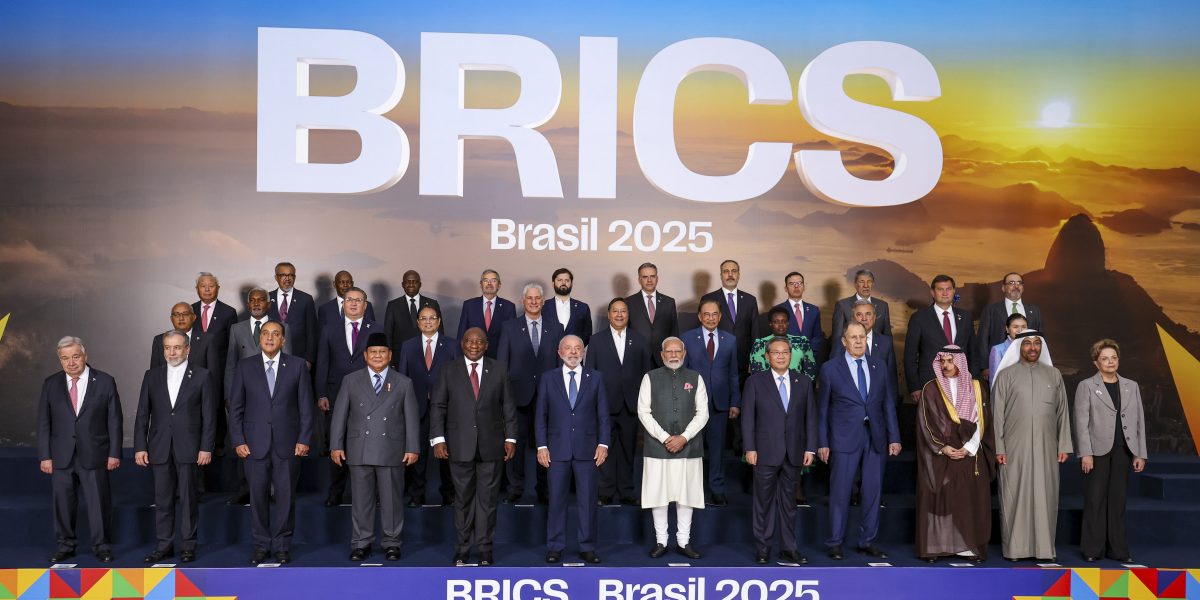
Strategic autonomy and ‘India first’ – both principles that should be driving India’s foreign policy – require India to pivot to BRICS to safeguard our economic interests.
If we are to understand the salience of the aggression on Iran (as well as Venezuela) that the US-Israel combine has wreaked upon the global economy, India’s economic foreign policy makers need to understand the context of the emergence of the Petrodollar System that started functioning in the early 1970s.
This understanding is essential to India’s ability to respond appropriately today, and protect the interests of India and the global south, of which we claim to be a leader. In fact, if we still take our chairmanship of BRICS in 2026 seriously, this becomes even more important.
The petrodollar system emerges
The dollar emerged after the Second World War as a dominant currency, as it was the only major economy that was left unscathed by war. But by the early 1960s, both Europe and Japan had restored their industrial power, and the US’s old industry could not stand up to their newer factory competition.
American industrial decline was accompanied by rising trade deficits, and the US began to print more dollars to pay for them. But the Bretton Woods system – created by the Allied Powers after their victory – had also ensured that dollar reserves were convertible into gold (held by the US Federal Reserve).
However, the US’s industrial decline, combined with imperial military overreach (e.g. Vietnam war), led to further deepening of the trade deficits. By 1971, the convertibility to gold was abandoned by the US President Richard Nixon. The availability of the US dollar had made it an international currency by then.
The collapse of the dollar’s convertibility to gold could have threatened its dominance. However, a clever diplomatic ploy by the US with Saudi Arabia, and later OPEC, only revealed recently, ensured that the Saudis would only accept the payment for oil sales in dollars. The US would offer security protection in return; thus bringing US bases to the Gulf (as in East Asia/Europe). That has sustained global demand for the US dollar as almost all countries import oil, and hence need the American currency. This also enabled the US to maintain huge budget deficits, low domestic savings and massive import surplus – supported by global demand for dollars (which the US could print) as well for US Treasuries – thus, financing US budget and current account deficits.
Economic sanctions: misuse of the petrodollar
Trump opposes de-dollarisation, as this exorbitant privilege enjoyed by the US enables it to maintain imperial power, and impose economic sanctions and freezing of assets on countries across the globe ever since then.
The US has imposed economic sanctions since the Cold War for a variety of reasons: ideological grounds (Cuba, Vietnam, Libya); counter-terrorism and security concerns post-2001 (Afghanistan, Iran, Sudan); great power competition post-2014 (Russia, China); and increasingly through the 2010s–2020s as a tool of financial warfare (Venezuela, Iran via banking isolation, and Russia under the largest sanctions regime ever imposed). By 2025 the most heavily sanctioned countries were Russia, Iran, North Korea, Syria, Venezuela.
Even India could not escape this as ‘secondary sanctions on third parties’ prevented India from buying Iranian oil from 2019-2026 and forced India to backtrack from its investment in Chabahar port and route to Afghanistan, Central Asia and Russia. The recent additional 25% tariff on India for buying Russian oil in 2025 is in the same category, however short-lived and narrow in scope.
Damaging Effects of sanctions
A study in Lancet (2025) estimated a significant causal association between sanctions and increased mortality. The study used a panel dataset of age-specific mortality rates and sanctions episodes for 152 countries between 1971 and 2021.They found the strongest effects for unilateral, economic and US sanctions, (but no statistical evidence of an effect for UN sanctions).
It estimated that unilateral sanctions were associated with an annual toll of 564,258 deaths, similar to the global mortality burden associated with armed conflict over that 50 year period.
That means around 28 million excess deaths, mostly of children and elderly, over that period only on account of US economic sanctions. That alone should be treated as a war crime. This has nothing to do with wars of aggression or regime changes that the US (and West) has together engineered over the years.
India and the BRICS: What should be our priorities?
India is risking global and BRICS isolation by siding with US/Israel (not just on aggression on Iran). India’s economic diplomacy is at the crossroads, because of the foreign policy decisions we are taking without regard to India’s development imperative and our commitment to strategic autonomy principle, which is the essential plank of our foreign policy. The principle of “India First” requires that we pivot towards the BRICS. We have shown some foresight by reviving the IBSA (India, Brazil, and South Africa) idea in the last BRICS summit.
Why India must reassert its strategic autonomy:
The Wire for more