
by SADAF SHABBIR

Suppression of critical voices through the instrumentalisation of religious fanaticism in university systems remains a powerful tool for maintaining the status quo, writes Sadaf Shabbir.
Throughout my four-year bachelor’s program, International Relations was taught predominantly through the lens of Realism or realpolitik, reinforcing hypermasculinity in both theory and pedagogy. Alternative theories were dismissed as inadequate, while religious ideologies were deeply embedded in classroom discussions. Criticism of radicalisation and extremism in Pakistan was often silenced, creating an environment where dissent was not just discouraged but dangerous. As a female student in a male-dominated space, expressing opinions that challenged theocratic narratives or questioned the weaponisation of religion against minorities and women often led to hostility, fear, and personal risk.
During a class discussion, a debate arose regarding the nature of the nation-state—specifically, whether it should be secular or theocratic. As Pakistan is a theocratic state, I expressed my opinion that the state should separate itself from religious affairs, considering how religion has historically been weaponised against gender and religious minority groups in the country. My opinion was met with disgust, and the atmosphere in the room turned hostile. With the class composed predominantly of male students (only 8% were female, who were seldom seen or heard in discussions), I was directly questioned about my religious beliefs. The question was loud enough to draw the attention of the entire class. This was not an ordinary situation; in Pakistan, such false portrayal can be life-threatening.
In 2021, Priyantha Kumara, a migrant, Sri Lankan factory manager working in Sialkot, a city in the Punjab province of Pakistan, was set ablaze by a mob after being accused of removing a poster with religious content from a wall. Most of the men responsible for his murder were staunch supporters of the notorious Tehreek-e-Labbaik Pakistan, a militant group that exemplifies the growing infestation of religious parasites in the country. Such incidents cannot be viewed in isolation. Blasphemy in Pakistan operates as an institution, where each heinous act serves as a warning to the rest of society. This vicious cycle of fear politics continues with impunity, often tacitly endorsed by the state. What makes it even more repulsive is how it is now infiltrating higher education institutions in Pakistan.
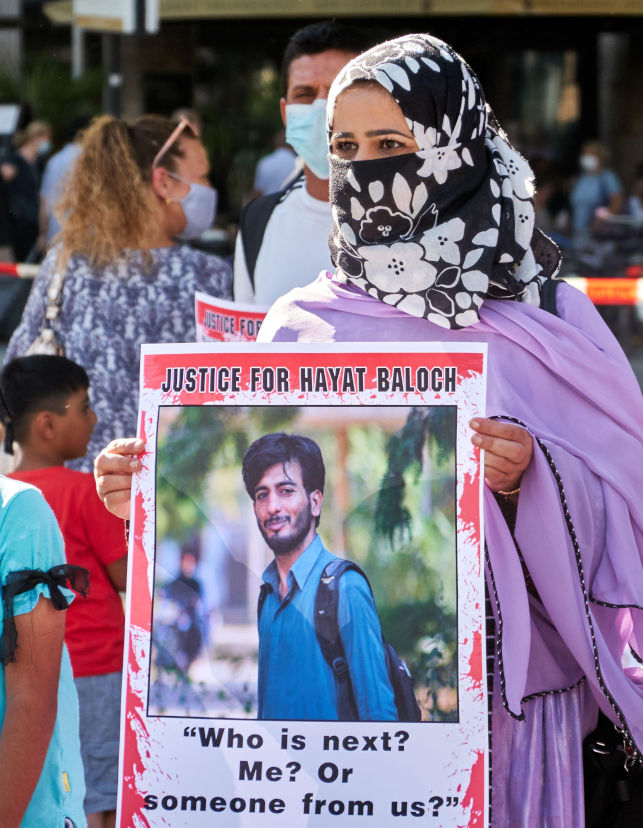
Two crimes during my undergraduate years left me both petrified and resilient. The first was the lynching of Mashaal Khan, a student accused of blasphemy. The second was the killing of Hayat Baloch, who was a victim of military aggression. The uproar following these killings ignited a sense of unity and hope but also revealed how the suppression of critical voices through the instrumentalisation of religious fanaticism remains a powerful tool for maintaining the status quo.
Not only does a mob mentality exist among the masses, but law enforcement institutions are also complicit in such crimes. Dr. Shahnawaz Kunbhar, a doctor from Umerkot, was falsely accused of blasphemy and killed in a staged encounter by the police in September, 2024. This crime lays bare the fact that religious extremism in Pakistan is not only shielded by law enforcement but also operates structurally within such institutions.
John Mendue for more