
A tale of two Mantos
by AJMAL HUSSEIN
Now that the Indian biopic Manto (2018, directed by Nandita Das) has been released in theaters (but banned in Pakistan by Pakistan Censor Board) and is available for streaming, the inevitable comparisons to the Pakistani biopic, also called Manto (2015, directed by Sarmad Sultan Khoosat) have become the topic du jour.
Both films are based on the life and work of Saadat Hasan Manto, a giant of Urdu literature whose trailblazing path was strewn with controversy and personal tragedy. In United India, he lived mostly in Bombay (now Mumbai) and spent his professional career shuttling between Bombay and Lahore. After partition of India, and the creation of Pakistan in 1947, he moved with his family to Lahore where he spent the last eight years of his life.
The ongoing animosity between India and Pakistan means that both countries begrudgingly own the writer, because it is hard to pin him down as either Indian or Pakistani. One can imagine Manto having the last laugh on this superficial conundrum because he always belonged to humanity.
The Pakistani version seems to be more mindful of this division than the Indian version, in terms of the portion of Manto’s life depicted. It only shows the writer’s life in Lahore, and does a poor job of that; there is hardly anything of Lahore to be seen in the film, specifically of the 1940s and 1950s.
This is an odd decision on the part of the filmmakers and indeed questionable, since filming in Lahore should not have been difficult. Manto’s house still stands in Laxmi Mansions, but it isn’t shown in the film. There is also a major anachronistic blunder in the scene where a modern-day Mercedes car is shown in the 1950s era. Period detail is an area where the Indian version excels.
Sarmad Khoosat, in addition to directing, plays the title role in his film, whereas Nawazuddin Siddiqui plays Manto in the Indian film. Siddiqui’s portrayal is nuanced and grounded, as befits an actor of his caliber. Khoosat puts in a game attempt, and is sometimes remarkably close to his Indian counterpart. However, he gets carried away in some scenes which reek of overacting. Also, his narration and diction are problematic at times.
Khoosat’s physical appearance is more in line with Manto’s Kashmiri ethnicity than Siddiqui’s. However, the former is much too bulky and healthier for the role whereas the latter is more suitably lean. Akbar Subhani, a Pakistani actor who has previously played Manto better (on television and theatre) than either of these two, is cast in a minor role in Khoosat’s film, and one feels it would have been a better casting choice to have him reprise the role.
The Indian version acknowledges the presence of other literary personalities and showbiz celebrities in Manto’s life, much more so than the Pakistani version. We get to see Ismat Chugtai, Faiz Ahmed Faiz, Munshi Premchand, Ashok Kumar, Jaddan Bai, Nargis, K. Asif, etc. Manto’s best friend was an actor-singer called Shyam, and he is given much screen time here, but the actor playing him does not rise above amateur level.
The portrayal of Ashok Kumar is also rather wooden, which is a shame and unfortunate irony, considering the real life actor was an accomplished and hugely popular presence in Indian cinema.
The Pakistani version does make Noor Jehan, the legendary singer, actress and director a part of its story, whereas the Indian version completely ignores her. Saba Qamar brings glamour and spark to her depiction of Noor Jehan, but is a little too hammy.
Manto’s wife Safiya was a very supportive and soothing presence in his turbulent life, and so both movies give her character ample screen time. The actresses in both versions do justice to their respective portrayals of Safiya. The bit parts in both movies are a mixed bag, with some strong and some weak performances.
Theatre Wallay for more
Manto, review: Man to man, rediscovering the Urdu writer, who died a pauper, at 42
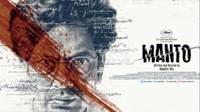
Manto, Review: Man to man, rediscovering the Urdu writer, who died a pauper, at 42
Before the film, the Central Board of Film Certification (CBFC) displayed categorises the language of the film as Hindi/Urdu. Saadat Hasan Manto wrote short stories and films in Urdu and there is some Hindi in the film, mainly spoken by others. Among the most controversial of Urdu writers, Manto has been the subject of rediscovery over the last decade or so for reasons unknown. Whatever the reasons, Nandita Das has made a compelling and eminently watchable biopic.
It comes on the heels of a Pakistani biography made in 2015 and Mantostaan, which filmed four of his short stories in 2017: Thanda Gosht, Khol Do, Assignment and Aakhiri Salute. We did not get to see the Pakistani film while the Indian outing, directed by Rahat Kazmi, received mixed reactions. Manto was his surname, and not his pen-name, as some might think. He was born in 1912 in Ludhiana but the family had a home in Lahore, while they moved to Mumbai as well.
His parents and his infant son were buried in Mumbai, but he had migrated to Lahore after living for many years in Mumbai, a city he loved dearly. Facing hostilities against the Muslim community, he was forced to leave much against his wishes. Not that he was a devout Muslim—a confirmed alcoholic, his only claim to Islam might have been the numerals 786 (denoting Bismillah—in the name of God) that he wrote before starting any story, and the prayer visits he made to his mother’s grave. Manto hated his late father. Muslim scholars and clerics roundly condemned his writing, often finding them un-Islamic and obscene. He died in Lahore, in 1955, aged 42, mainly as a result of alcohol abuse. All this is chronicled in the present film.
Writer-director Nandita Das’s Manto is not a true biopic, for it does not tell us too much about the personal life of the man and his family. It begins when Manto is already an established writer in Mumbai’s film industry of the mid-1940s and takes us through to his death, a decade later. Along the way, we meet many of his friends and publishers, including Ismat Chughtai (also condemned for writing stories considered obscene, including one on lesbianism), Shyam Chaddha (popular hero Shyam, who died early, like Manto but before him, after falling of a horse during shooting), Ashok Kumar (the boss at Bombay Talkies, who pooh-poohed Manto’s fears when the latter told him about repeated threats to kill him and other Muslims employed at Bombay Talkies) and many more. Ismat stood by him and the two were tried by a court in Lahore, for publishing obscene material. She stood by him all through, when the poet laureate of Pakistan, Faiz Ahmed ‘Faiz’, a leading light of the Progressive Writers’ Association, refused to consider his obscene work as literature at all. (The film ends on Faiz’s poem, in a tribute of supreme irony).
From the Bombay (now Mumbai) of 1946, the action shifts to Lahore, in 1948, where Manto follows his wife Safia and daughter Nighi, who had left earlier, to attend a wedding. In this city of refugees, just an hour away from the Indian town of Amritsar, he is shunned and prosecuted, and finds very little work. His drinking increases with frustration, though some more his greatest works were written there, where he learnt about the assassination of Mahatma Gandhi, an event that stunned him, just as partition itself had left deep scars on his psyche. These anxieties were developed into an all-time great short story, Toba Tek Singh, about madmen being exchanged between India and Pakistan, and a village which is in both Hindustan and Pakistan and, therefore, neither here nor there.
It was a sentence uttered in an unguarded moment by Shyam (remember Dillagi and the song ‘Too mera chand’ sung and picturised on him?), whose family had lost a member to the riots in Lahore and the rest of them had managed to escape to India, that finally made Manto decide to quit India. Shyam had said that he could have killed Manto in a fit of rage had he been around when the rioters attacked his family. Shyam used to nurse and humour Manto a lot. He did regret his statement, but the two met only once afterwards, when Shyam visited Lahore for a film’s release.
Film Festivals for more
So What Do We Do About Manto, Who Was Neither Indian Nor Pakistani?
by HARISHCHANDRA THORAT
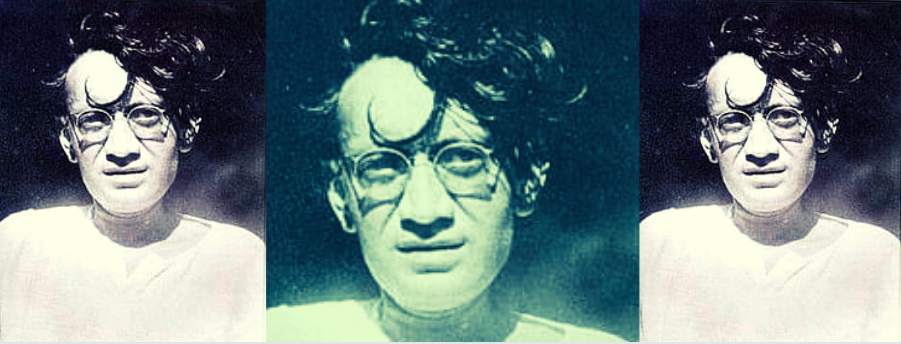
In our quest to define Manto, we arrive at the same results as we have while getting to the bottom of our current political crises.
Saadat Hasan Manto was born in 1912 in a village in Ludhiana district, Punjab, then part of the British Empire. He lived in the cities of Amritsar and Aligarh for a while, before moving to Mumbai. After the partition, he migrated to Lahore in Pakistan. He died there, somewhat prematurely, in 1955.
The government of Pakistan posthumously awarded him the Nishaan-i-Imtiyaaz, a prestigious civil award, in 2012. Manto is, therefore, a transnational entity.
He is known as a Punjabi writer, even though he hasn’t written much in Punjabi. He wrote in Urdu, so he is an Urdu writer. It doesn’t seem like he took religion very seriously – he is still known as a Muslim writer. In his youth, he was a member of the Indian Progressive Writers association. The latter had a distinct leftward lean. So Manto could be called a Marxist writer too.
Something which is important from the point of view of his cultural and literary identity – and which is a point of contemporary controversy and relevance- is that his family has roots in Kashmir. After being displaced from Kashmir, his ancestors moved to Punjab. Manto was proud of his Kashmiri roots. His family lovingly maintained the distinctiveness of Kashmiri culture. In a letter to Pandit Nehru, he does mention their shared connection to Kashmir.
‘To be Kashmiri is to be beautiful,’ he wrote.
So what do we do about Manto? In which identity do we bracket him? If we call him Indian, he was Pakistani too. If we call him Punjabi, he was Kashmiri as well. His being ? leftist comes in the way of trying to capture his identity as a ‘Muslim’ writer, on the basis of his religion. Punjab, Kashmir, the alleys of Mumbai and being a Mohajir in Lahore; all these dichotomous ?aspects were united in his character. Manto, as a writer, can be connected to all of these things, but not to any one of them.
Contemporary politics does not get along with such complex identities – formed of elements which are often conflicting but complementary. It prefers to state questions of identity in a simplistic, crude, rigid and politically convenient ways. To it, identity is something without any ambiguities, an easily identified uniform. Such a uniform would allow, for example, to demarcate a writer into two categories – ‘ours’, or ‘theirs’. This is exactly what has happened to Manto.
Recently, an English translation of one of Manto’s books came to my attention. The book is Why I Write. The translator and editor of this translation is Aakar Patel. It includes Manto’s discursive prose. Mr. Patel writes about Manto in the preface of the book.
The preface begins by stating that Saadat Hasan Manto was an Indian trapped in Pakistan. Mr. Patel next goes on to say that Manto’s ‘identity didn’t come from religion and it came only partially from geography. It came mainly from his belonging to our culture, about which he wrote with great skill.’ By ‘our’ culture, Mr. Patel of course means ‘Indian’ culture, which is, of course, different from ‘Pakistani’ culture. Patel concludes that Manto was a great Indian writer; he wrote in an Indian language, for an Indian audience and about the Indian experience.
Mr. Patel unambiguously puts Manto’s writings in the category of Indian literature and in doing so, excludes the place of Pakistan in the formulation of the notion of Indian literature. Before Independence and Partition, about 70 years ago, there was no nation called Pakistan. So the difficult question of what to do about the literature from the region now in Pakistan, before the nation existed, whether to call it Indian or to call it Pakistani, does not seem to occur to Patel.
Does political partitioning lead to cultural partitioning too, if so, what exactly is its process, these questions too do not bother Mr. Patel.
He also forgets that a national identity is an artificial construct, not a natural one. His scheme of classification is simple – writings are either Indian or Pakistani.
The Wire for more