
by JUE LIANG
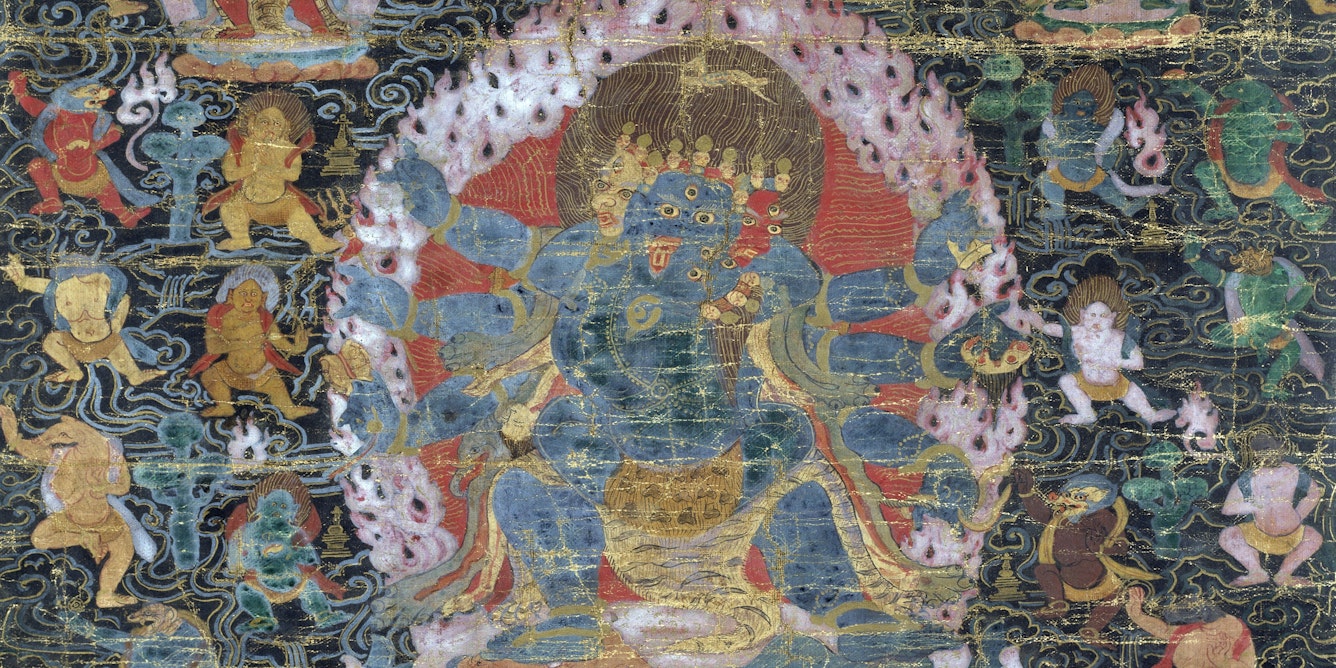
You’ve seen it in bookstores – the metallic turquoise spine peeking out from the shelf under “Eastern Religions.” Or, perhaps, another of its more understated editions rendered in muted tones. It is “The Tibetan Book of the Dead,” arguably the most well-known Tibetan Buddhist text outside Tibet.
It was first translated by American anthropologist Walter Evans-Wentz in 1927. The book’s philosophy of death and rebirth as spiritual practice was adapted in 1964 by Timothy Leary, the founder of psychedelic studies, to guide psychedelic experiences. Actor Richard Gere narrated the audio version of the book in 2008, helping introduce it to a broad audience.
As someone who studies Tibetan Buddhism, I’m often asked: What is “The Tibetan Book of the Dead”?
Most famous book in Tibetan Buddhism
In the Princeton University series “Lives of Great Religious Books,” there are only two texts representing Buddhism. One is the “Lotus Sutra,” the most popular Buddhist scripture on universal compassion, flexible teaching methods and potential for Buddhahood for all beings; the other is “The Tibetan Book of the Dead.”
Originally, the book was not even called “The Tibetan Book of the Dead” – and this book is not just about death.
The full title of the original Tibetan text from the 14th century translates as “The Great Liberation by Hearing in the Intermediate States.” In Tibetan, it is shortened to “Bardo Thodrol,” which loosely translated to “liberation upon hearing.”
The English title took off with Evans-Wentz’s first translation. But Evans-Wentz translated only a part of the book, and the translation was based on oral commentary rather than the Tibetan text.
The first full translation was done in 2007 by scholar and translator of Tibetan Buddhism Gyurme Dorje. It has been endorsed through an introduction written by the Dalai Lama, the most recognized Tibetan Buddhist leader of our time.
The 11 chapters of the book teach one how to seize every opportunity to become enlightened, even in the least possible place. It all starts with the teaching of bardo.
The six ‘bardos’
The Tibetan word bardo means “intermediate state” or “the state of being in-between.” In its origin in Indian Buddhist teachings, the bardo, or “antarabhava” in Sanskrit, refers to the time period between the end of this life and the beginning of the next.
The Conversation for more