
by ASHLEY SMITH
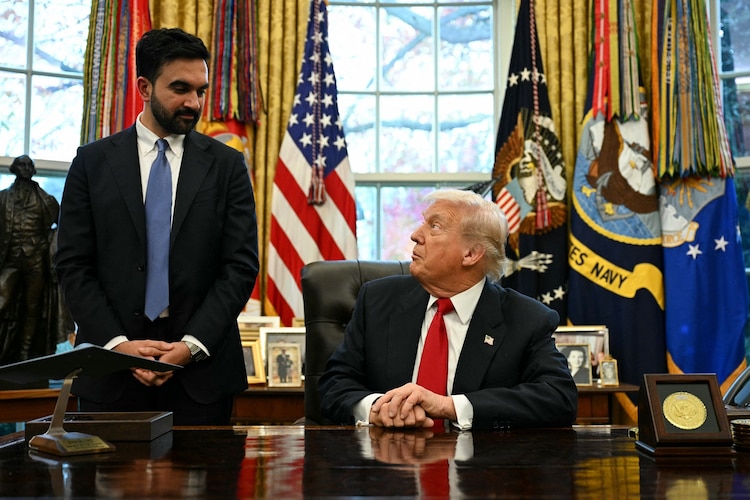
IMAGE/Jim Watson/AFP via Getty Images/ABC News
Mamdani, Trump, and socialist strategy
It was the most anticipated meeting at the White House since Donald Trump’s confrontation with Ukrainian President Volodymyr Zelensky. Would Trump dress down and insult New York City Mayor Elect Zohran Mamdani? Would Mamdani give as good as got and humiliate Trump as effectively as he did Andrew Cuomo in their Mayoral debates?
But it was neither a battle royale nor a celebrity death match. It was a surreal, chummy meeting where the two embraced over their supposedly shared agenda of addressing the U.S. capitalism’s spiraling affordability crisis. The surprisingly affable nature of the meeting evoked a wide range of responses, from praise for Mamdani’s tactic of preemptively disarming Trump to condemnation of the Mayor Elect as a sellout.
In reality, Mamdani’s decision to avoid conflict and Trump’s embrace of the affordability agenda are both born out of a shared political weakness that drove them toward accommodating one another. Even worse, in the aftermath of their meeting, Mamdani, despite reaffirming his denunciation of Trump as a despot and fascist, persisted in saying he would work with Trump to make New York more affordable. But this friendly state of affairs will only be temporary; the knives will inevitably come out. To prepare for the confrontation, we must double down on building mass class and social struggle to win the demands and secure the rhetorical promises of Mamdani’s campaign and defend ourselves against the Trump regime.
Boxed in office
First, we must grasp the reasons behind Mamdani’s non-confrontational approach to the meeting. Remember, he is in a weak position. He won just over 50 percent of the vote, squeaking out a narrow victory against two far-right candidates, Cuomo (supported by Trump!) and Sliwa, who amassed together almost 49 percent of the vote.
Moreover, his office, while seemingly powerful, is dependent on the City Council, the state government controlled by Kathy Hochul and the Democratic Party establishment, and the federal government imperiously wielded by Trump against any and all enemies real and perceived. And, beyond these political obstacles, Mamdani’s ability to deliver anything from his office in the capitalist state depends on the growth and profitability of corporations, especially finance capital whose international headquarters is in New York, for tax revenue to fund reform.
Despite his nods to popular struggle, Mamdani is a reformist. He believes that holding office is the route to delivering social change. Given this, he has little room to maneuver and therefore every reason to cut deals in the hopes of ingratiating himself to the real power brokers in the state and capitalist economy so that they will let him enact reforms. That explains why he has met with the Democratic Party establishment, sought their endorsement, attempted to defang the opposition of the real estate bosses by meeting with them, and even reappointed the dreaded billionaire police commissioner Jessica Tisch.
All of this also explains why Mamdani (like AOC) has chosen to oppose the primary challenge by a fellow DSA member, Chi Ossé, to dethrone neoliberal Zionist and House Minority Leader Hakeem Jeffries. Mamdani went further, telling NBC that he wants Jeffries to remain the Democratic Leader and become the Speaker if Democrats retake the House. The logic of reformism, especially without mass class struggle from below, is one of adaptation to the capitalist class and its politicians, at best delivering milquetoast liberal reform and at worst simply managing the existing system (remember Francois Mitterrand, the “Red Margaret Thatcher?”).
Diplomacy not confrontation
Mamdani’s objective weaknesses and his reformist strategy shaped his tactical approach to the meeting with Trump. He abandoned any pretense of confrontation with the head of a regime that is carrying out a bigoted class war at home. Trump has abolished the union rights of over a million government workers and is carrying out state terror against migrants and transactional, unilateral imperialism abroad—from murderous gunboat diplomacy in Latin America to imposing imperialist “peace deals” in Palestine and Ukraine that reward Israel and Russia as colonial aggressors. Mamdani raised none of this. Out the window went turning up the volume to denounce Trump as a despot, fascist, and genocidal war criminal.
Instead, Mamdani stuck like a broken record on appealing to Trump to join him in a partnership for affordability. He was intent on charming and, in his own mind, disarming Trump in the hopes of seducing him to sustain the flow of federal dollars into New York City’s coffers. Now, many of Mamdani’s advisers will argue that he’s playing three- or four-dimensional chess and can outfox Trump. Such arguments justify reformism’s logic of accommodation, not resistance, to someone that they readily and openly call a fascist. Only . . . mass struggle can win reform, not glad-handing a monster in the White House.
This strategy will not work to stop Trump. He’s already waging war on New York. ICE is sweeping up people in the city, those dependent on Obamacare are about to lose their subsidies, Medicaid cuts are ravaging the working class, trans people are under federal siege, and on and on. And if, under pressure from below, Mamdani does stand up on any of these issues of class exploitation and social oppression, Trump will come down on the city and its people like a ton of bricks. This may happen anyway.
The high price of accommodation
Thus, the strategy of reformist accommodation comes at a high cost to workers and the oppressed. We can already see it happening. In the meeting, Mamdani underscored his commitment to keeping the police commissioner and her gestapo of 35,000 officers that enforce the brutal racist class inequalities of NYC. He didn’t blink an eye when Trump said they shared a tough on crime agenda. This is just one of many high-priced concessions to come, unless workers and the oppressed fight for the campaign’s demands and the fulfillment of its rhetorical promises.
Tempest Mag for more