
by DAVID SZONDY
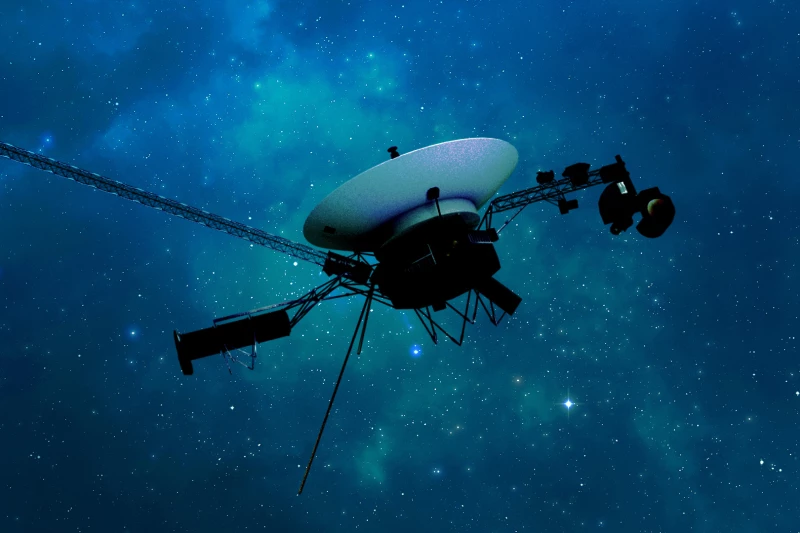
As it heads out of the solar system never to return, the deep space probe Voyager 1 is headed for yet another cosmic milestone. In late 2026, it will become the first spacecraft to travel so far that a radio signal from Earth takes 24 hours, or one light day, to reach it.
According to Einstein, the speed of light is as fast as it’s possible for anything to go. That may seem arbitrarily restrictive, but at 186,000 miles per second (299,388 km/s), that leaves a lot of leeway unless you’re dealing with things at computer speeds where a delay can be aggravating.
Another thing that can be aggravating is that though light is fast, the universe is, as The Hitchhiker’s Guide to the Galaxy says, really big. This means that if you have to cover a long enough distance, the speed of light starts to become noticeable in a way that we don’t see on Earth.
Perhaps the first time we saw this publicly was during the Apollo Moon landings over 50 years ago. If you watch old video recordings of the astronauts on the lunar surface talking to Mission Control back on Earth, you’ll notice that there’s a delay of about 2.6 seconds between when someone makes a comment and the other party replies. That’s because with the Moon being about 226,000 miles (363,000 km) from the Earth, it takes a radio signal 1.3 seconds to travel the distance.

If you go to Mars, this gap becomes up to four minutes. For Jupiter, it’s up to 52 minutes, and for Pluto (which I still stubbornly say is a planet!) that comes to up to 6.8 hours. Small wonder that deep space missions require robotic spacecraft that have a high degree of autonomy. If they had to wait for direct instructions from Earth before making a move, a few Mars rovers would have ended their careers as a pile of scrap at the bottom of a ravine.
None of this compares to Voyager 1, the veteran probe launched in 1977 to make a flyby of Jupiter and Saturn before heading out on a one-way trajectory into interstellar space. Despite being almost a half-century old and flying through the incredibly cold, radiation-saturated depths of space at the edge of the solar system, it still continues to function and NASA is determined that it will continue to do so until its nuclear power source finally gives out in the next year or so.
New Atlas for more