
by BEN COXWORTH
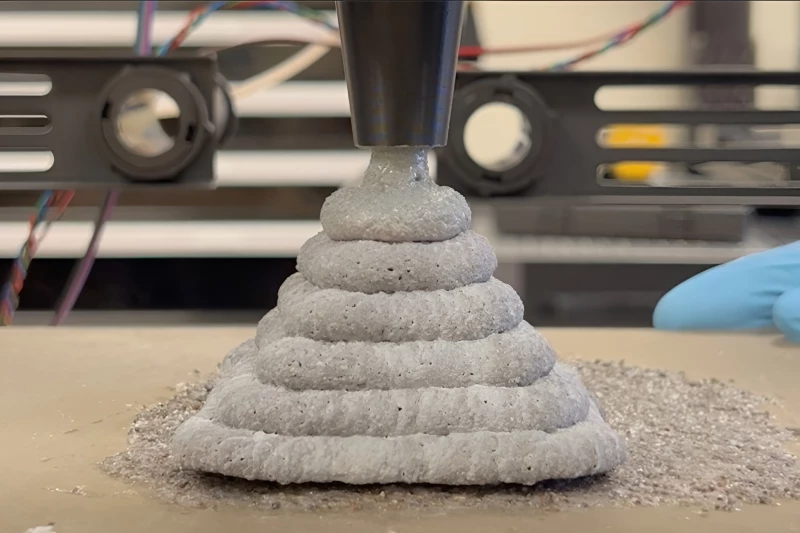
Although we’ve heard a lot about how 3D-printing concrete homes speeds up the construction process, you still have to wait up to 28 days for the concrete to sufficiently cure. A new printable substitute, however, is ready to go in just three days.
Concrete consists of three parts: water, an aggregate such as sand or gravel, and a cement which binds everything together. The cement is the part that typically takes about a month to cure after being poured. And a slow curing time isn’t cement’s only problem.
Traditional Portland-style cement is made by grinding up limestone and other raw materials, then heating the resulting powder to temperatures of up to 1,450 ºC (2,642 ºF). Unfortunately, the processes by which that heat is generated produce a lot of carbon dioxide.
What’s more, as the heated limestone forms into cement via a process known as calcination, it releases trapped carbon dioxide as a byproduct. The combination of that CO2 and the CO2 produced in the heat-generating process is estimated to be responsible for 5% to 8% of all human-caused greenhouse gas emissions.
That’s where the new 3D-printable material comes in.
Created by Asst. Prof. Devin Roach, doctoral student Nicolas Gonsalves and colleagues at Oregon State University, it’s composed mainly of clay soil infused with hemp fibers, sand and biochar. The latter is a charcoal-like material produced via a process called pyrolysis, in which heat is used to decompose wood chips and other organic material in the absence of oxygen.
Importantly, instead of Portland cement, the new material utilizes a thermally-triggered acrylamide-based binding agent. In a chemical reaction known as frontal polymerization, that agent initiates the curing process as soon as the mixture is extruded from the printing nozzle. This makes it strong enough to be printed over unsupported gaps, such as the tops of window openings.
New Atlas for more