
by MAWADDA ISKANDAR
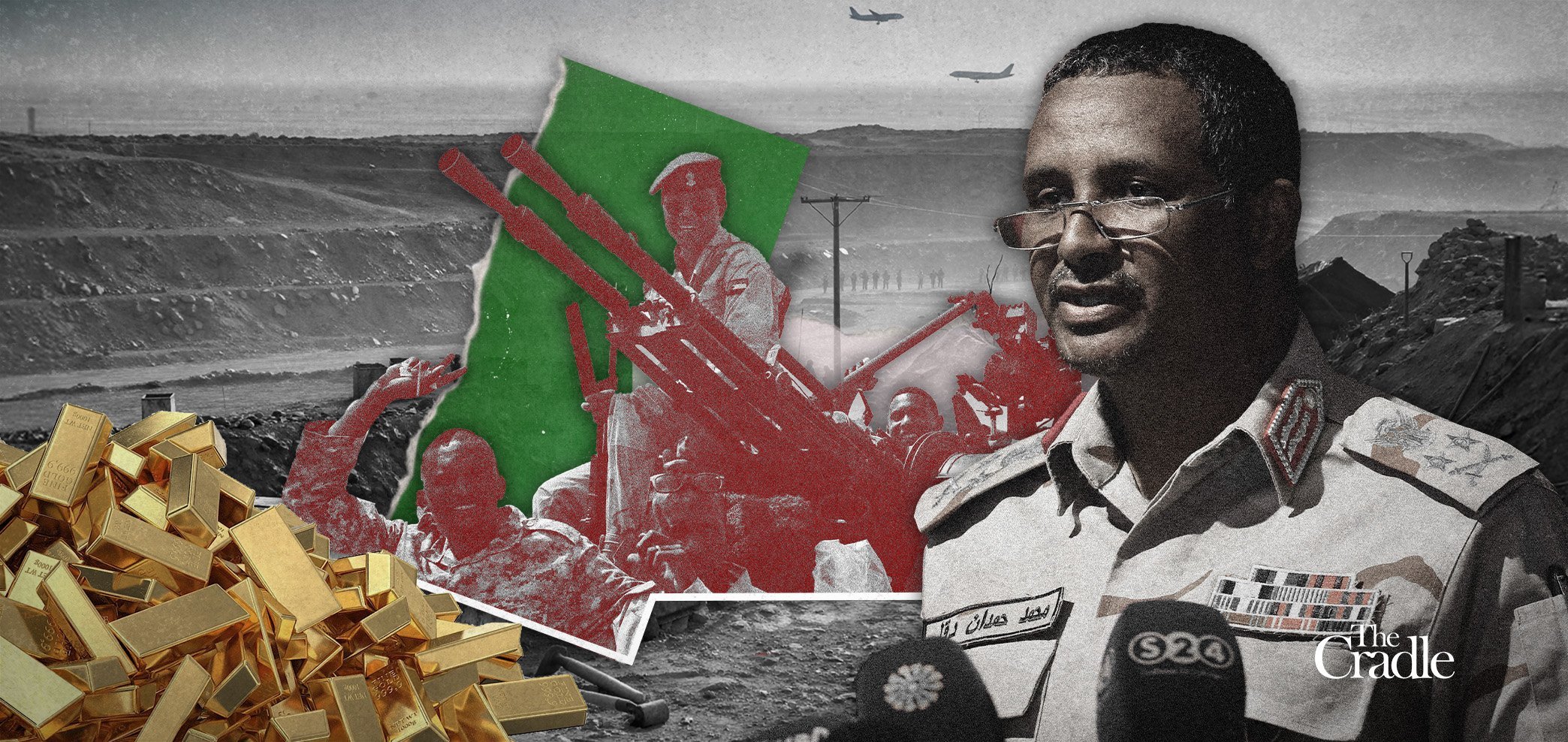
Gold pulled from Sudan’s war zones moves along hidden routes – passed between smugglers, militias, and middlemen – before reaching Dubai, where it is converted into money and influence. This trade, rooted in state collapse and empowered by armed groups, now binds the Persian Gulf to some of Africa’s most fragile fronts.
Before the guns piled up on the blood-soaked sands of Darfur, the story began in mid-2012 with three young men scanning the earth near Jeli using simple metal detectors. A faint signal drew them westward for 20 kilometers, until they stood at the foot of Jebel Amer – a mountain that would later be known as Sudan’s “Mountain of Gold.”
Their find proved fateful. Within days, word raced across the region: dirt roads thickened with travelers, tents and pumps multiplied across the hills, and thousands of prospectors poured in. What started as a lucky strike quickly altered Darfur’s balance, unleashing rival claims, sudden fortunes, and the violence that shadowed them.
The mountain that ignited Darfur
Jebel Amer sits in the Al-Sarif locality north of El-Fasher in North Darfur. It produces an estimated 50 tonnes of gold each year – one of the largest deposits on the continent – and holds other minerals, including iron, aluminium, and platinum.
After South Sudan’s secession in 2011 stripped Khartoum of roughly three-quarters of its oil revenue, the government pushed citizens toward artisanal mining as an economic lifeline. Instead, the rush for gold deepened instability and drew armed groups into an already-fractured region.
When major deposits surfaced in April 2012, the area became a magnet for wealth and influence – and a battlefield. Janjaweed militias moved to seize the mines, displacing local communities and igniting conflict.
By the end of the year, violence had spread across the region, and in January 2013, open fighting killed hundreds while mine shafts collapsed on dozens of workers. Truces came and went, but each collapse and clash made clear that the conflict was no longer just a tribal one but a struggle for control of one of Sudan’s most valuable assets.
By 2017, almost complete control of Jebel Amer had been settled in the hands of the Rapid Support Forces (RSF) through the Mohamed Hamdan Dagalo-owned Al Junaid Holding Company, and gold became their main source of financial power, directly linked to their ability to finance their military activities and control the area.
The gold did not stop there. Its shine carried far beyond Sudan, drawing the interest of the UAE, whose ambitions in Africa were rising. From Darfur, the metal moved along smuggling routes, through commercial flights, and via corporate parcels into Dubai’s markets and refineries – feeding a network in which Sudan’s conflict became someone else’s gain.
Sudan: The Arab world’s gold giant
Sudan is the largest Arab gold producer, with more than 40,000 exploration sites and 60 refining companies spread across 13 states, with its focus on the Nile, the North, and the Red Sea.
The UAE quickly became Sudan’s primary export destination. Deals flowed through companies linked to Dagalo (Hemedti) and his relatives, gold moved by land and air into Dubai, and the RSF used the profits to procure weapons.
Global Witness estimates that Sudan exports around $16 billion in gold to the UAE each year. Official production in 2024 reached 64 tonnes, yet only 31 tonnes were recorded as legal exports. Nearly half simply vanished into parallel channels.
Export documents reveal the involvement of Emirati firms such as Kaloti, which purchased 57 tonnes from Sudan in 2012 – far above the country’s official output. In 2018, Al Junaid Group, a business front of the RSF, partnered with Dubai-based Rosella, complete with accounts at First Abu Dhabi Bank.
When war erupted in 2023, the gold trade shifted from an economic pillar to a war chest. The US sanctioned 11 companies – many registered in the UAE – for facilitating RSF financing through gold.
The RSF’s gold highways to Dubai
Before the war expanded, Darfur’s gold traveled quietly from Jebel Amer to Chad via land, then onward to Dubai through commercial shipments and corporate parcels, becoming part of a smuggling network linking the conflict’s mines to Persian Gulf markets. The RSF rapidly became the dominant player in this network, relying on front companies, routes that stretched through Chad, South Sudan, Libya, and new routes to Egypt.
The Chadian corridor remains the most lucrative: gold leaves Jebel Amer and Sango via secret pathways, crosses into N’Djamena, and is then exported as “Chadian” gold. Al Junaid’s front companies, along with previously documented ties to Dubai-based firms, operate at the heart of this system.
After Khartoum airport was destroyed and Port Sudan slipped beyond RSF control, the militia adopted new tactics. Motorcycles ferry gold across borders. Air shipments depart from Nyala in containers labeled as agricultural goods and livestock. Night flights – less than 90 minutes long – avoid detection.
A UN panel of experts exposed an African logistical chain linking gold shipments and weapons deliveries: arms arriving from Um Girass airport, traveling overland to RSF positions, supported by money raised from the sale of Sudanese gold in Dubai. An integrated war economy now spans from Darfur’s mines to Emirati refineries.
Abu Dhabi’s continental appetite
Talk of the UAE’s ambitions in Africa starts with Sudan, the continent’s third-largest gold producer and the second-largest proven reserve of about 1,550 tonnes. But Sudan is not an isolated case, as the picture extends to the entire continent.
The Cradle for more