
by BEN BURGIS
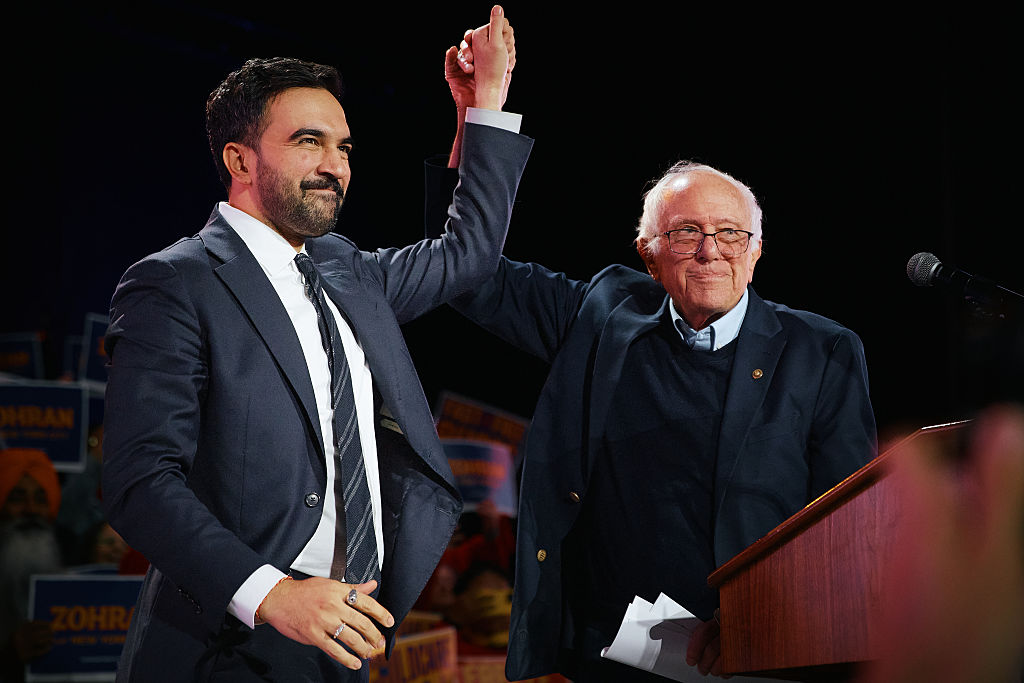
Zohran Mamdani’s historic mayoral victory marks a new chapter for democratic socialism in America. Like Bernie Sanders before him, he’s shown that relentless focus on a unifying message of economic justice can win against establishment sabotage.
None of it worked. The months of smears. The months of sabotage from the Democratic establishment. The absurd accusations of antisemitism. The even more absurd insinuations that Zohran Mamdani is a secret Islamic fundamentalist plotting to impose Sharia law on the Big Apple.
Voters saw through all of it. They were persuaded by his message of turning the page on billionaire-backed policies and making New York City more affordable for the working class. And they handed him a decisive victory.
This momentous victory wouldn’t have happened if Bernie Sanders hadn’t laid the groundwork during his two historic runs for president, giving birth to the revitalized, millennial-led democratic socialist movement out of which Zohran comes. Bernie, too, began his political career as a local mayor, and he seems to see much of himself in Mamdani.
After the mayoral primary, when the election would have been all but over if the rules of normal politics had been followed (instead of former governor Andrew Cuomo throwing the “vote blue no matter who” rulebook out the window and running as an independent), Sanders emerged as Mamdani’s most outspoken supporter on the national stage.
Of course, all of the democratic socialist elected officials who have won office in recent years are, in a sense, following in Bernie’s footsteps. Members of the congressional “Squad,” for example, support universalist economic redistribution and embrace the “democratic socialist” label Bernie dusted off in his first run for president, just two years before the first of the “Berniecrats” were elected.
But Zohran is Bernie’s heir in particular ways. First, he is, to a unique extent, a product of the post-Bernie “millennial left.” He was deeply involved in its main organization, the Democratic Socialists of America (DSA), for years before he ran for office.
In high-profile races, DSA branches have often supported candidates with roots entirely outside the group. But Mamdani is a product of New York City DSA (NYC-DSA) and the broader culture of New York City socialism. This even led to a tedious mini-scandal during the campaign about his history of advocating for “socializing the means of production,” revealing the strong influence of the organization’s political philosophy on his development. (Critics seem completely unaware of how many major cities in liberal capitalist nations have been successfully governed by political parties that had such socialization as the long-term horizon of their politics.)
The second sense in which Zohran is Sanders’s heir is even more interesting.
One of Bernie’s greatest strengths as a left-wing communicator has always been that, while he unapologetically holds straight-down-the-line progressive positions on social policy issues, he’s relentlessly focused on broadly appealing calls for universalist economic redistribution. Wake him up in the middle of the night, and the first words out of his mouth might well be, “This is the only major country on earth that doesn’t guarantee health care as a right.”
Jacobin for more