
by CHRISTOPHE JAFFRELOT
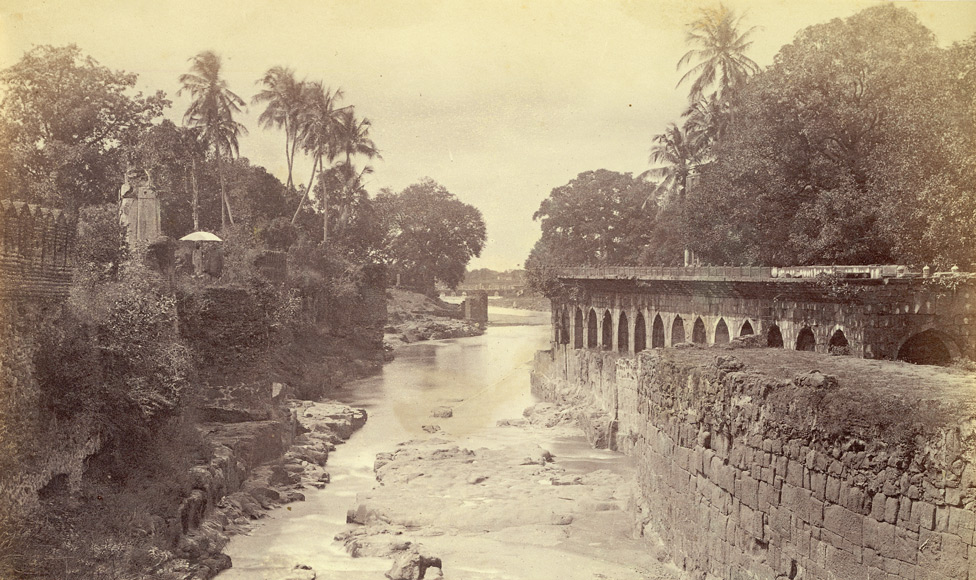
The cities created in the Deccan by Muslim leaders introduced the concept of public space to the Indian world.
When India specialists examine what Islam has brought to the country, they often focus on cultural aspects such as language, poetry, music, painting, culinary arts, or spirituality. They rarely consider the urban dimension.
Certainly, historians and geographers readily examine how what the Marçais brothers called “the Islamic city” spread throughout India, but mainly to see it as an exogenous institution, even an enclave sheltering an elite that came from outside and was cut off from society. Pratyush Shankar’s recent book covers this dimension, of course, but goes further.
In History of Urban Form of India, a work based on the analysis of 42 Indian cities, the author distinguishes three types of cities – which form the three parts of the book: ancient cities, medieval cities, and cities produced by the modern state.
Ancient cities, apart from those of the Indus civilisation, are mainly epitomised in the “temple cities” of southern India. While medieval cities follow several different patterns, Pratyush Shankar distinguishes above all between merchant cities – typical of Gujarat – those of the Himalayas (whose form is conditioned by the terrain), and those built by Muslims in the Deccan.
Comparing them proves very useful in understanding Islam’s contribution to the Indian civilisation – something Pratyush Shankar helps us to do, without attempting it himself – thanks to his morphological approach to the city: he is interested only in the form of the city, not in its local mode of governance or its relationship with the state.
All Indian cities inherited a significant part of their form or structure from the caste system. Pratyush Shankar points out in the introduction that the “Caste system had a huge impact in determining the location and formation of neighbourhood clusters that were inward looking (in cases of Jodhpur and Udaipur) and the possibility to shut off from the city by controlling the gates (Pols of Ahmedabad)”.
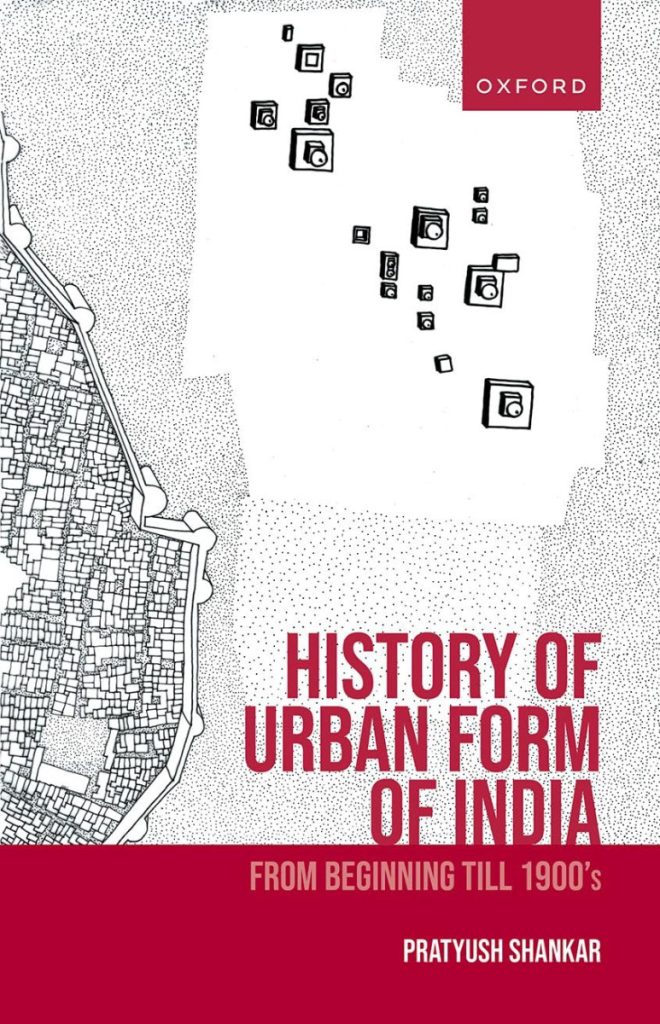
History of Urban Form of India: From Beginning till 1900’s, Pratyush Shankar, OUP, 2024.
The caste logic is naturally at work in the “temple city”:
“The idea of using a Brahmin settlement (with a temple) for creating a surplus economy was central to the birth of cities in South India. This was legitimized through the Brahminical ideology of the Brahmin-Kshatriya coalition expressed through Vedic and puranic religion”.
And naturally, the “temple city” is “divided into various sectors based on function differentiation that was represented through various caste-based housing. The caste system was strictly observed and manifested itself in the planning of these urban centers”.
The cities built by Muslim leaders from the 14th century onwards in the Deccan did not escape the caste system – especially since distinguishing between Hindu and Islamic cities constitutes “a very simplistic binary” that does not reflect a much more complex reality. But these medieval cities of the Deccan added something new to the urban form that had prevailed in the country until then. This innovation did not take place within the city, but outside – and still, that was a key element of the city dynamics: not far from the city walls, but well outside the city itself, Sufi saints settled in an almost systematic manner. They deliberately distanced themselves from the city to show their detachment from material things and live in peace. At the same time, the inhabitants revered them: “People would leave the material city behind to spend a day at the sacred Sufi sites and return by evening”.
The Wire for more