
by PETER BACH
“The Sleep of Reason Produces Monsters”—the caption of Goya’s 1799 etching—was a warning against moral blindness, against reason stripped of empathy. It may not apply neatly to Jared Kushner, Donald Trump’s son-in-law, but his rise has had the same somnambulant quality: less a climb than an inheritance.
Installed in the White House by marriage rather than merit, he became his father-in-law’s most indulged adviser—a diplomatic novice handed the Middle East peace portfolio because family outranked expertise. Between 2017 and 2021, this young and slightly mysterious man who once said he relaxed by looking at buildings oversaw the administration’s “peace plan,” culminating in the highly transactional Abraham Accords—deals that normalised Israel’s ties with Gulf monarchies while leaving the Palestinians conspicuously outside the frame. Jordan, as I wrote at the time, kept its caution.
When the first Trump years ended, Kushner did what many former officials only dream of—he turned his address book into a balance sheet. In 2021 he founded Affinity Partners, a private-equity firm based in sun-slapped Miami. Within six months he had secured $2 billion from Saudi Arabia’s Public Investment Fund, chaired by Crown Prince Mohammed bin Salman, whose personal approval overrode internal misgivings. Reuters later reported additional Gulf-state backing, the Senate Finance Committee since noting that Affinity has collected roughly $157 million in management fees—a tasty afterglow of office that would trouble almost anyone but the man himself.
Since leaving Washington, Kushner and Ivanka Trump, who converted to Judaism in 2009, have kept a calculated distance from Donald Trump—part image management, part tactical retreat. The separation read as both self-preservation and positioning: close enough to profit from future influence, far enough to escape the chaos that once defined it. It is an image carefully sculpted, not slapped on like wet clay.
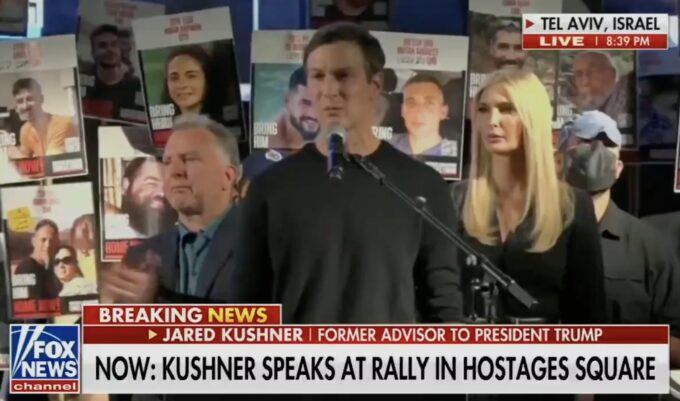
By 2024, as Gaza burned, Kushner re-emerged. “Gaza’s very valuable waterfront property,” he said—a phrase that landed like a Freudian slip, reducing catastrophe to real estate. He offered advice on Gaza’s reconstruction even as he pursued mega-deals such as the $55 billion Electronic Arts “take-private”—much to the chagrin of EA gameplayers—with the same Saudi fund that seeded his firm. In October 2025, amid a fragile cease-fire, the Associated Press credited Trump-era envoys—including Kushner—with quiet, back-channel involvement.
Photos of Affinity’s Miami offices show a family office disguised as a global fund: muted décor, small staff, white walls, and the steady hum of expensive air-conditioning. Tom Wolfe would have had a field day. Visitors describe Kushner pacing barefoot during long calls, gesturing with his phone. Meetings, people suggest, often end in polite vagueness rather than decision. The manner is frictionless—calm, confident, faintly antiseptic. Former colleagues recall the same vibe in Washington: rarely angered, never hurried, convinced that numbers could soothe politics. Even so, Kushner’s struggle to secure a permanent top-level security clearance was widely cited in Washington as a red flag.
Counterpunch for more