
by BRUCE E. LEVINE
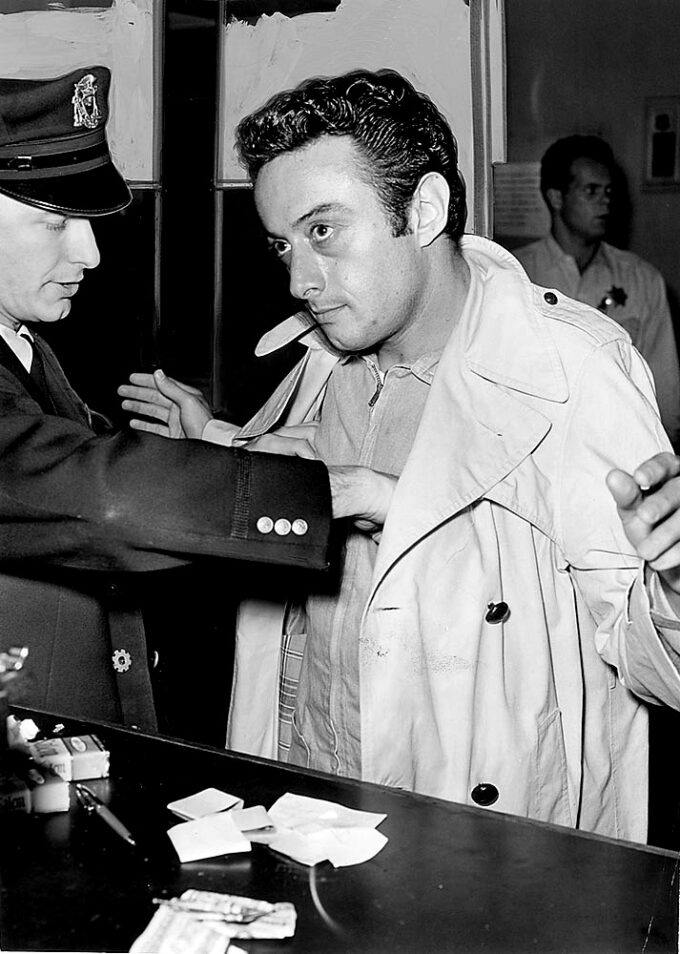
“Lenny Bruce is not afraid”
—“It’s the End of the World as We Know It (And I Feel Fine),” R.E.M.
Lenny Bruce, born Leonard Schneider on October 13, 1925, died on August 3, 1966. Officially, Bruce died from a drug overdose. Unofficially, he was murdered by the New York County District Attorney’s office.
The Trump Reich is not the first era in U.S. history in which local, state, or federal government has attempted to abolish free speech and destroy opposition; for example, Woodrow Wilson threw Eugene Debs in prison for speaking out against capitalism and World War I. What makes the current era different is that a U.S. president is not only acting like a dictator, he is doing everything possible to ensure the world views him as one, getting these headlines: “Trump Pulls From Dictator Playbook and Hangs Giant Banner of His Face.” Today, one risks imprisonment or having a career derailed not simply for challenging obscenity laws, as did Bruce, or speaking out against a capitalist war, as did Debs, but for hurting a president’s feelings. So, it’s an especially good time to celebrate Lenny Bruce.
At the time of his death, Bruce was blacklisted by almost every venue in the United States, as owners feared that they too would be arrested for obscenity. One of the New York district attorneys who prosecuted Bruce’s last 1964 obscenity case, Assistant District Attorney Vincent Cuccia, later admitted, “We drove him into poverty and bankruptcy and then murdered him. I watched him gradually fall apart. . . . We all knew what we were doing. We used the law to kill him.”
“As a child,” Bruce recounted, “I loved confusion: a freezing blizzard that would stop all traffic and mail; toilets that would get stopped up and overflow and run down the halls; electrical failures—anything that would stop the flow and make it back up and find a new direction.” At age 16, Lenny ran away from home and boarded with the Dengler family, working on their Long Island farm in the 1940s. The Denglers had a roadside stand, and city and suburban folks loved the idea of fresh farm eggs, but the Denglers didn’t have enough chickens to meet the demand, so they would buy eggs wholesale, and a teenage Lenny repackaged them in Dengler cartons; and he would later recount, “With my philanthropic sense of humor, I would add a little mud and straw and chicken droppings to give them an authentic pastoral touch.”
Bruce’s rebellions against authority, on stage and off, remain legendary among comics. Fed up with the navy in 1945, Bruce told medical officers he was overwhelmed with homosexual urges, and this tactic worked to get him discharged. He then fell in love with Honey, a stripper at the time, and they married in 1951. To raise money so that Honey could leave her profession, Lenny created the “Brother Mathias Foundation,” in which he impersonated a priest and solicited donations. Bruce was arrested for that scam but was lucky and found not guilty.
Counterpunch for more