
by B. R. GOWANI


The Indian subcontinent (Bangladesh, India, Pakistan) was unified under British colonial rule. In 1947, India was divided into India and Pakistan. In 1971, Pakistan got divided into Pakistan and Bangladesh. Since coming to power in 2014, Hindu nationalist Modi’s hatred of minorities, particularly Muslims, has created internal division and turned Muslims into second class citizens.
On the other side, Pakistan today is facing another crisis which, if not handled humanely and fairly, could result in yet another division.
The Indian subcontinent is not a homogeneous entity, it is an amalgam of various ethnicities, one could say nations. India is suppressing Kashmir‘s autonomy. The southern states in India are not happy, too, with the central government. Ditto with the northeastern states.
Same situation exists in Pakistan: the province of Punjab’s domination since Pakistan’s creation forced the majority province of East Pakistan to secede, and form the new nation of Bangladesh. The other three provinces, Sindh, Khyber Pakhtunkhwa (formerly NFP or North Western Frontier Province), and Balochistan are not happy either — especially Balochistan. It is sparsely populated, and is the largest province and is also the most ignored by the central government.
In 2012, Adaner Usmani wrote:
As Pakistan marks the 65th anniversary of its independence, the ongoing rebellion of the Baloch is a damning verdict on the country’s ruling-class. The fact that the national question remains arguably the most salient fault line in the country’s politics — not just in Balochistan, but in Sindh, Khyber-Pakhtunkhwa, Gilgit-Baltistan, and even inside Punjab itself — illustrates the colossal failure of the State’s attempts to chloroform popular aspirations in the hollow language of “national unity.”
Balochistan Liberation Army
On March 11, 2025, BLA members, based in the Baluchistan region of Afghanistan, hijacked Jaffar Express, a train with over 440 passengers in Pakistan on its way from Quetta, Balochistan to Peshawar, Khyber-Pakhtunkhwa.

The clash between the government forces and the hijackers lasted over 36 hours and resulted in the death of 33 hijackers, 26 hostages, and 5 security personnel. BLA attacks have been steadily prevalent as is evident from the list of all the BLA attacks over the recent times.
Government reaction
Pakistan, Iran, the United Kingdom, China, the European Union, and the United States have declared BLA a terrorist organization. It is widely believed that BLA gets support from India and Afghanistan.
Prime Minister Shehbaz Sharif (PML-N) issued a statement similar to other world leaders’ when confronted with such situations. An extract:
“We will continue the war against the monster of terrorism until it is completely eradicated from the country. We will thwart every conspiracy to spread insecurity and chaos in Pakistan.”
President Asif Zardari’s (PPP) declaration was no different:
“The situation is clear—the state will continue to exist, and we must win the war against terrorism.”
The Balochistan issue is a decades old problem and needs some serious planning and negotiations with the Balochi people and their leaders, rather than issuing worn out useless statements.
Aasim Sajjad Akhtar reminds us of the remoteness of Balochistan:
“Balochistan only enters the mind of mainland Pakistan when something spectacular happens.”
The tragedy is that governments are not interested in listening to the Baloch grievances or to enter into negotiations. The PML-N’s previous government had made an indirect effort but it didn’t yield results because of its lack of enthusiasm to grant Baloch requests, or to continue negotiations.
Journalist Zahid Hussain sums up the current state of government inertia:
“The latest wave of militant violence gripping the country may have shaken the corridors of power but so far there have been few signs of any course correction. There is not even an attempt to understand what has gone wrong and what needs to be done.”
Nothing has changed in the government’s approach, and the situation has worsened.
Government crack down
Thousands of Balochis have been protesting over the disappearance of their relatives and friends. Over 5,000 Balochis are missing but the government refuses to take any action. Critics of the administration are jailed. The Pakistani government’s indifference towards Balochi peoples’ plight and their grievances has exacerbated the situation.

A human rights activist and lawyer Imaan Mazari fights for the rights of various communities and, also, defends journalists. She fights for Balochi struggle for their rights and has been incarcerated many times. In January 2026, she, along with her husband, human rights lawyer Hadi Ali Chattha, were sentenced to 17 years in prison. The judgement read:
“She propagated a narrative that aligned with hostile terrorist groups and proscribed organisations and individuals. Her contents incited ethnic hatred, undermined public trust on state organisations and portrayed the armed forces are behind terrorism and forced disappearances.”
The judgement further noted the tweets made between 2021 and 2025 by Mazari “portrayed the agenda” of the banned Balochistan Liberation Army (BLA) and Tehrik-e-Taliban Pakistan (TTP).
The Pakistani military spokesperson Lieutenant General, Ahmed Sharif Chaudhry, accused Mazari of “terrorism:”
“They operate under the guise of democracy and human rights to promote terrorism.”
Defending people against the Pakistani government’s terrorism becomes “terrorism.” It is the strange reality currently prevalent in Pakistan (also true in most of the world today).
People, associated with the United Nations (UN), who have expertise in human rights urged the Pakistan government to not equate freedom of expression with “criminal” behavior or “terrorism”.
“Lawyers, like other individuals, are entitled to freedom of expression. The exercise of this right should never be conflated with criminal conduct, especially not terrorism.” “Doing so risks undermining and criminalising the work of lawyers and human rights defenders across Pakistan and has a chilling effect on civil society in the country.”
Journalist Arifa Noor points out that news about Imaan Mazari “on the idiot box is a no-no.” The result is that the issue does not receive coverage.
Another Baloch Dr Mahrang Baloch is also behind bars for protesting the disappeared Balochis.
According to Balochistan Times, Pakistan’s intelligence agencies use death squads made up of local men, “mostly thieves and drug peddlers,” who “sell drugs, loot, abduct and kill without fear of consequences.” These squads hold protest rallies, against Baloch political activists.
Many Balochis fighting for their rights have been murdered. In 2013 alone, 116 bodies were discovered throughout the province.
Activists murdered
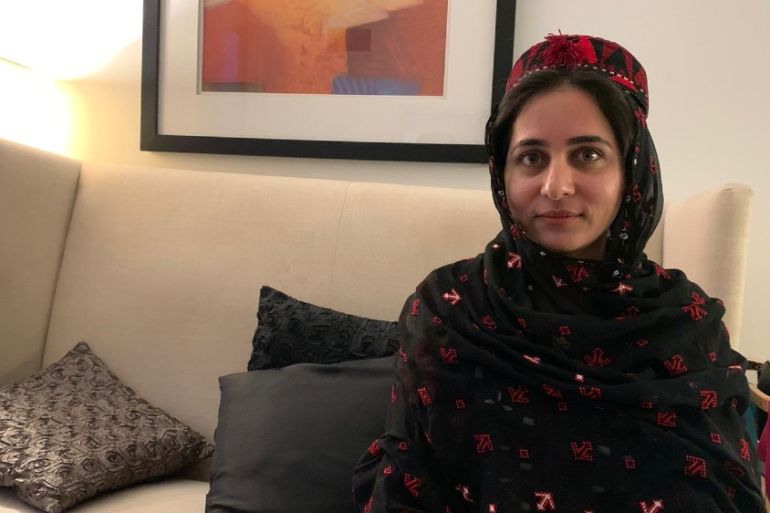
In May 2014, Karima Mehrab Baloch, first woman to be a chairperson of Baloch Student Organization (BSO-Azad), outlined the murderous nature of the Pakistani security agencies:
“… many of our members have been brutally killed and thousands have been abducted. Two months back, the chairman of my organization was kidnapped right in front of my eyes. Before that, in 2009, the vice-chairman of our organization Zakir Majeed was kidnapped by the secret services while he was attending a crowded procession.”
In 2013, BSO-Azad, Pakistan’s largest ethnic Baloch student group was banned on charges of “terrorism” — the easiest excuse to arrest, ban, or even kill. Sensing danger to her life, Karima exiled herself to Canada. In 2020, Karima’s dead “body was found near Toronto.”
Baloch activists, particularly those calling for independence, have been subject for years to a sustained and documented campaign of enforced disappearances and extrajudicial killings, local and international rights groups say.
Aljazeera
That same year, journalist Sajid Hussain Baloch‘s body was found in Sweden’s Fyris River. Between 2012 and 2017, he lived his years in exile in Oman, UAE, and Uganda where in 2015 he started Balochistan Times. In 2017, he settled in Sweden.
There has been a sharp escalation in Baloch separatist violence over the past five years, with 2025, the deadliest year on record. “According to the Pakistan Institute for Peace Studies, the province saw at least 254 attacks in 2025 (a 26 per cent increase from the previous year) resulting in more than 400 deaths.”
Sometimes bodies of Balochis are just thrown in graves, without being covered with a shroud, by the authorities.
Pakistan needs to tackle the Balochi problem
Globally and regionally, the world is changing rapidly. Old alliances are disappearing or losing relevance. New ones are being formed; some are in embryonic stages. Then, there are US and Israel led wars in Gaza, Palestine, Lebanon, and in particular, against Iran that have created economic hardships, rise in inflation, and shortage of oil and gas due to the blockade of Strait of Hormuz.
In the face of this reality, Pakistan’s leaders are gloating in the worldwide coverage of their role as mediators between Iran and the US. But that is not going to solve the pressing economic problems facing the country.
Then, there are problems in the neighborhood. Pakistan’s relations with two of its four neighbors are not good at all. With India, Modi’s unnecessary rigidity and his four day war with Pakistan last May further deteriorated the already strained relations.
Also, for some time now, the war between Afghanistan and Pakistan has resulted in border closings affecting Pakistan’s trade with Central Asia. Pakistan is now using different routes via Iran and China making it more costly and time consuming.
With Afghanistan, an additional problem exists of the TTP (Tehreek-e-Taliban Pakistan) <1>, a Jihadi group operating from Afghanistan, that the Pakistani authorities accuse of supporting BLA.
Already financially constrained, Pakistan faced another problem recently, when UAE suddenly demanded its loan of $3.5 billion back. The reason being the UAE wanted to see Iran nuked but Pakistan argued that if Israel nuked Iran today, they’ll come after Gulf countries tomorrow. Saudi Arabia and Qatar came to Pakistan’s rescue with billions of dollars.
In this critical situation, Crisistan should try to keep peace within its borders, by:
- granting due rights to Balochi people
- letting Balochis decide what course their province wants to take
- release the thousands of Balochis if still alive, and the whereabouts of all who have disappeared by the army
- the central government should contribute towards the economic development of the province
- and so on …
Only steps to placate Balochistan would permit the government to concentrate on other critical problems facing the country, rather than wasting its energy on fighting its own people.
<1> Looking for “strategic depth,” Pakistan wanted to use friendly Afghanistan as an area to retreat in case of an Indian attack. The idea germinated during Benazir Bhutto’s rule. But now, things have changed so much that Afghanistan has become a pit full of anti-Pakistan terrorist groups, including TTP (Tehrik-e-Taliban Pakistan), which consists of several armed militant groups. This, in turn, has led to unjust and inhumane deportation of Afghan refugees, many of them had settled in Pakistan for decades.
B. R. Gowani can be reached at brgowani@hotmail.com