
by STAN COX
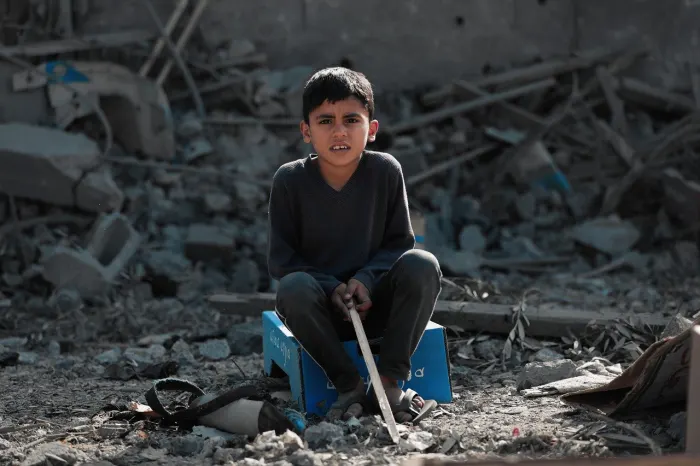
The Israeli regime will use any excuse at any time to kill, maim, or displace Palestinians. The regime, not the resistance, is the driving force behind the conflict.
In February, the public health specialist Muna Abed Alah published a paper in the journal Current Psychology titled “Shattered Hierarchy: How the Gaza Conflict Demolished Maslow’s Pyramid of Needs.” The idea of a hierarchy of needs—first published by the psychologist Abraham Maslow in 1943 and subsequently modified in various ways by Maslow and others—has long been pervasive in the world of pop psychology, while some in academia have poked holes in Maslow’s logic. Now, Alah suggests that the Palestinians of Gaza have rendered the hierarchy of needs wholly obsolete.
Briefly, Maslow and others who followed have identified universal human needs—including but not limited to basic physiological requirements, safety, cognition, self-actualization, and transcendence—and listed those needs along with others in a precise order. They maintain that an individual’s physiological needs (food, water, shelter, etc.) must be satisfied first and that each subsequent need can be fulfilled only after the needs that precede it in the list have been at least partially fulfilled.
Well, Alah writes, the people of Gaza have torn up and thrown away Maslow’s blueprint.
Regarding non-fulfillment of physiological needs, Alah of course cited Israel’s campaigns depriving Palestinians of food, water, fuel, shelter, sleep, and other necessities. Safety was being totally erased by Israel’s relentless bombing throughout Gaza. Endlessly repeated destruction of hospitals, assassination of medical personnel, and targeting of trucks and people that gather at food-distribution locations has prevented the satisfaction of both physiological and safety needs. With serial displacement of millions of people, separation of family members, and deaths of tens of thousands of Palestinians, the need for esteem has been swamped; people’s sense of dignity and control over their lives has been wrecked. Israel’s intentional bombing of schools and universities has blocked their pursuit of cognitive needs. Regarding the need for self-actualization, Alah wrote, “The relentless focus on mere survival in the face of constant threat overshadows any opportunity for self-fulfillment . . . In such an environment, where safety and basic needs are a daily struggle, the luxury of realizing personal potential becomes nearly impossible.”
But what about transcendence, the peak of the hierarchy of needs? In Alah’s words, it “involves connecting with something larger than oneself, including spiritual experiences, deep connections with others, and contributions to the broader society.” With none of the prerequisites being satisfied, transcendence should have receded completely out of reach months ago, according to Maslow’s thesis. Instead, Alah, observed, transcendence is the one need that was being realized:
“Amidst ongoing conflict and siege, achieving transcendence is notably difficult, yet it manifests itself in unique and meaningful ways. Despite the limitations in aid and resources, many people in Gaza have started to help each other, fostering a strong sense of community and solidarity. This mutual assistance not only addresses immediate needs but also serves as a powerful form of transcendence, allowing individuals to connect with and contribute to something greater than themselves.”
The coordinated service, heroism, and sacrifice personified by Palestinian journalists, taxi drivers, first responders, and health care professionals during the war is by now legendary. But countless other people in all walks of life have demonstrated similar degrees of transcendence. In his article, Alah focused on the resilience of Gaza’s civilian population. Here, I’ll just add that the armed resistance forces in Gaza—encompassing the al Qassam Brigades (Hamas’s armed wing) and others—also have transcended unbearable hardship by mounting an extraordinary collective effort.
“Something Greater than Themselves”
A report released in August by Ground Truth Solutions and Arab World for Research and Development (AWRAD) revealed the extent of mutual aid occurring in Gaza over the past year. Conducted in June and July, the survey of 1,200 civilians confirmed that none of the fundamental needs at the base of Maslow’s hierarchy were being fulfilled in Gaza. As expected, when asked about their most immediate priorities, 90 to 99 percent of the respondents listed Maslow’s basic needs: food, water, shelter, and safety.
But more than 90 percent also listed priorities such as “care for marginalized groups” and “doing something to contribute or support.” A large share of people also provided food, water, help with daily affairs, electric power, housing, childcare, or psychosocial support to others in the community—and received such help from others. Community volunteer groups organized early in the conflict, and about one-third of respondents told interviewers they had benefited from support provided by these groups.
Displaced families or communities taking refuge in a new location said they’d found plenty of help. Local leaders and committees helped them set up tent encampments or “find other housing arrangements in host families.” Furthermore, “When asked about the most important resources available to them, people often mention community kitchens, which provide a means through which local aid groups can provide support and residents can pool resources to try and reach those in greatest need.”
LA Progressive for more