
by HAMMAD SARFRAZ
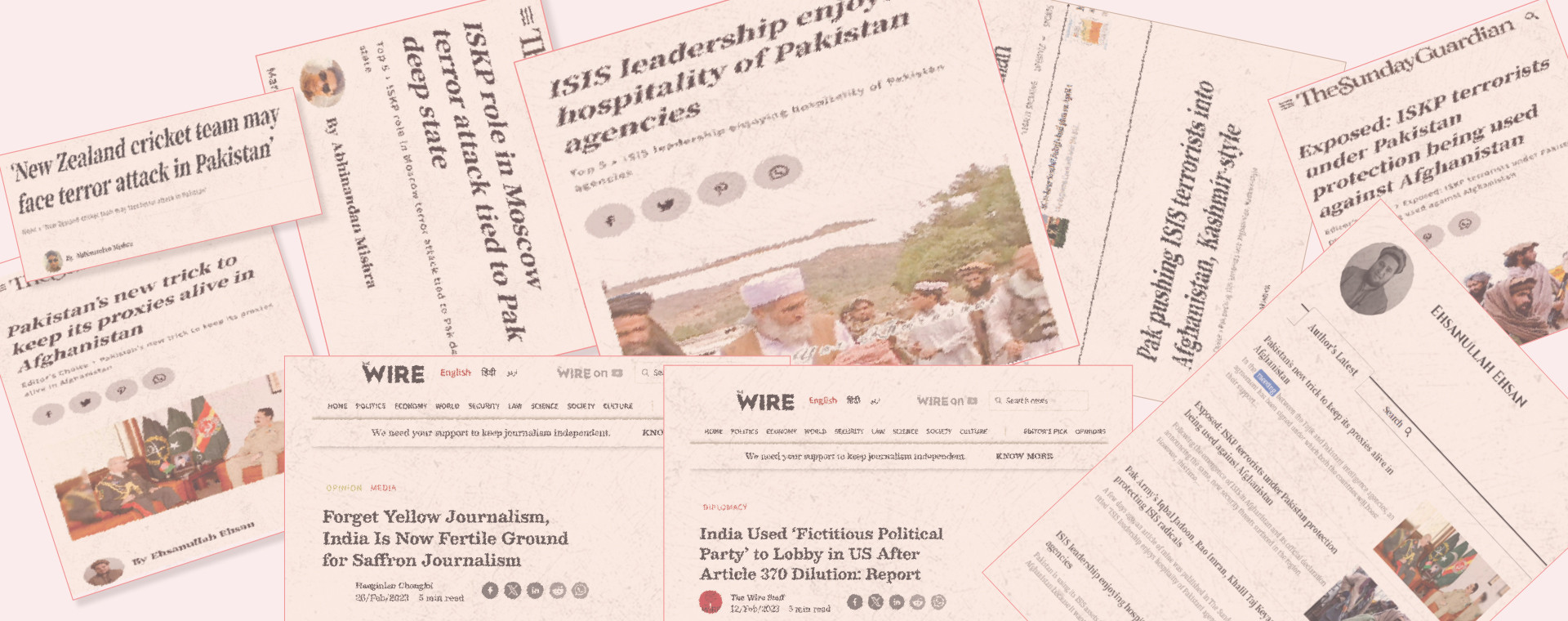
Despite being exposed by EU DisinfoLab, Indian fake news farms thrive with impunity across borders
With free speech under assault at home, ostensibly in the guise of combating fake news, India has paradoxically emerged as a major purveyor of misleading content aimed at discrediting foreign adversaries. Across borders, a far-reaching network of disinformation, supported by deceptive pro-India news outlets and fake NGOs, has also been actively involved in shaping global perceptions about Prime Minister Narendra Modi’s Hindu nationalist government for more than a decade.
In 2020, a damning report by the EU DisinfoLab uncovered a sophisticated misinformation network that had been active for over 15 years. The Brussels-based non-profit, dedicated to combating misinformation within the European Union, revealed extensive operations comprising over 260 pro-Indian local news sites spanning across more than 65 countries.
Traced back to the New Delhi-based Srivastava Group, this expansive web of disinformation was created to discredit India’s rivals, mainly Pakistan and China. Furthermore, EU DisinfoLab detailed the operation’s broader objectives, which included influencing decision-making processes within international bodies such as the UN Human Rights Council (UNHRC) and the European Parliament in favour of the Indian government’s official narrative. The network, according to the findings, engaged in various fraudulent tactics, including the resurrection of defunct NGOs at the UN, impersonation of experts, and the laundering of content from fake media to real media outlets, thereby reaching millions across South Asia and beyond.
In its findings, the EU DisinfoLab singled out the Srivastava Group—a suspicious business conglomerate—and Asian News International, India’s largest video news agency and a local partner of Reuters, as key players in the global misinformation campaign. Both rely heavily on amplifying content and disinformation campaigns to further Indian narratives – particularly those in favour of the BJP administration.
The Srivastava Group, operating through its intricate web of fake news networks, has spearheaded numerous pro-India campaigns worldwide, particularly those aligned with the BJP administration. According to findings by the EU DisinfoLab, this shadowy entity has gone as far as establishing think tanks to advocate for the Modi government. A year prior to the release of the DisinfoLab’s report, researchers scrutinised the Srivastava Group for orchestrating a visit by far-right Members of the European Parliament to Indian-occupied Kashmir. It was revealed that these visits were organised by the International Institute of Non-Aligned Studies (IINS), a think tank established by the Srivastava Group in Brussels. These events unfolded shortly after the occupied region was deprived of its special status and was subjected to a security and communications lockdown by the far-right government in New Delhi.
Interestingly, while the EU DisinfoLab stopped short of implicating the Modi administration in their report, the Indian Ministry of External Affairs (MEA) was quick to issue a rebuttal, pre-emptively denying any government involvement in the scandal. This response from New Delhi surprised many, prompting Suhasni Haider, an Indian journalist, to share her observations on X, the platform formerly known as Twitter. “MEA denies the European agency’s claim of an Indian ‘network of disinformation’. What’s odd is that the report doesn’t actually blame the government,” she remarked in her post, highlighting the apparent anomaly.
Fast-forward to 2023, Asian News International (ANI) found itself under renewed scrutiny amid its increased prominence and financial success during Prime Minister Narendra Modi’s tenure. In its latest report titled “#BadSources: How Indian News Agency ANI Quoted Sources That Do Not Exist,” released last year, the EU DisinfoLab disclosed that ANI had published hundreds of articles entirely relying on false sources. According to the Brussels-based agency, ANI’s content not only promoted the Indian government’s agenda but also disparaged its rivals, Pakistan and China. Concurrently, ANI’s articles served as primary sources for numerous Indian media outlets, as well as online news portals such as Yahoo News. Given the substantial stake held by the international news powerhouse Thomson Reuters in ANI, its raw multimedia content is also readily available to Reuters subscribers. “With this expansive network, ANI indirectly shapes the news consumed by millions of Indians,” cautioned the EU DisinfoLab in its report.
Express Tribune for more