
by ISAAC STANLEY-BECKER & SUSAN SVRLUGA

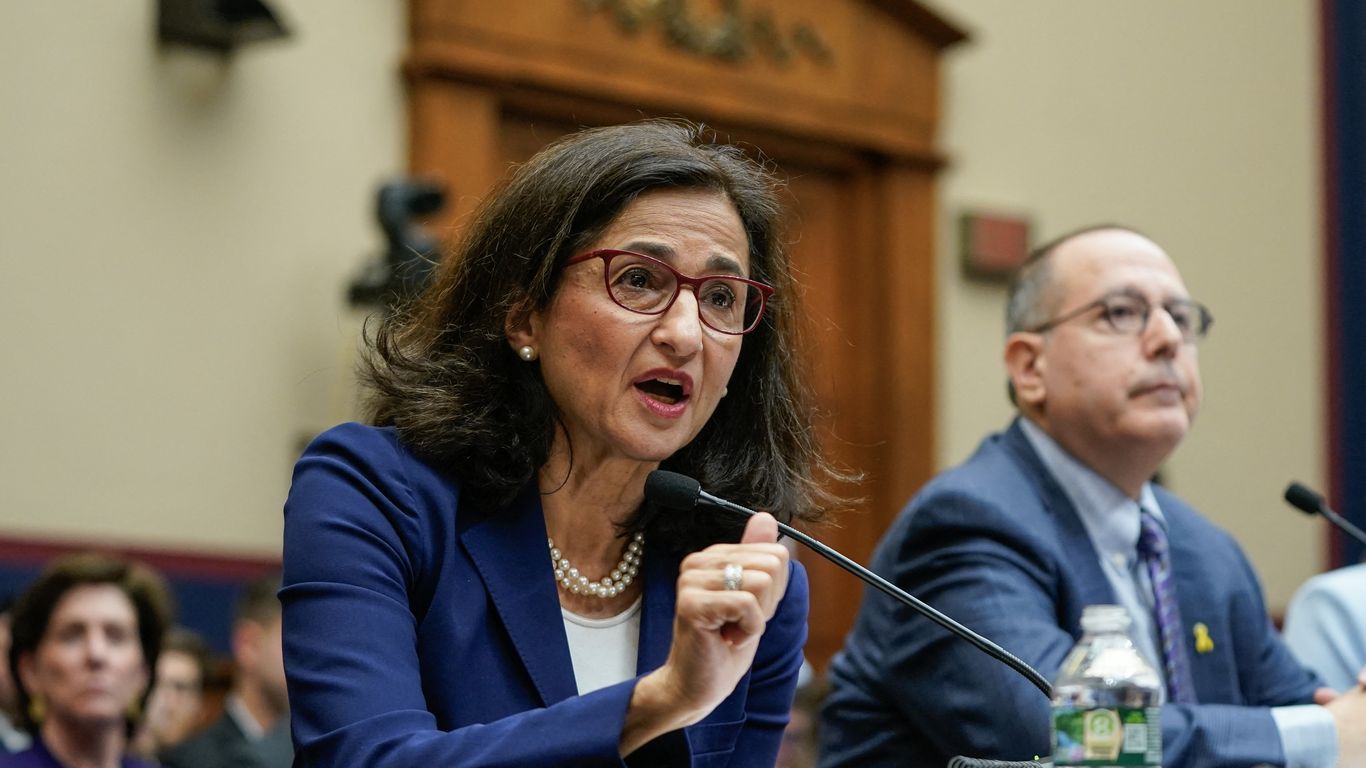
Minouche Shafik, the president of Columbia University, was in Washington on April 17 when she logged in to Zoom to convene her deans.
Earlier in the day, pro-Palestinian demonstrators had erected a tent encampment on the Manhattan quad. They staged their protest just as Shafik — an economist and former vice president of the World Bank who was less than 10 months into her presidency — was preparing to testify before a House committee investigating Columbia and other universities over their response to campus antisemitism inflamed by the Israel-Gaza war.
Hours later, she met with the deans remotely, people familiar with the meeting said, not to solicit advice or seek approval from the university leaders with vast responsibility over their respective schools, in charge of academics, discipline and public relations. Instead, she informed them of her plan: to call police onto campus if the students refused to yield.
By the time she arrived back on campus the next day, Shafik had set in motion a series of events that would fuel protests throughout the country and turn her campus into the center of a national debate over speech, hate, complicity and university governance. This debate is unfolding against the backdrop of a bruising presidential campaign increasingly intertwined with the aftershocks of the Hamas attacks of Oct. 7 and the global consequences of the war in Gaza.
Columbia, unlike many large universities, doesn’t have its own police force. Shafik’s decision to enlist the New York Police Department to clear the student encampment, made swiftly with only a handful of high-level advisers, came over the express disapproval of the university senate, a policymaking body representing faculty, students, administrators and alumni and set up in response to the campus demonstrations in 1968 that made Columbia a landmark in agitation against the Vietnam War.
Shafik’s use of force galvanized the protests, with escalating rhetoric soon pitting students against one another and leading a rabbi on campus to urge Jewish students to return home for their safety. The standoff culminated in a second encounter with police nearly two weeks later, after demonstrators occupied Hamilton Hall, a highly symbolic building targeted in previous student protests. And it set off a cascade of similar confrontations with law enforcement nationwide, from Indiana University to the University of Texas at Austin to UCLA.
Interviews with administrators, trustees, donors and others show decision-making at Columbia became increasingly centralized and shrouded even to high-level university officials as the crisis intensified — eroding trust in the president even as she faced what many concede were impossible choices. On Wednesday, the Arts and Sciences faculty agreed to consider a motion of no confidence in Shafik, with voting to take place for a week.
In a Thursday email to faculty, Shafik acknowledged, “I know that many of you are angry, and that you feel let down by me and by other University leaders for many different reasons.” A university spokesperson declined to make Shafik available for an interview but wrote in a statement that she “leads through consultation and consensus, and regularly meets with people from across Columbia, including faculty, administration, and trustees, as well as with state, city, and community leaders.”
On the April 17 Zoom, some deans warned Shafik about the consequences of police action, asking her to consider the damage done to the university’s reputation in 1968, according to people familiar with the discussions.
“This was not a conversation to explore options,” said one person who participated in the Zoom session and, like some others interviewed for this story, spoke on the condition of anonymity to share sensitive details. “When some tried, it was clear the decision had already been made.”
A university official rejected that characterization, saying Shafik continued to consider alternatives as Columbia gave students more time to disband, ultimately enlisting police the next morning. Throughout the crisis, Shafik has faced competing pressures, including from a board of trustees where some floated unorthodox ideas, such as erecting a barrier around the student protesters to prevent them from disrupting university business, according to a trustee. Some trustees saw in the Hamilton Hall occupation echoes of the storming of the U.S. Capitol on Jan. 6, 2021, according to a person familiar with their thinking.
Numerous trustees supported Shafik’s move to call police onto campus, but some did not, according to a person familiar with those deliberations. A trustee said Shafik listens patiently and seeks consensus but is a decisive leader who understood that the decision was ultimately hers. Shafik acted, she explained in a letter to the NYPD, to ensure campus safety and compliance with university policies.
Some influential donors wanted firmer action.
“Columbia has been too slow to respond and to recognize these s—heads for what they are,” Leon Cooperman, a billionaire investor and Columbia Business School alumnus, said in an interview. Cooperman said he spoke one-on-one with Shafik several weeks before her congressional testimony, after he had threatened publicly to cut off contributions to the university.
Many other university leaders have also involved law enforcement to confront Columbia-style encampments that sprang up after police moved in on the New York campus. But not all of them. The president of Wesleyan University in Middletown, Conn., wrote this week that he would not call the police on students even though their encampment violated the school’s rules.
“Cops don’t always give people tickets for going a few miles over the speed limit,” wrote the president, Michael S. Roth, a historian. “Context matters. … In this case, I knew the students were part of a broad protest movement, and protest movements often put a strain on an institution’s rules.”
Some students at Columbia, Wesleyan and elsewhere have demanded their universities disclose and sell off holdings in businesses and funds they see as complicit in Israel’s war. Nearly all of those demands have gone unmet, though some schools have taken steps to allay student anger, including promises to solicit their input on investments.
Some see in the national showdown centered at Columbia not just echoes of past protests but also omens of an even more fractured future.
“This protest is different from others that have occurred at Columbia, and Columbia’s had a lot of protests,” said James Valentini, a chemist and former longtime dean of Columbia College. “This is the first protest that wasn’t just students against the administration as the object of the action. Now we have students pitted directly against other students in a quite significant and dangerous way.”
‘They’ll destroy you’
A scheduling conflict prevented Shafik from joining the presidents of Harvard, the University of Pennsylvania and MIT when they appeared before the Republican-led House Education Committee in December and gave nuanced yet evasive answers about disciplining calls for genocide. Two later resigned.
Four months later, Shafik was determined not to be the committee’s third casualty when it was her turn to appear on Capitol Hill, according to people who prepared her for the April 17 testimony or spoke with her team.
In her testimony, Shafik vowed to suppress hateful speech and discipline individual employees who seemed to express support for Hamas or its rampage on Oct. 7. And she stated unequivocally that calls for genocide would violate the university’s code of conduct.
A baroness in Britain, where she previously led the London School of Economics, Shafik had less experience with U.S. politics. But her approach drew on the advice of seasoned political strategists.
“The rap on the December hearings was that there were too many lawyers and too few communicators,” said Philippe Reines, a former longtime press aide to Hillary Clinton who helped prepare Shafik and others from the university, including the two co-chairs of the university’s board of trustees, for their testimony.
Clinton, who teaches at Columbia, recommended Reines to Shafik, he said. He had prepared the former secretary of state and Democratic presidential nominee for her testimony about the 2012 attacks in Benghazi, Libya, and later played Donald Trump during her debate practice in 2016.
Others involved in readying Shafik for the congressional gantlet had previously advised U.S. presidents: Shailagh Murray, Columbia’s executive vice president for public affairs who earlier served as a high-level communications adviser to President Barack Obama and then-Vice President Joe Biden and before that was a Washington Post reporter, and Dana Remus, who until July 2022 served as President Biden’s White House counsel and is now a partner at Washington-based Covington & Burling, whose offices served as a makeshift war room on the day of the hearing. The New York Times first reported Covington’s involvement.
Shafik’s vow to prevent protests from growing abusive — and her rejection of such slogans as “from the river to the sea,” a common chant of student protesters that some interpret as an antisemitic call to eliminate Israel — earned praise within the GOP. “Columbia beats Harvard and UPenn,” Rep. Aaron Bean (R-Fla.) quipped.
But her disclosure of specific disciplinary decisions rankled many back on campus, who criticized her approach to avoiding conflict with the committee. “I think the feeling was, ‘My God, you can’t go toe-to-toe with a congressional committee. They’ll destroy you. Your only hope is to give in,’” said a former senior administrator. “It was a capitulation to a committee that was out to condemn universities.” A university official said voluminous document requests from the committee had included information about individual employees.
The table had already been set for Shafik to try mollifying critics. After protests began last fall, administrators clarified and tightened rules for campus events, without input from the university senate, and used them to suspend two groups, Students for Justice in Palestine and Jewish Voice for Peace.
Joseph Slaughter, a former faculty senator and director of Columbia’s Institute for the Study of Human Rights, described these developments as a “coup” by senior administrators “who don’t know our students, and don’t know the statutes and norms of Columbia.” (A university official said that the groups were in violation of every iteration of Columbia’s rules, and that neither group has since agreed to comply, which would enable their reinstatement.)
In early April, the university suspended a handful of students for their alleged involvement in an unauthorized event called “Resistance 101.” To gain information about attendees at the event, the university enlisted what an administrator described in a statement as “an outside firm led by experienced former law enforcement investigators.”
Students expressed their outrage by beginning their encampment on the day of Shafik’s testimony, gaining maximum visibility as Congress turned a spotlight on their university. They labeled an area on the central quad a “liberated zone” in an echo of language used in the 1968 protests.
The university issued an order to disperse at 11 that morning. Plans to bring in the police took shape quickly, devised by Shafik along with the provost, general counsel and other senior university leaders, according to a Columbia official.
MSN/Washington Post for more