
by ISABELLE B. LAUMER, ARIF RAHMAN, TRI RAHMAETI, ULIL AZHARI, HERMANSYAH, SRI SUCI UTAMI ATMOKO, & CAROLINE SCHUPPLI
Abstract
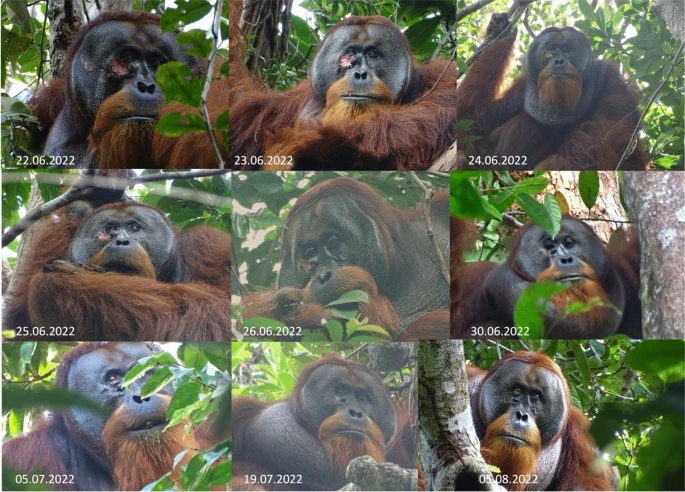
Although self-medication in non-human animals is often difficult to document systematically due to the difficulty of predicting its occurrence, there is widespread evidence of such behaviors as whole leaf swallowing, bitter pith chewing, and fur rubbing in African great apes, orangutans, white handed gibbons, and several other species of monkeys in Africa, Central and South America and Madagascar. To the best of our knowledge, there is only one report of active wound treatment in non-human animals, namely in chimpanzees. We observed a male Sumatran orangutan (Pongo abelii) who sustained a facial wound. Three days after the injury he selectively ripped off leaves of a liana with the common name Akar Kuning (Fibraurea tinctoria), chewed on them, and then repeatedly applied the resulting juice onto the facial wound. As a last step, he fully covered the wound with the chewed leaves. Found in tropical forests of Southeast Asia, this and related liana species are known for their analgesic, antipyretic, and diuretic effects and are used in traditional medicine to treat various diseases, such as dysentery, diabetes, and malaria. Previous analyses of plant chemical compounds show the presence of furanoditerpenoids and protoberberine alkaloids, which are known to have antibacterial, anti-inflammatory, anti-fungal, antioxidant, and other biological activities of relevance to wound healing. This possibly innovative behavior presents the first systematically documented case of active wound treatment with a plant species know to contain biologically active substances by a wild animal and provides new insights into the origins of human wound care.
Introduction
In the early 1960s Jane Goodall first described the presence of whole leaves in the feces of chimpanzees (Pan troglodytes) at Gombe Stream, Tanzania1. By the late 1990s, this behavior, now called whole leaf swallowing, was documented at several African great ape study sites, along with bitter pith chewing, and demonstrated to have therapeutic, anti-parasitic functions2. Since then, various forms of self-medication have been observed in wild great apes (e.g.,2,3,4,5,6). Some of the most detailed evidence for animal self-medication comes from research in primates (e.g.,1,2,3,4,5,6,7,8,9,10,11,12).
Animal self-medication is now divided into five categories2,4: (1) sick behaviors, such as anorexia; (2) avoidance behaviors, such as avoiding e.g. feces, contaminated food or water; (3) prophylactic behaviors, such as routine consumption of foods with preventive or health maintenance effects; (4) therapeutic behaviors, defined by the ingestion of a small amount of a biologically active or toxic substance with no or little nutritional value for the curative treatment of a disease or its symptoms, and; (5) therapeutic topical application of pharmacologically active plants onto the body for the treatment of external health conditions or placement of such species in the nest as a fumigant or insect repellent13. Several of these behaviors can be found in wild apes2.
While sick and avoidance behavior (category 1 and 2) can be regularly observed in non-human animals (e.g.14), self-medication in the form of ingestion of specific plant parts (prophylactic and therapeutic behavior, category 3 and 4) is widespread, albeit exhibited at low frequencies (e.g.,15, but see16). So far, leaf swallowing has been reported in chimpanzees (Pan sp.; e.g.,7,9,16,17), bonobos (Pan paniscus3), gorillas (e.g. Gorilla beringei graueri18), and in only one Asian ape species, the white-handed gibbon (Hylobates lar)19. Another study reported the consumption of plant species directly related to the occurrence of parasite infections in individual orangutans (Pongo sp.), but not correlated with the plant’s distribution in the environment20. Another therapeutic self-medicative behavior seen in chimpanzees is bitter pith chewing of Vernonia amygdalina to treat worm infection8,10,13. Despite the plant’s year-round availability, the behavior is highly seasonal, peaking during the rainy season when worm infections also peak8,13. Interestingly, as Vernonia amygdalina is not evenly distributed in their home range, the apes often need to actively adapt their usual travel routes to gain access to the plant13.
Among Bornean orangutans (Pongo pygmaeus) there are several reports proposing the intentional ingestion of specific plant species also used in ethnomedicine for their medicinally active properties. In Sabah, Malaysia, a 4- to 5-year-old severely wounded female Bornean orangutan was observed eating ginger leaves and stem (Zingiberaceae)21. Ginger is known as a traditional medical plant against inflammation with antibacterial, antiviral, antifungal properties22,23,24,25. In 7 years of observation, no other individual, except two flanged males was ever observed feeding on the same ginger species at that study site. The researchers concluded that the juvenile may have attempted to treat itself with these plants. Another study, which interviewed 13 traditional healers from Central Kalimantan, showed that Bornean orangutans feed on the same plant parts from two plant species (Uncaria gambir Roxb and Pternandra galeata Ridl), used by traditional healers for treating internal illness, tumors, and haemorrhage26. Additionally, they observed a female Bornean orangutan selectively choosing young leaves of Mezzetia sp., the pulp of Dyera lowii and Ilex cymosa, and leaves of Belang Handipek (Scolopia macrophylla)27. This plant combination is used in ethnomedicine as a prevention against fatigue27. Despite these reports, overall, evidence of plant consumption for self-medication in orangutans is still limited.
Reports of the topical application of plants or insects to one’s own body (category 5) are found in a limited number of taxa, but the evidence for medicinal benefits remain mostly anecdotal (e.g.28,29,30,31,32,33,34,35,36,37,38). However, there is growing evidence for the application of biologically active plant compounds to the skin in orangutans. At Sabangau peat swamp forest in Central Kalimantan, two adult female and one adolescent female Bornean orangutans were observed chewing leaves of Dracaena cantleyi for three to five minutes and then rubbing the resulting green-white lather onto their arms and legs for up to 35 min11. Ten years later, a follow-up study confirmed the same behavior in six additional adult females and one flanged male of the same population (the lather was similarly applied and massaged into the skin for up to 45 min6). The behavior appeared to be intentional as only specific body parts were treated, the behavior was repeated several times until the hair was fully wet and the entire process took a considerable amount of time6,11. Orangutans were never observed ingesting the leaves6. Dracaena cantleyi is a medicinal plant used by indigenous people for several medical treatments including sore muscles, joint or bone pain6, pain after a stroke6 and swelling11. Indeed, pharmacological analyses revealed that Dracaena cantleyi inhibits TNF?-induced inflammatory cytokine production thereby acting as an anti-inflammatory agent6.
Nature for more