
by AMY LI BAKSH
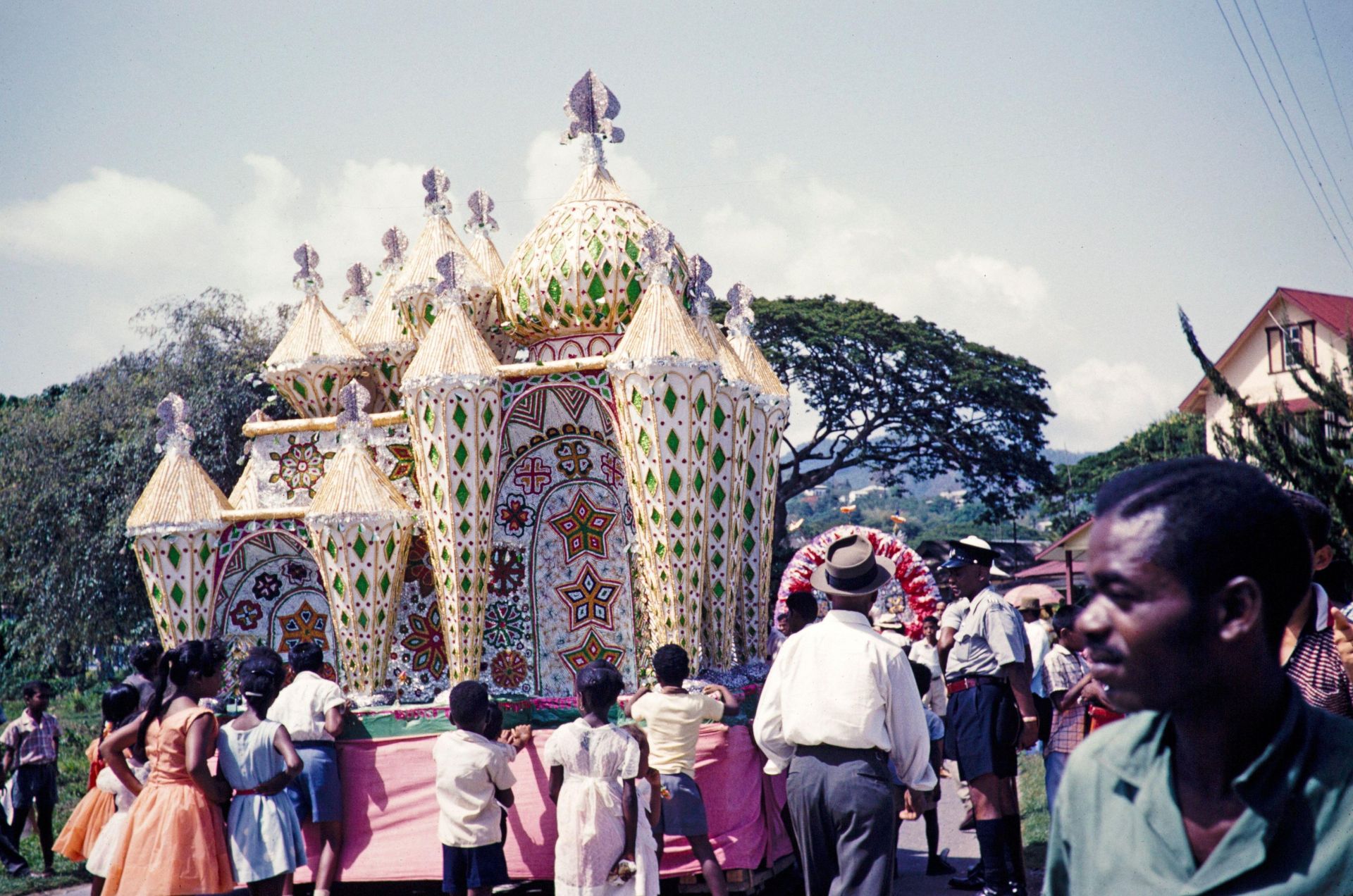
Indentured Indian workers brought the Shiite ritual of Muharram from overseas, shaping it into Hosay, amid influences from African drumming to colonial repression
When my great-grandfather arrived in Trinidad from West Bengal, his name was documented as Abdul Kassim, although as my mother reminds me we can never know if this was the name he was actually born with. Leaving a wife and daughter behind in India, he found a new home on this island, selling fabric door to door from a suitcase. It was here that he would meet my great-grandmother, Hapijan, whose grandfather Babu Meah came to the country in one of the earliest waves of Indian immigration, most likely on an indentured contract.
Trinidad and Tobago is a land of many cultures: Indigenous First Peoples; English, French and Spanish colonizers; enslaved Africans; and Indian, Chinese and Portuguese laborers. As these cultures merged and mingled, many practices and traditions from around the world became “creolized” — absorbed by the islands’ many peoples and in the process altered into something different and new. Tracing my own family history, I became curious about what laborers like my maternal Muslim family had brought across from India during the era of indentureship, which started in 1845. The family was deeply involved in the local Islamic community; in fact, Babu Meah built a mosque on nearby Ryan Street. I became particularly fascinated by the transformation of the Islamic practice of commemorating the death of Husayn ibn Ali on the 10th day of the Islamic month of Muharram and how that had morphed from “Husayn” to “Hosein” and then to today’s Caribbean tradition of “Hosay.” And it wasn’t just the name that changed. Many aspects of Trinidadian culture affected the ritual, from colonial suppression to African drumming.
Only 5% of Trinidad’s population are Muslim — approximately 100,000 people — and an even smaller proportion practices Shiite Islam. Yet the mourning of Muharram has become a widespread observance on the island. The tradition has roots as far back as 632 and the death of the Prophet Muhammad, which left a political vacuum that would result in the split of the religion’s two major sects: Sunni Muslims, who selected Abu Bakr, a companion of Muhammad, as his successor and the first caliph (leader of the Islamic community), and Shiite Muslims, who followed Muhammad’s son-in-law and cousin Ali ibn Abi Talib, believing that Muhammad’s bloodline should rule.
For decades, the two groups vied for leadership. Muhammad’s two grandsons, Hasan ibn Ali and Husayn ibn Ali, were considered by Shiite Muslims to be the rightful rulers. After the death of his brother, Husayn refused to pledge his allegiance to the Umayyad caliph Yazid ibn Muawiyah and gathered his supporters to attempt an overthrow of the Umayyads in 680. In the first month of the lunar Islamic calendar, known as Muharram, Husayn’s retinue of 70 men was intercepted by a 5,000-strong Umayyad army and fought in what is now called the Battle of Karbala. Husayn and most of his followers were slaughtered, and the event became central to Shiite history. The battle is commemorated as a time of mourning by Shiite Muslims and became synonymous with the name of the month.
The nature of Muharram observances shifted with the adoption of the ritual in India. Professor of religion and anthropology Frank Korom writes in his book, “Hosay Trinidad,” that, “Although many similarities exist between the Indic subcontinent and Iran in terms of performing Muharram rituals, there are some great differences as well.” In its oldest form, the Persian word “ta’ziyeh” was used to refer to the ritual dramatic reenactment of Husayn’s death. But once the custom had traveled to India, the word became associated with elaborately decorated model tombs that were carried during the public processions.
In Trinidad, this solemn occasion has taken on an entirely different expression again, resulting in the celebration we call Hosay. As is the case with much of Caribbean culture, there have been adaptations — whether through the necessity of what was available or through the merging of different cultures as they met within the various diasporic communities. At the same time, the colonial rulers were always searching for ways to sever the ties between the mainly African and Indian working-class people and their cultural identities, for strong communal bonds were seen as dangerous to the colonial status quo.
The ritual was brought to the Caribbean by Indian immigrants like my ancestors, not all of whom were Shiite — or even Muslim. What is now our modern-day “Hosay” can trace a direct line back to the very first indentured laborers coming to work on the plantations as early as 1845. Many participated in Hosay despite being Hindu or Sunni Muslim. As Korom notes, “Although the Indian origins of the rite can be observed clearly in Trinidad, there is no question that the ritual performance has gone through a fairly lengthy process of indigenization.”
New Lines Magazine for more