
by CARLOS L. GARRIDO
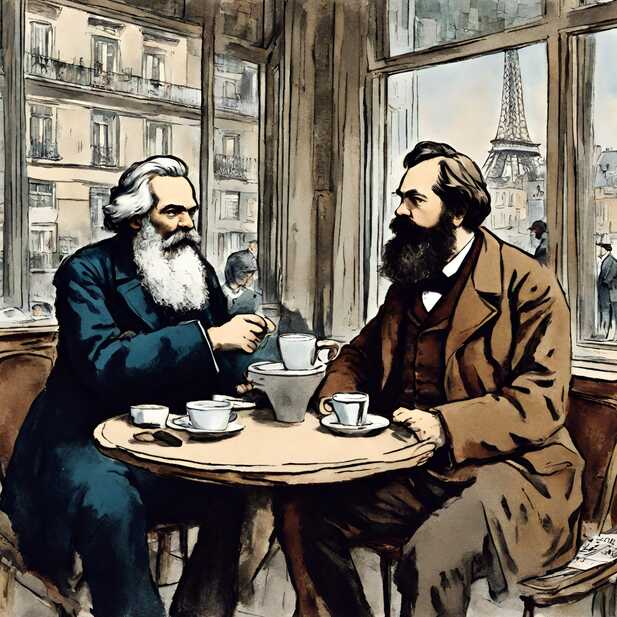
Historical Materialist View of Ideas
The
collections of ideas we hold are historically conditioned by the mode
of life we exist in. They reflect, in the realm of ideas, the
limitations and possibilities of the mode of social life that dominates
the era – of the forms of social intercourse which pervade our everyday
lives. A feudal peasant cannot concern themselves with their social
media profiles – with the likes their posts get, the shares it receives,
and the subscribers or followers they have accumulated. These are,
however, central concerns for most people today. We live in the era of profilicity as
the dominant identity technology. As is evident, all the collections of
ideas, concerns, aesthetic experiences, desires, beliefs, etc. which
are tied to the profile-based mode of identity curation are dependent
and grounded in the technological developments our era has achieved. In
Marxist terms, these developments at the level of how we think (about
ourselves and others) presuppose developments in the forces of
production. Likewise, in most of the Western world, no youngsters would
concern themselves with who their families will arrange them in marriage
with. These preoccupations belong to an era that has passed – to a mode
of social intercourse humanity has overcome.
This is a central component of historical materialism – the “law of development of human history” which Engels’s eulogy tells us Marx discovers. It is pithily formulated in the famous 1859 preface to Marx’s A Contribution to the Critique of Political Economy, where he writes that:
“The totality of these relations of production constitutes the economic structure of society, the real foundation, on which arises a legal and political superstructure and to which correspond definite forms of social consciousness. The mode of production of material life conditions the general process of social, political and intellectual life. It is not the consciousness of men that determines their existence, but their social existence that determines their consciousness.”[1]
Ideological Institutions and False Consciousness
The ideas that come to dominate a form of life do not exist in a transcendental realm. They are, instead, embodied materially through institutions and people. The influence these institutions hold varies. Their purpose, however, is the same: to sustain the consent of the masses (the subaltern) for the dominant order. They are tasked with ensuring the smooth reproduction of the current mode of life. In being the dominant institutions that pervade people’s everyday lives, they don’t simply get us to consent (which implies a conscious act of acceptance) but shape our spontaneous and common-sense worldviews to such an extent that we are unable to recognize, with the exception of those grand moments of rupture called ‘events’ in the history of philosophy, the conditioned and implanted character of our thoughts.
Like the slaves in Plato’s allegory of the cave, we are deeply unaware of the structures which contain the horizon of how we view reality. Plato could not have been more correct in emphasizing the painful character of the hypothetical cave’s escapee. It is not easy to have our notions of reality so easily overturned – to have our desires, beliefs, aesthetic experiences, etc. demolished. Like the escaped slave, who painfully needs to readjust their eyes, the overcoming of bourgeois ideology is a painful process – not a spontaneous and immediate ‘moment’. When our conditions of life are so systematically pervaded by lies and manipulations, all aimed at preventing us from rocking the boat, truth is painful. Truth is dangerous. The quest for truth has always had, as W. E. B. Dubois notes, “an element of danger and revolution, of dissatisfaction and discontent, [but] nevertheless, men strive to know.” From the killing of Socrates to the killing of King, class society has shown its proclivity to fight back viciously when threatened by the truth tellers. This was, once again, already prophetically described by Plato’s allegory.
Capitalism“is a social order that necessitates the general acceptance of an inverted understanding of itself… Reality [needs to be] turned on its head. But this is not, as Vanessa Wills notes, a problem of “epistemic hygiene”. The root of the ‘error’ is not in our minds, that is, in our reflection of the objective phenomena at hand. As I’ve argued previously, “it is much deeper than this; the inversion or ‘mistake’ is in the world itself… This world reflects itself through an upside-down appearance, and it must necessarily do so to continuously reproduce itself.”
As Marx and Engels noted long ago,
“If in all ideology men and their relations appear upside-down as in a camera obscura, this phenomenon arises just as much from their historical life-process as the inversion of objects on the retina does from their physical life-process.”
Capitalist ideology is as capable of accepting truth as vampires are of consuming garlic. Truth, which almost always stands on the side of the masses, is its Achilles heel.
Midwestern Marx for more