
by RON JACOBS
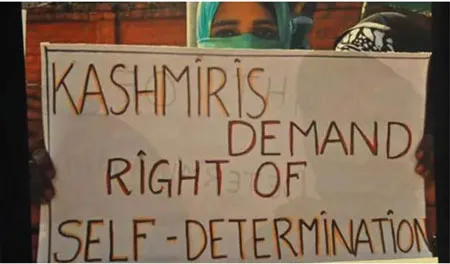
Together with Palestine, the state of Kashmir is one of the longest existing political and territorial conflict remaining from the aftermath of the British Empire. Kashmir, together with its sister state of Jammu, were granted a quasi-autonomy at the end of British rule in the subcontinent. The status of the states was to be determined by a popular referendum, which has yet to occur. Arguably, the reason it has not occurred is because India fears it would lose any claim and the people of Jammu/Kashmir would vote for independence, while leaning toward Pakistani and its Muslim foundations. The conflicts between India and Pakistan over Kashmir has erupted into wars between Delhi and Islamabad at least twice. Furthermore, an intensification of Indian repression and military occupation led to an armed insurgency in 1989. Recently, India’s Hindu nationalist government overturned laws protecting the states’ autonomy when, according to the US-government-funded (and not a friend of liberation movements as a rule) Freedom House, “what had been the state of Jammu and Kashmir was reconstituted as two union territories under the direct control of the Indian central government. The move stripped residents of many of their previous political rights. Civil liberties have also been curtailed to quell ongoing public opposition to the reorganization. Indian security forces are frequently accused of human rights violations, but perpetrators are rarely punished.”
In essence, this move by the Indian regime made Kashmir and Jammu part of India, ignoring United Nations resolutions, centuries of history and, most importantly, the people living in those states. It is this history and the proclaimed desires of the majority of Kashmiris that inform a new book on the subject. Written by Dr. Farhan Mujahid Chak, the book titled Nuclear Flashpoint: The War Over Kashmir is a knowledgeable discussion of Kashmir’s history and a critical examination of India’s manipulation of that history to deny Kashmir’s liberation struggle.
The narrative provided by Chak, who also serves as the Secretary-General of Kashmir Civitas—an organization that exists to fight for Kashmiri self-determination, is a narrative that explains the religious, economic and political history of Kashmir over several centuries. It is a story that involves invasions, settlements, and political and financial deals between royals and conquerors. Likewise, it is a chronicle of Kashmir’s long tradition of resistance and struggle; a tradition that exists even today despite the presence of over 500,000 Indian troops that occupy much of the region. The harsh nature of the Indian military’s repression and occupation is a major reason why even a mainstream organization like the aforementioned Freedom House gave the country a rating of “not free.”
It is the contention of the text that India’s repression has intensified since the rise of the Hindu Nationalist Party and its leader Narendra Modi. The author describes the thinking of this extreme right-wing party and its government as one that sees its adherents and supporters as exceptional, creating an Indian exceptionalism in a manner similar to the exceptionalism assumed by many US and Israeli citizens in their justifications for invasions, colonization and crimes against humanity. Chak describes some of the manifestations of this exceptionalist thinking; the rewriting of history and an insistence on religious and cultural uniformity according to the ruling party being primary among them. In a parallel manner, Chak discusses the political spaces where the non-sectarian elements of India’s political system are as opposed to Kashmiri self-determination as the Hindu nationalists. In short, the scenario Chak has written about India and its relation to Kashmir is a scenario that is synonymous with that practiced by other settler-colonial nations, especially the United States and Israel.
Pakistan Observer for more