
by ESTHER CHAPMAN

What science tells us about our need to connect.
Several times a week, Rita Goldhor picks up her phone and dials into a class or support group offered through the national Well Connected program for older adults. Goldhor, who lives in San Leandro, is 96 years old, legally blind, and confined to a wheelchair, but that doesn’t stop her from participating in a writers’ group, two support groups for those with vision impairments, and a “Gratitude Group” in which people with challenges and disabilities take turns sharing something positive.
“Without Well Connected, I think I would be severely depressed,” she says. “These groups form a community and even a family for you. You make a connection.”
Goldhor may not know it, but she is in step with a growing field of science around the health benefits of positive human connection. In a report released in May, “Our Epidemic of Loneliness and Isolation,” United States surgeon general Vivek Murthy shared scores of studies showing that rates of loneliness are rising in our nation and contributing to many negative health impacts. On the flip side, positive social connections can protect our health and contribute to better mental, emotional, and physical well-being.
There may be no one-size-fits-all answer to the “loneliness epidemic,” but many experts have ideas about how we can reverse the isolation trend we face as individuals and communities.
THE PROTECTIVE EFFECTS OF CONNECTION
Loneliness is a normal part of the human experience, especially when we go through a major life change or disruption. A child moves to a new neighborhood, a young adult graduates from college and starts a new job, a parent leaves the workplace to stay home with young children, or an older adult loses his spouse and must navigate loneliness alongside his grief.
These transient seasons of loneliness can actually be helpful, prompting us to reach out to others to build—or rebuild—connections. However, chronic loneliness and isolation can contribute to negative long-term health impacts, such as:
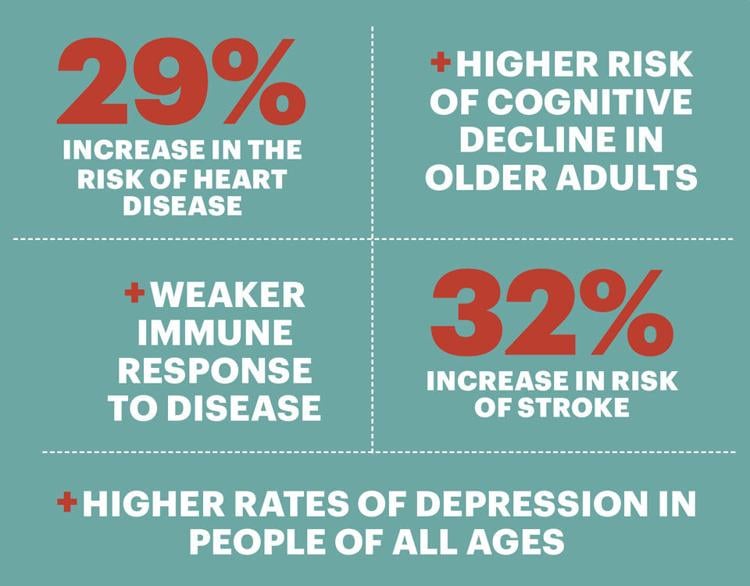
On the other hand, positive social connection produces beneficial health outcomes almost from the moment we enter the world.
“Early in life, if we’re attended to, nurtured, and supported, we end up in a category called ‘securely attached,’ and that makes us healthier, happier, and more satisfied in relationships throughout adulthood,” says Emiliana Simon-Thomas, Ph.D., science director at the Greater Good Science Center at UC Berkeley.
Social connection can prompt us to take on the healthy habits of our peers, studies show, such as becoming more physically active, quitting smoking, and getting involved in rewarding activities like volunteering. In the workplace, those with supportive work relationships tend to report more job satisfaction and less burnout.
Close community even seems to contribute to a longer life span. When scientists studied the five areas of the world with the longest-living populations, referred to as Blue Zones, they discovered one commonality was a tight-knit community. Close community provides a positive network of support that elevates happiness and well-being and also reinforces shared practices (diet, exercise) that promote better health and longer life.
HOW WE LOST CONNECTION
Though many people believe the COVID-19 pandemic caused our current state of isolation, the trend actually started decades earlier. Time-use studies beginning in 2003 show people spending more time alone and less time with family and friends. According to other research, 90 percent of those who say they are not lonely have three or more confidants, yet almost half (49 percent) of Americans have three or fewer close friends, up from 27 percent in 1990.
Diablo Mag or more