
by GEORGE B. CUNNINGHAM & KELSEY GARRISON
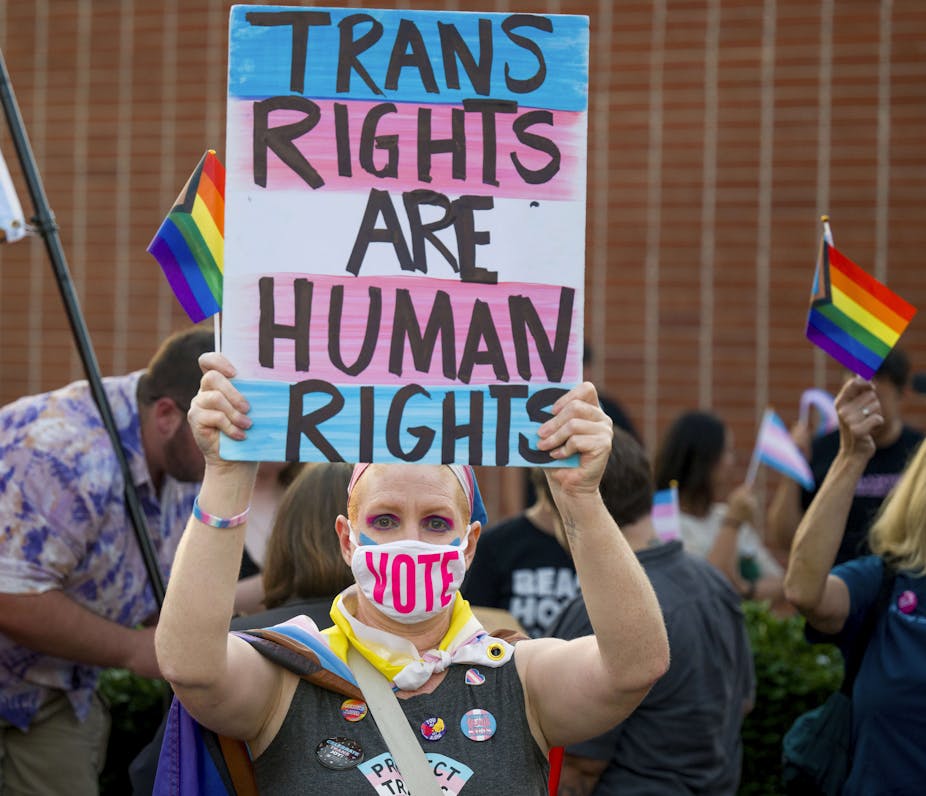
In 2023, 24 states had laws or regulations in place prohibiting transgender students from participating on public school athletic teams consistent with their gender identity. These bans mean that a person whose sex assigned at birth was male but who identifies as a girl or woman cannot play on a girls or women’s athletic team at a public school in that state.
The topic has spurred many debates about fairness, the science behind sports performance, civil rights and sports as a human right.
As researchers who study diversity, equity and inclusion in sport, we were interested in understanding what prompted such bans. Though not a surprise, we showed for the first time through an in-depth study set to be published in the peer-reviewed Journal of Sport Management that state-level politics and public biases against transgender people are largely to blame.
Our research
We collected two years of data in 2021 and 2022 on states that passed legislation prohibiting transgender athletes from participating in sports on teams that connect with their own gender identities.
To determine the political leanings of a state’s population, we collected data about the share of Republican state senators and the party affiliation of the governor.
Finally, we collected information about the biases people had toward transgender individuals. The data came from responses to the Project Implicit website. People visiting the site can take tests aimed at measuring their biases toward different groups, including transgender people. Administrators then remove identifying information and make the data freely available. For our study, we aggregated the responses to have transgender bias scores for each state.
The politics of transgender bans
States whose residents have conservative political leanings tend to have more restrictive views on civil rights issues such as immigration, health care and the use of the death penalty.
These patterns hold for transgender rights, too.
In our work, we found that states with conservative-leaning legislatures such as in Wyoming and West Virginia were most likely to enact transgender athlete bans. As were states with Republican governors, such as Ron DeSantis in Florida and Greg Abbott in Texas.
These statewide patterns are consistent with national political actions.
In 2023, the Biden administration proposed a change to Title IX, the federal law that bans sex discrimination at K-12 schools and colleges that receive federal funds. Under Biden’s proposed changes, Title IX would also ban discrimination based on sexual orientation and gender identity.
In response, nearly all – 25 of the 26 Republican governors – called on Biden to delay or withdraw the rule change. To date, Biden has not made a final decision and has delayed the change.
Bias against transgender people
But politics tells only part of the story.
We found that conservative political leanings spurred collective biases against transgender people, which in turn prompted the bans.
The Conversation for more