
by TARA ISABELLA BUTLER
Bending a mysterious world to your will was the goal of esoteric practices. Now it’s the unashamed aim of the tech titans
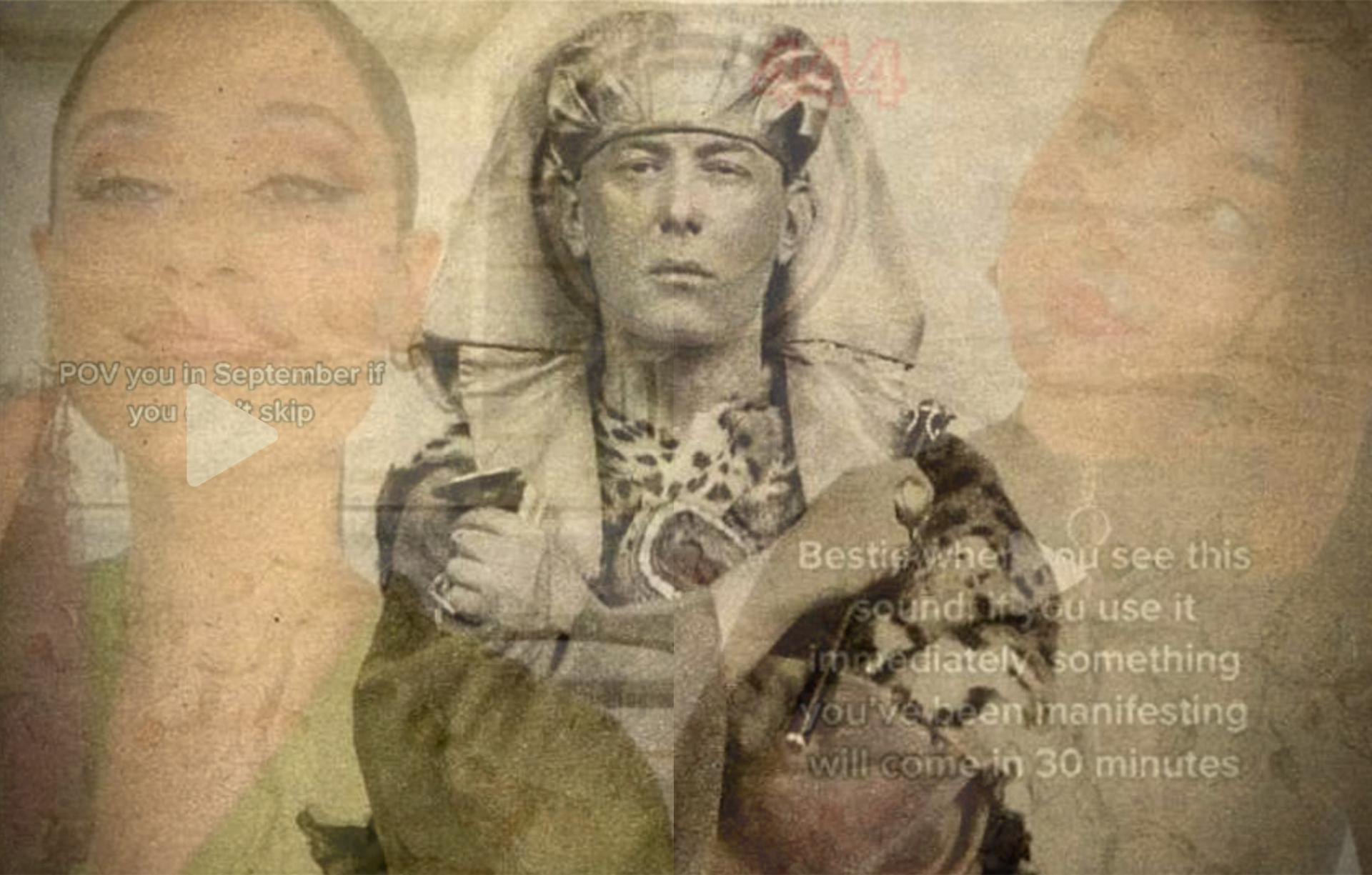
Deep in the labyrinthine tags of TikTok, a group of teenage occultists promise they have the power to help you change your life. ‘Manifesting’ influencers – as they’ve come to be known – promise their legions of viewers that, with the right amount of focus, positive thinking and desire, the universe will bend to their will. ‘Most of these people [who manifest] end up doing what they say they’re going to do and being who they say they’re going to become,’ insists one speaker on the mindsetvibrations account (600,000 followers). Another influencer, Lila the Manifestess (70,000 followers) offers a special manifestation (incantation?) for getting your partner to text you back. (‘Manifest a text every time.’) Manifest With Gabby tells her 130,000-odd followers in pursuit of ‘abundance’ about ‘5 things I stopped doing when learning how to manifest’ – among them, saying ‘I can’t afford.’
It’s not just TikTok. Throughout the wider wellness and spirituality subcultures of social media, ‘manifesting’ – the art, science and magic of attracting positive energy into your life through internal focus and meditation, and harnessing that energy to achieve material results – is part and parcel of a well-regulated spiritual and personal life. It’s as ubiquitous as yoga or meditation might have been a decade ago. TikTok influencers and wellness gurus regularly encourage their followers to focus, Law of Attraction-style, on their desired life goals, in order to bring them about in reality. (‘These Celebrities Predicted Their Futures Through Manifesting’, crows one 2022 Glamour magazine article.)
It’s possible, of course, to read ‘manifesting’ as yet another vaguely spiritual wellness trend, up there with sage cleansing or lighting votive candles with Ruth Bader Ginsburg’s face on them. But to do so would be to ignore the increasingly visible intersection of occult and magical practices and internet subcultures. As our technology has grown ever more powerful, our control over nature seemingly ever more absolute, the discursive subculture of the internet has gotten, well, ever more weird.
…
In an article for Wired magazine in 1995, Erik Davis chronicled one ritual, performed by Mark Pesce – the founder of the early programming language known as VRML (virtual reality modelling language) – during an event that was equal parts technopagan ritual and scientific summit. Heavily structured along traditional Hermetic and Rosicrucian lines, the ritual involved four personal computers, taking on the customary role of elemental watchtowers, running a graphical browser that depicted a ‘ritual circle’, pentagrams and all. An observer chanted: ‘May the astral plane be reborn in cyberspace.’ The internet seemed to be a place where humanity could achieve a more democratic and collective magical rebirth. After all, it was a place where, in the absence of our physical bodies and social restrictions – we could exist solely as manifestations of our own will. The early internet became a gathering space for waves of magically inclined cybernauts. Technopagans, Discordians (essentially: worshippers of disorder), neopagans, Wiccans, transhumanists could find each other in cyberspace, shoring up the notion that digital life itself might presage the magician’s eschatological dream of a place where human creativity could shape the landscape of its world.
In the 1990s, the Extropian transhumanist Max More hailed the internet as an evolutionary portal. ‘When technology allows us to reconstitute ourselves physiologically, genetically, and neurologically,’ he wrote, ‘we who have become transhuman will be primed to transform ourselves into posthumans – persons of unprecedented physical, intellectual, and psychological capacity, self-programming, potentially immortal, unlimited individuals.’ (More was explicit about the occult genesis of the Extropian movement, exhorting readers to praise Lucifer as a self-divinising rebel against a hierarchical creator-God.) The British philosopher Nick Land, later a major figure in the far-Right Dark Enlightenment scene, hoped that digital advancements would ‘accelerate’ capitalism and technological progress and precipitate a civilisational collapse that would hasten the post-apocalyptic world to come. A devotee of Crowley, Land moved into the magician’s former home after resigning from the University of Warwick. He also coined the portmanteau term ‘hyperstition’ (‘hyper’ plus ‘superstition’) to express the notion that an idea might become real merely by being thought, which sounds uncannily like a precursor of manifesting. Later waves of transhumanists include the philosopher David Pearce, whose World Transhumanist Association (later Humanity+) openly pursued ‘eternal life’. In an interview in 2007, Pearce said that, in order to do so, ‘we’ll need to rewrite our bug-ridden genetic code and become god-like.’
The internet has absorbed some of its techno-utopian luminaries’ foundational ideas to the extent that they are practically built-in. In some ways, it’s provided us with nothing more nor less than a magical canvas – a soul-space, to paraphrase the early internet historian Margaret Wertheim, where our desires, impressions and the forces that act upon them can be made ‘manifest’. In this shared collective hallucination, we can don ideal avatars, create untethered social and even erotic relationships, curate our self-image, and in turn allow the mystical algorithm to present us with a landscape – from news headlines to targeted advertisements – in which our desires determine all that we see.
In the modern internet, desire is the secret undercurrent shaping our new reality. Our desire for dopamine hits – Likes, hearts, a few seconds’ TikTok entertainment – is inextricable from the wider economic enmeshment of desire within a capitalistic attention economy, where our time and clicks are monetised in the service of advertisers bent on stoking our desire further. Unencumbered by our bodies, or communities, we live in a miasma of yearning, willingly succumbing to an increasingly palpable form of spellcraft practised by the digital magi who profit from our attention. Like the old witches’ bargains of eras past, we agree to sell parts of ourselves – our eyeballs – in exchange for certain illusory fulfilments of desire packaged up by powerful corporate tech titans and memetically gifted shitposters capable of ‘going viral’ with a perfectly worded image or tweet. Memes, in this telling, become the modern interpretations of the magician’s sigil: a magical image empowered to convey the magician’s desired energy.
Aeon for more