
by PAVAN KULKARNI
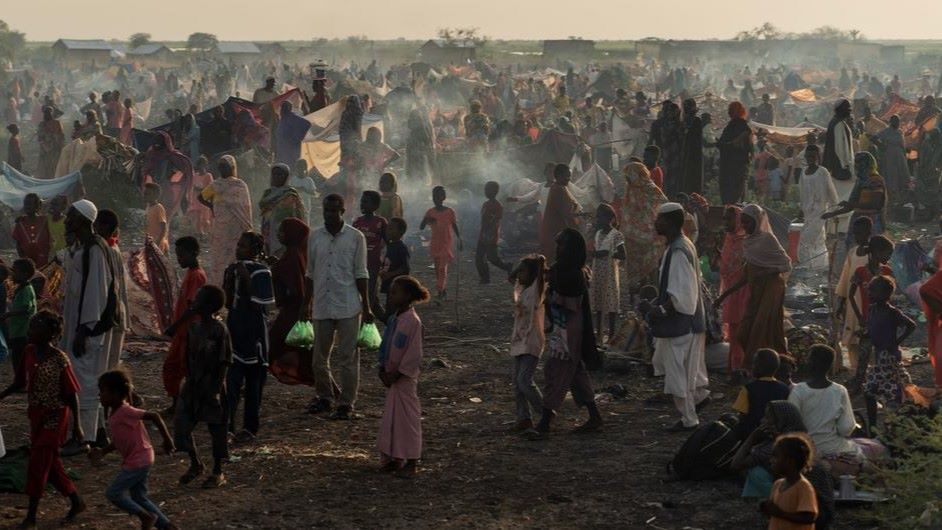
Rawia Kamal, a health activist displaced after the paramilitary attacked her home, recounts the travails of being in war-torn Sudan with looming threat of diseases
As the war in Sudan, which has killed thousands, continues into its eighth month with no ceasefire in sight, cholera stalks millions in Africa’s third-largest country whose already fragile healthcare system has all but collapsed due to attacks and shortages.
The most vulnerable to this deadly water-borne disease is the displaced population which is “surviving in overcrowded camps, schools, dormitories and mosques,” said Rawia Kamal, an activist of People’s Health Movement (PHM) and a medical lab technician by profession.
With little or no drinking water supply in these shelters, people have to buy water carried for distribution in unsafe conditions on donkey carts. Those unable to access or afford it are forced to drink from irrigation wells or rivers, whose waters have been contaminated by defecation and washing in its streams in the absence of sufficient toilets and bathrooms for the displaced, she explained.
Kamal is one of the six million people who have been displaced so far by this war which started when the Sudanese Armed Forces (SAF) and the Rapid Support Forces (RSF), formerly ruling partners in the military junta, began fighting each other on April 15.
1.2 million of the displaced have fled to neighboring countries. The remaining 4.8 million remain displaced within the national borders, adding to the 3.7 million Internally Displaced People (IDPs) already uprooted from their homes in the previous conflicts before this war. This makes Sudan “the country with the largest number of displaced people,” according to the UN Office for the Coordination of Humanitarian Affairs (OCHA).
Amid what the UN Security Council also described on Thursday as “the world’s largest displacement crisis,” the WHO has reported at least 2,525 suspected cases of Cholera/Acute Watery Diarrhea (AWD) in five States as of November 9, with a fatality rate of over 3%. The OCHA warned last week that the disease is likely to spread to eight of Sudan’s 18 States by December, putting “more than 3.1 million people” at risk of infection.
The outbreak of the disease was first reported in the state of El Gedaref, “where Cholera cases are not new,” Kamal said. “Only 10% of Gedaref’s population has access to sanitation facilities, while only 28 percent of the state population have access to safe drinking water,” according to the UN Children’s Fund’s (UNICEF’s) 2022 report on the situation in the state before the war.
Under the circumstances, “dengue, malaria, black fever, and other diseases have been endemic in its humid climate. Cholera cases are reported every year when the rainfall peaks between June and September,” Kamal said. However, the Health Ministry used to roll out an emergency plan during these months to contain its spread, which was mostly limited to the refugees living in settlements.
As of 2020, the refugee population consisted of about 26,400 Ethiopians and Somalians who had fled the conflicts in their countries into this border state of Sudan. It has nearly tripled since, with almost 51,000 more refugees from Ethiopia after the Tigray People’s Liberation Front (TPLF) started a war with the national army in the northern part of the country in November of that year.
With an additional influx of about 270,500 IDPs from the Khartoum state into Gedaref since the war broke out between SAF and the RSF on April 15, the health ministry has failed to contain the disease.
Of the 2,525 suspected cases reported as of November 9, including 78 associated deaths, about half of them – 1,243 suspected cases and 36 deaths – are from Gedaref, where the outbreak was declared on September 26.
It has since spread to all the four neighboring states and has also been reported beyond in a fifth state, South Kordofan, on the border with South Sudan, which split from Sudan in 2011 after 22 years long civil war. Nearly 900,000 IDPs, returnees, vulnerable residents and refugees were in need of humanitarian assistance in this state as of 2022, well before the current war broke out.
Gederef’s western neighbor Gezira, which is hosting the highest number of IDPs of the current war — over 404,000, amounting to more than 8% of the 4.8 million — has reported over 500 suspected cases. More than 400 other suspected cases, including 24 associated deaths, have been reported from Khartoum state.
While the WHO and UNICEF are providing States with high concentrations of IDPs with safe water tanks and mobile toilets, Khartoum remains inaccessible, in the throes of heavy fighting, Kamal said. It is from the three cities of this state — the national capital Khartoum, and its sister cities, Khartoum Bahri (North) and Omdurman — that more than 68% of this war’s IDPs, including Kamal, have fled.
“I cannot survive in Sudan any more”
“I was living within walking distance from Khartoum’s Sports City where the first shots of the war were fired on the morning of April 15. Our neighborhood was under the control of the RSF from the first hours of the war,” Kamal recalled.
The notorious paramilitary was formed in 2013 by coalescing the militias created by the SAF during the civil war in the 2000s in the region of Darfur where alleged genocide, war crimes and crimes against humanity were committed.
People’s Dispatch for more