
by DURRIE BOUSCAREN
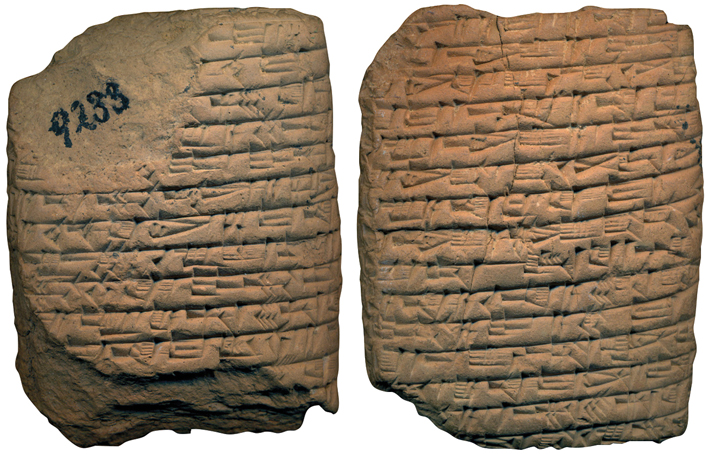
The parents of an Assyrian woman named Zizizi were furious. Like many of their neighbors’ children, their daughter had dutifully wed an Assyrian merchant. Sometime around the year 1860 B.C., she had traveled with him to the faraway Anatolian city of Kanesh in modern-day Turkey, where he traded textiles. But her husband passed away and, instead of returning to her family, Zizizi chose to marry a local. “Before god, you do not treat me, your father, like a gentleman! You have left the family!” wrote her father, Imdi-ilum, using a reed stylus to press neat wedge-shaped, or cuneiform, characters into a small clay tablet. Zizizi’s mother, Ishtar-bashti, also signed the missive. Her parents did not explicitly state disapproval over Zizizi’s choice of husband—in fact, as they reminded her, they had financially supported her second marriage. But they resented the fact that after her marriage, she hadn’t done more to help their family business of exporting textiles to Anatolia.“ We are not important in your eyes,” they seethed.
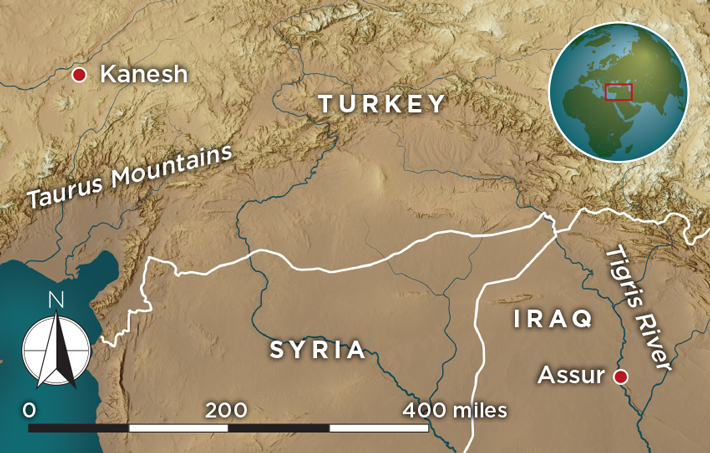
The tablet would have dried in the sun near the parents’ home in the Assyrian city of Assur, on the banks of the Tigris River in modern Iraq, before being wrapped in a thin cloth and placed in a clay envelope. As was done with much Assyrian correspondence, one or both of Zizizi’s parents would have taken a stone cylinder that hung from a cord around their neck and rolled it across the envelope’s surface, creating a ribbonlike impression or seal. Her mother’s seal depicts tall deerlike figures with long horns standing upright, each one leaning on a staff. This seal was unique to Ishtar-bashti and functioned like an ID, signaling to Zizizi that the letter was indeed from her mother. Next, the tablet was packed on a donkey caravan and transported for six weeks across 750 miles of A tablet bearing an irate letter from the Assyrian merchant Imdi-ilum and his wife, Ishtar-bashti, was found in the archive of their daughter Zizizi, who lived in Kanesh. Syrian steppe, southeastern Turkey’s Taurus Mountains, and, finally, the Anatolian plains to Kanesh, where Zizizi had launched a career as a successful moneylender. There, Zizizi, who had settled into her new life but perhaps still missed her parents, filed away the tablet in a private archive in her home.
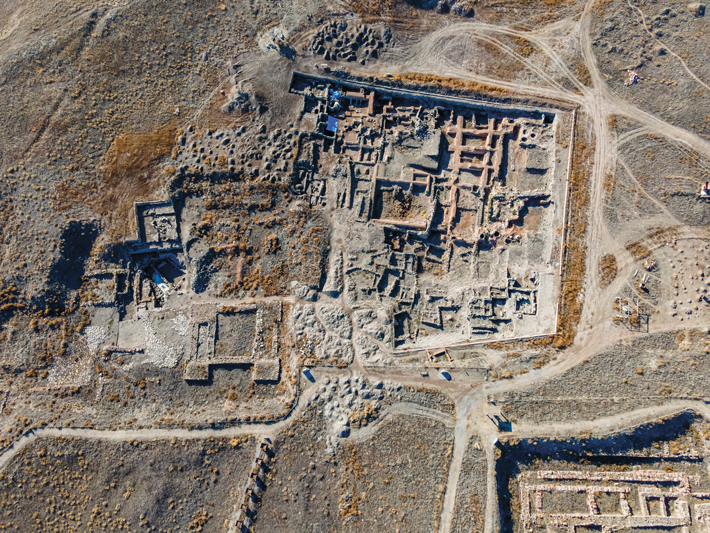
Nearly 4,000 years later, archaeologists discovered the angry missive during excavations at the site of the ancient city in central Turkey, now known as Kültepe, a low, grassy plain crowned by a tall mound. More than 23,000 cuneiform tablets have been uncovered at the site. Of these, epigrapher and Assyriologist Cécile Michel of the French National Center for Scientific Research has curated and interpreted more than 300 that bear letters written by or to women who belonged to a highly literate Assyrian merchant class. “With private correspondence, we go deeper and get closer to the people,” says Michel. “It’s a contrast to official language, where there’s a big distance between what people write and what people think.”
The texts uncovered at Kültepe form the earliest significant corpus of correspondence in the world, but fewer than half of them have been translated and published. Most of the tablets were preserved by chance. Around 1835 B.C., a fire destroyed Kanesh, baking and hardening many of the clay tablets stored in the archives of private homes. While it’s possible the blaze was accidental, most researchers believe it may have been an act of war. “Kanesh was destroyed in exactly the right way,” says Gojko Barjamovic, a Harvard University Assyriologist who has focused much of his career on the tablets unearthed at Kanesh. “People got out— there are no dead people in the houses, there are no skeletons in the fire—they must have been warned. But they couldn’t take their archives with them.” These private archives contain not just personal letters from Assyrian merchants’ families, such as the one from Zizizi’s parents, but also records of financial transactions, debts, and contracts. Many tablets were unearthed during clandestine digs in the late nineteenth and early twentieth centuries and then dispersed to museums all over the world. A team working at the site today, led by Ankara University archaeologist Fikri Kulako?lu, continues to discover more.
Archaeology for more