
by DIAA HADID & ABDUL SATTAR
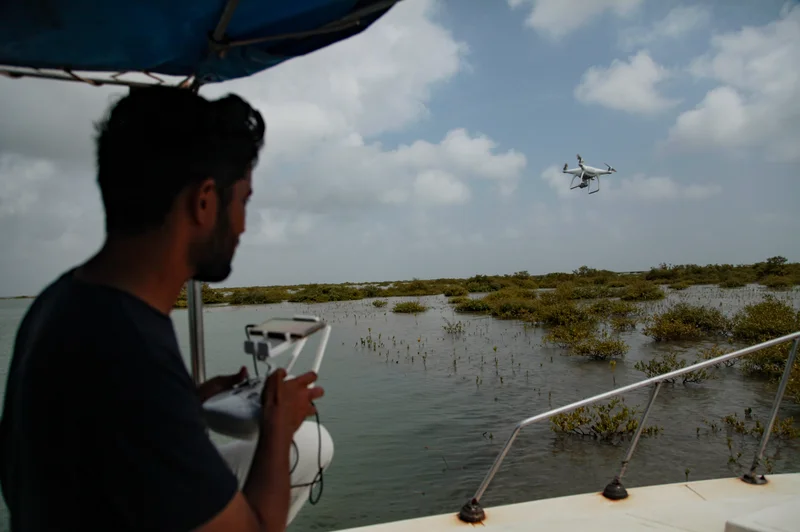
Wildlife ranger Mohammad Jamali boats through mangrove forests of the Indus River Delta, the terminus of a curly waterway that begins thousands of miles upstream in the Himalayas. Birds flutter in and out. Insects dart around mangrove roots that poke like fingers out of the mud. It looks ancient, but this part of the forest is only 5 years old.
“We planted this,” says Jamali, 28-years-old. We — rangers of the wildlife department of the government of the southern Pakistani province of Sindh, and locals of nearby fishing communities.
This forest in southern Pakistan is part of one of the world’s largest mangrove restoration projects, covering much of the vast delta, an area nearly the size of Rhode Island. These trees, which exist in slivers between sea and land, are powerhouses of sucking up the carbon dioxide that is dangerously heating up the planet.
“They do this very big job per hectare,” says Catherine Lovelock, an expert on coastal ecology. Mangroves capture, or sequester, carbon dioxide “through their roots and into the soil, as well as above ground,” she says.
This mangrove reforestation effort alone in the Indus Delta is expected to absorb an estimated 142 million tons of carbon dioxide over the next sixty years. It’s a test case for restoration, and planting mangroves at this scale might help the fight to curb planetary warming.
Speaking over gusty winds, Jamali, the wildlife ranger, says reforestation began here two decades ago after a cyclone swept through and killed dozens of people. The area was hit hard, because the mangrove forests that once fringed this area had died away over the decades after successive Pakistani governments built dams upstream that deprived the delta of fresh water. The mangroves were a buffer between the sea and local communities, muting the impact of storm surges during cyclones and heavy storms.
According to Afia Salam, an environmental campaigner, it was a former Sindh wildlife ranger, Tahir Qureshi, who pioneered planting mangrove species that don’t need so much fresh water, because there’s so little of it now in the Indus River Delta.
Qureshi died in 2020 after a lifetime of advocacy for mangroves, and on behalf of the impoverished fishing communities that rely on them to attract aquatic life. Salam recalls fisherfolk called him “baba,” or father, “because they respected what he was doing,” she says, “how he was benefiting the communities.”
Qureshi oversaw the forestation of some 30,000 hectares of mangrove forest over the decades. But planting efforts were supercharged after a Pakistani company, Delta Blue Carbon, partnered with the provincial government to restore more than a hundred thousand hectares of degraded forests, and to plant an area more than double that with new mangroves.
Building out a mangrove forest, sapling by sapling
Jamali, the wildlife ranger, jumps out of the boat to show how they are expanding mangrove forests. From a mangrove tree, he snaps off a thing that looks like a spear. It’s a propagule, basically, an already germinated seed that drops from the mother tree and lodges into the muddy, wet soil below.
NPR for more
(Thanks to reader)