
by LAURA GEGGLE
For decades, we thought the first humans to arrive in the Americas came across the Bering Land Bridge 13,000 years ago. New evidence is changing that picture.
During the last ice age, humans ventured into two vast and completely unknown continents: North and South America. For nearly a century, researchers thought they knew how this wild journey occurred: The first people to cross the Bering Land Bridge, a massive swath of land that connected Asia with North America when sea levels were lower, were the Clovis, who made the journey shortly before 13,000 years ago.
According to the Clovis First theory, every Indigenous person in the Americas could be traced to this single, inland migration, said Loren Davis, a professor of anthropology at Oregon State University.
But in recent decades, several discoveries have revealed that humans first reached the so-called New World thousands of years before we initially thought and probably didn’t get there by an inland route.
So who were the first Americans, and how and when did they arrive?
Genetic studies suggest that the first people to arrive in the Americas descend from an ancestral group of Ancient North Siberians and East Asians that mingled around 20,000 to 23,000 years ago. They crossed the Bering Land Bridge sometime between then and 15,500 years ago, said David Meltzer, an archaeologist and professor of prehistory in the Department of Anthropology at Southern Methodist University in Dallas and author of the book “First Peoples in a New World, 2nd Edition” (Cambridge University Press, 2021).
But some archaeological sites hint that people may have reached the Americas far earlier than that.
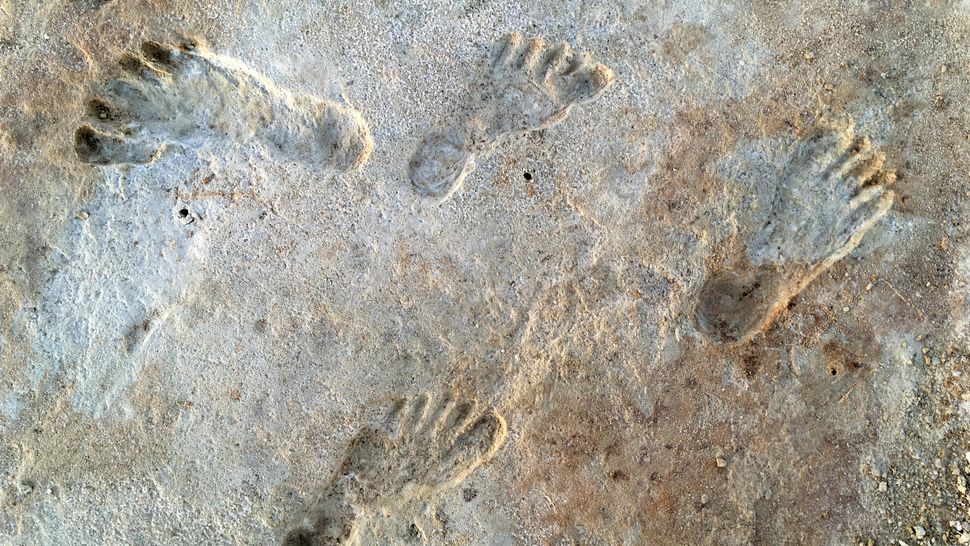
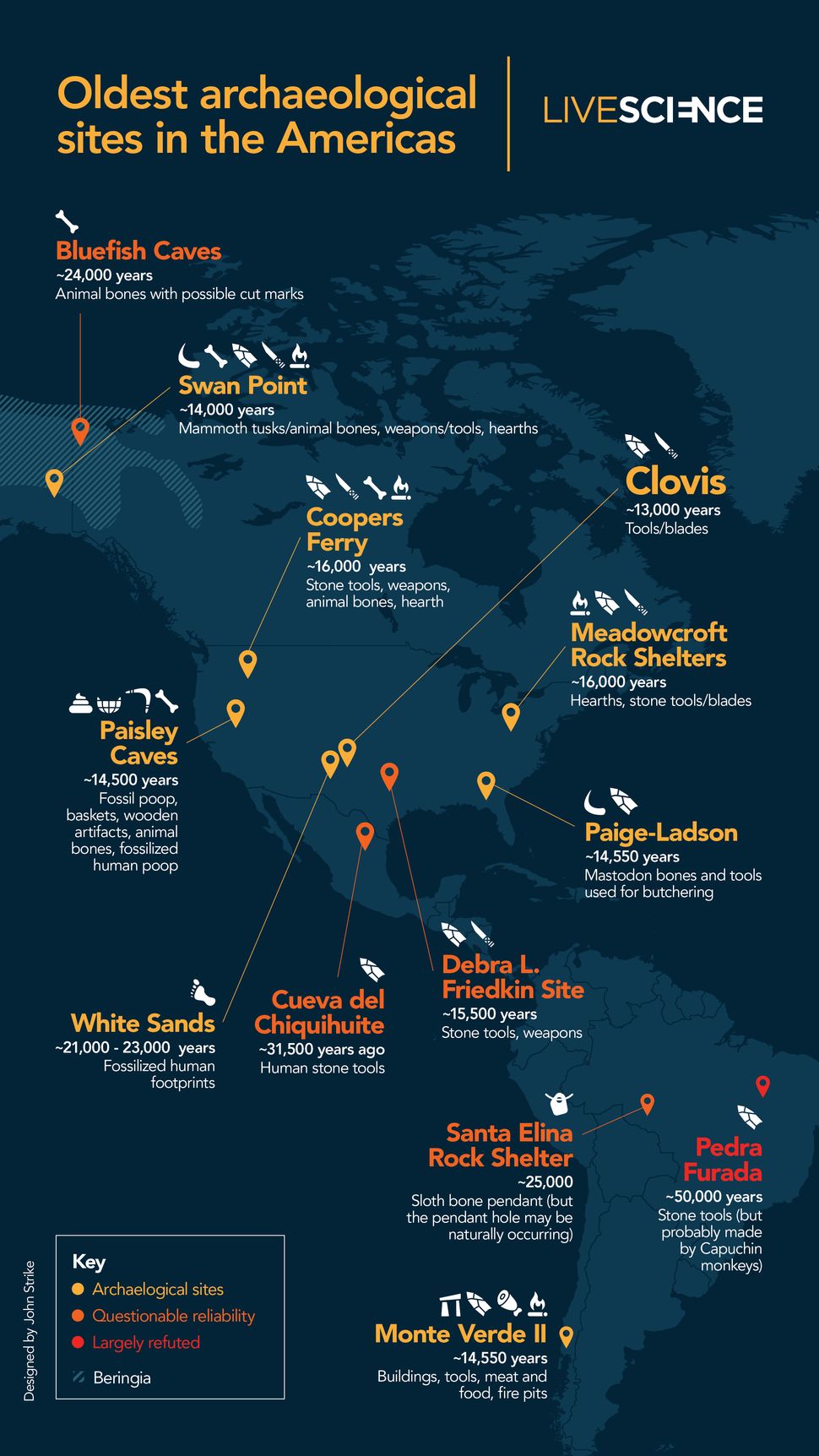
For instance, there are fossilized human footprints in White Sands National Park in New Mexico that may date to 21,000 to 23,000 years ago. That would mean humans arrived in North America during the Last Glacial Maximum (LGM), which occurred between about 26,500 to 19,000 years ago, when ice sheets covered much of what is now Alaska, Canada and the northern U.S.
Other, more equivocal data suggest the first people arrived in the Western Hemisphere by 25,000 or even 31,500, years ago. If these dates can be confirmed, they would paint a much more complex picture of how and when humans reached the Americas.
Almost all scientists agree, however, that this incredible journey was made possible by the emergence of Beringia — a now-submerged, 1,100-mile-wide (1,800 kilometers) landmass that connected what is now Alaska and the Russian Far East. During the last ice age, much of Earth’s water was frozen in ice sheets, causing ocean levels to fall. Beringia surfaced once waters in the North Pacific dropped roughly 164 feet (50 meters) below today’s levels; it was passable by foot between 30,000 and 12,000 years ago, Meltzer and Eske Willerslev, a geneticist at the University of Cambridge, wrote in a 2021 review in the journal .
From there, the archaeological picture gets muddier. The older version of the story originated in the 1920s and 1930s, when Western archaeologists discovered sharp-edged, leaf-shaped stone spear points near Clovis, New Mexico. The people who made them, now dubbed the Clovis people, lived in North America between 13,000 and 12,700 years ago, based on a 2020 analysis of bone, charcoal and plant remains found at Clovis sites.
At the time, it was thought that the Clovis traveled across Beringia and then moved through an ice-free corridor, or “a gap between the continental ice sheets,” in what is now part of Alaska and Canada, Davis, who leads excavations at an ancient North American site in Cooper’s Ferry, Idaho, told Live Science.
“Once they exited, they spread quickly throughout the Americas, bearing a signature stone tool known as the Clovis spear point,” which was likely used to hunt megafauna, such as mammoths and bison, as well as smaller game. For decades, it was challenging to suggest the first Americans arrived any earlier than 13,000 years ago.
Slowly, however, new discoveries began turning back the clock on the first Americans’ arrival. In 1976, researchers learned about the site of Monte Verde II in southern Chile, which radiocarbon dating showed was about 14,550 years old. It took decades for archaeologists to accept the dating of Monte Verde, but soon, other sites also pushed back the date of humans’ arrival in the Americas.
Live Science for more