
by IVAN ROMAN
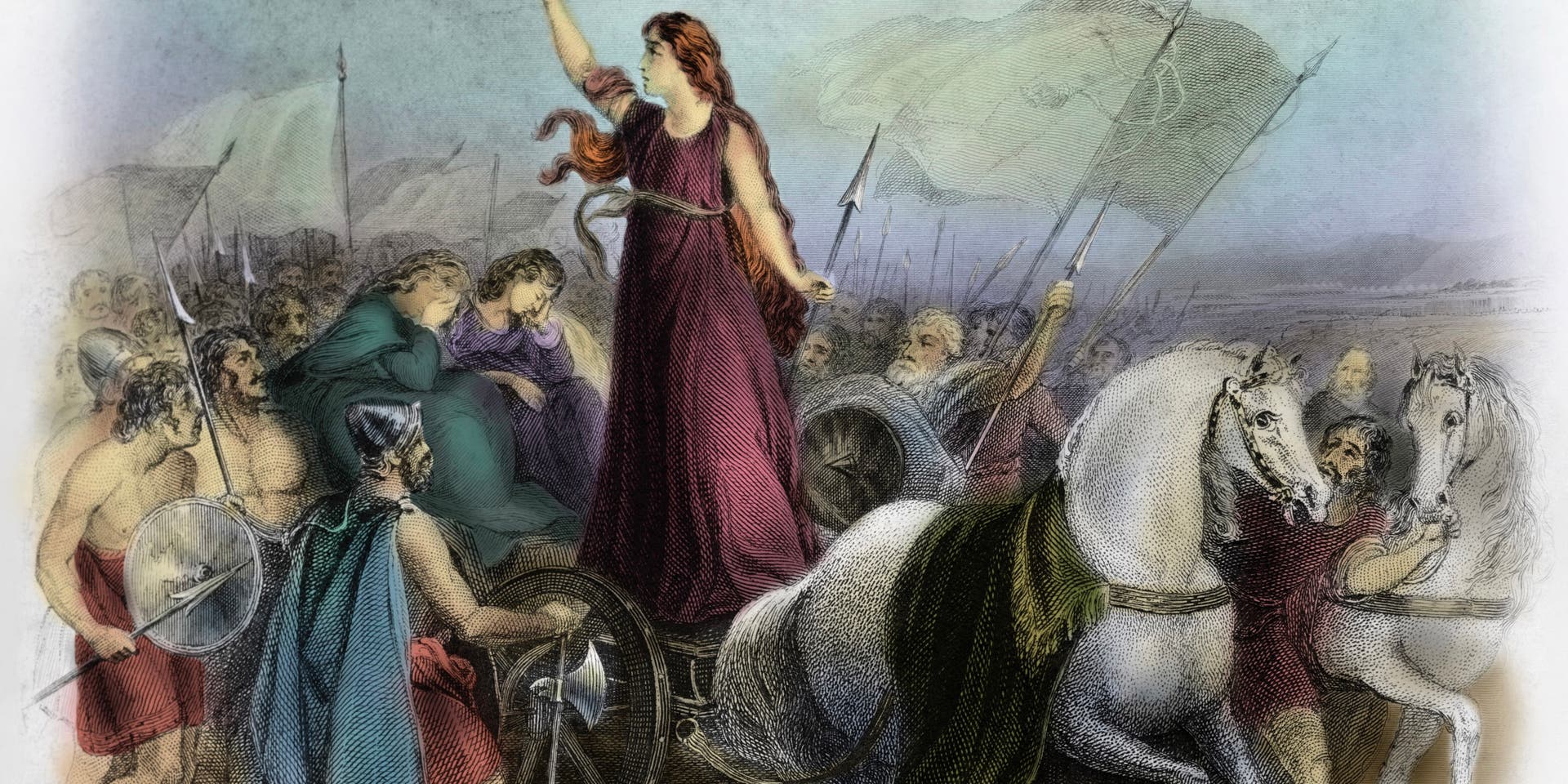
Cleopatra. Boudica. Queen Seondouk. Female rulers in antiquity were few and far between, but left powerful legacies.
Very few women ever rose to power in the kingdoms and empires of the ancient world. The handful who did, in the Near East, Asia and Europe, fought their way through significant barriers, in often violent times.
These women first accessed their power through men—fathers, husbands, brothers and sons. But they stayed in power, sometimes for decades, through a mix of ambition, intelligence, political savvy, generosity, guile and, in some cases, a ruthless and bloody drive for power.
“In every single case, it’s crisis that brings them to the throne. It’s a lack of men, they are there as placeholders or stopgaps, and they usually have a bad end,” says Egyptologist and archaeologist Kara Cooney, who teaches about female rulers in antiquity at the University of California, Los Angeles.
When their reigns ended, they sometimes died violently. Their lives and achievements were often scrubbed from collective memory by subsequent male rulers eager to take credit and reinforce prevailing patriarchal norms.
“In each case, the woman is swept aside. In each, case the woman has no genetic legacy. And in each case, her ambition is judged as self-serving and dangerous,” says Cooney, author of The Woman Who Would Be King: Hatshepsut’s Rise to Power in Ancient Egypt. And for millennia thereafter, their stories were chronicled largely by male historians. Those narratives, sometimes framed around the women’s violent or promiscuous ways (think Egypt’s Cleopatra or Phoenician royal Jezebel), became “cautionary tales” that “have invaded our cultural psyche,” says Cooney, preventing many from seeing a more complete picture of their real lives and accomplishments.
Here are five ancient female rulers who overcame obstacles to help shape the history of their times.
HATSHEPSUT | Ancient Egypt
Queen Hatshepsut, who assumed the role of pharaoh in Egypt’s 18th Dynasty, ruled during 22 years of great prosperity, peace and an explosion of artistic creativity that would forever influence Egyptian culture.
The eldest daughter of a pharaoh, Hatshepsut married her half-brother Thutmose II around the age of 12 and later became queen regent to her stepson and nephew Thutmose III, who inherited the throne at the age of two. Seven years into her regency, in 1478 BCE, she broke with tradition and had herself crowned pharaoh, co-ruler with the child king.
To be accepted by Egypt’s patriarchal society, where monarchs had long been male, Hatshepsut fashioned a masculine image. She wore traditional royal kilts and false beards. She had herself depicted with large muscles, making royal offerings to the gods or bashing in foreign captives’ heads.
The longest-reigning female ruler in ancient Egypt, Hatshetsup fueled a booming economy, re-established lost trade networks and built hundreds of construction projects in Upper and Lower Egypt. She performed holy rituals usually reserved for male kings in many temples, securing her religious base and legitimacy on the throne.
When she died, her co-ruler Pharaoh Thutmose III erased Hatshepsut’s name from public records, destroyed her statues and carved out her image from public monuments. He backdated his reign to his father’s death, taking credit for his stepmother’s accomplishments.
WU ZETIAN | China
Empress Wu Zetian, the first and only female empress of China, served as de facto ruler of the Tang Dynasty for 40 years from 665 to 705—25 years through her husband and sons and then for 15 years when, in an unprecedented move, she founded the Wu Zhou Dynasty and became empress in her own right. Revered for leading with a strong hand, she shaped a more efficient and less corrupt government, revitalized China’s economy and culture and bucked the aristocracy to advance the peasant class. She expanded China by conquering new territory in Korea and Central Asia, making it one of the world’s most powerful empires.
She first came to the imperial court as a concubine to Emperor Taizong, and when he died, married his ninth son and successor, Emperor Gaozong. Well-educated, charismatic and ambitious, she was more decisive and proactive than her husband and was considered the real power behind the throne.
She gained that power, in part, through ruthlessness, deceit, lots of palace intrigue, accusations of witchcraft—and lots of spilled blood. She created a spy network to help her kill real, potential or perceived rivals. She demoted or exiled enemies and their children. She targeted members of her own family and massacred 12 collateral branches of the imperial family when some tried to remove her from power.
When her sons became emperors, she still held true power as empress regent and blocked them from governmental and political affairs. In 690, then in her 60s, she forced her youngest son, Emperor Ruizong, to abdicate, made herself the sole ruler and founded the Second Zhou Dynasty that would last 15 years.
She promoted arts and literature, initiated campaigns to raise the position of women and support women’s rights and spread and consolidated Buddhism over Taoism. In February 705, a coup removed Wu Zetian from power. She died later that year.
BOUDICA | Ancient Britain
History for more