
by SAKHI THIRANI
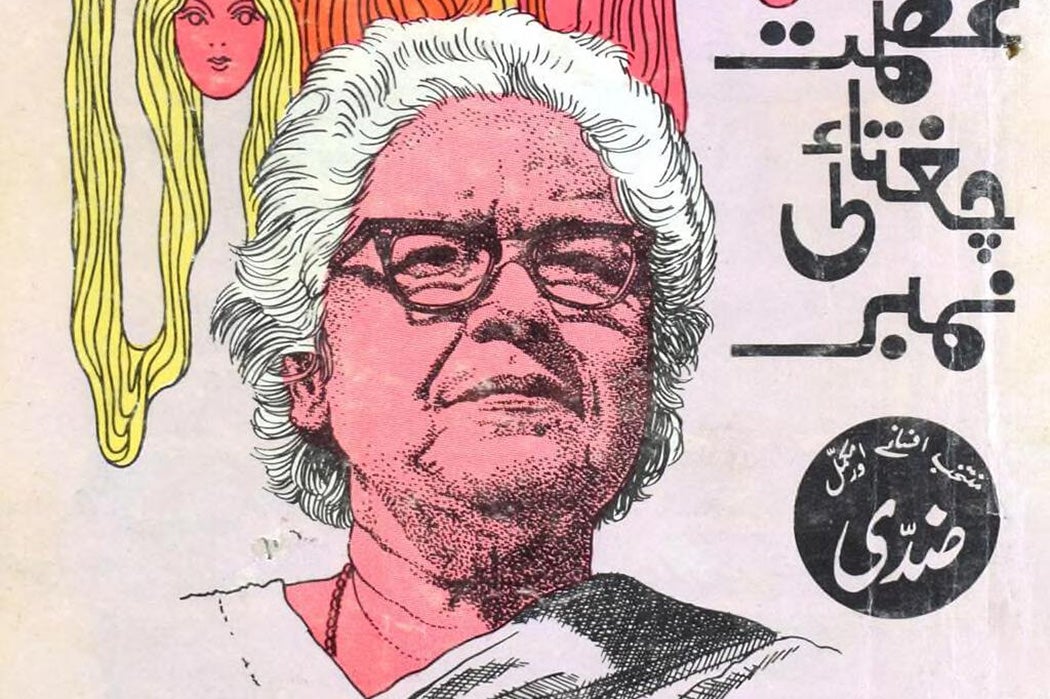
Long before India decriminalized homosexuality—in September 2018—the short story “Lihaaf” sparked outrage and a lawsuit for its depiction of same-sex, intergenerational intimacy.
In the West, the closet remains the go-to metaphor for a place where a person hides to avoid disclosing their queer identity. This image cannot be universalized; spatial and sexual politics are not uniform. Take the case of India, where the identification and visibility that accompany “coming out” were completely implausible prior to September 6, 2018; until then homosexuality was illegal under the draconian Section 377 of the Indian Penal Code. Amidst the tumult of exclusion, an alternative material sphere—the quilt—was conceived. It concealed non-normative sexualities without curtailing them. Indeed, the writer Ismat Chughtai carefully wove one during the colonial 1940s with “Lihaaf” (“The Quilt”), an audacious real-life inspired Urdu short story that challenged heteronormativity, and in the process caused great controversy.
Thanks to her gritty and mischievous tales, Ismat Chughtai (1911-91) remains an unparalleled figure in South Asian literature. Writing in an utterly unstable and complex cultural milieu wherein the colonial subcontinent transitioned to independent nation-states through brutal partitions, Chughtai, in her own distinctive style, captured the intricacies of gender and sexuality. Against the orthodoxies that trapped Indian women into honor codes of respectability, she drew from her own personal experiences and embroidered into her texts deviant female voices that otherwise remained muted in dominant discourse.
Published in 1942, Chughtai’s love story is set within the nooks and corners of an aristocratic household in colonial India. An intimate tale, it centers around Begum Jan, the wife of a wealthy pederastic Nawab (prince), and her queer relationship with a female maidservant, Rabbu. Begum Jan’s unnamed niece is the adult narrator who chronicles the relationship through her childhood gaze, adopted from Chughtai’s very own. Having been sent to her aunt’s house for a brief stay, the young niece shares Begum Jan’s room; the hope is that the girl will learn appropriate feminine comportment from her aunt. Yet once there, she is witness to the unexpected: the exchange of sensuous massages between her aunt and Rabbu throughout the day and, at night, under a quilt’s cover. The eroticism sparks the girl’s curiosity even while she does not understand it. Sounds that escape from under the quilt often wake her at night and she comes to associate these deviant happenings with an elephant-shaped spectral figure. On one particular night, the girl inspects the goings-on and catches an interstitial glimpse underneath the quilt. She never spells out for the reader what she sees, leaving us only with astonishment at her discovery.
In the midst of the tale, the narrator herself experiences fright and fascination in her own first encounter with desire. When Rabbu is away, the Begum makes a sexual advance on the girl. While the child is overwhelmed, Chughtai’s retrospective prose makes the narrator’s own attraction toward the Begum discernable. The ambivalence that colors this encounter and their relationship endures; the peculiar phantom of the elephant reappears every time the narrator wraps herself in a quilt thereafter—even into adulthod.
Embroidering these elephantine shapes, Chughtai creates a liminal realm where the past and present, the real and spectral blur. Beyond hegemonic categorizations, it is here that non-normative desire can safely emerge. Chughtai plays with “the elephant in the room” idiom deliberately. Her narratorial persona doesn’t address what the aberrant elephant stands for, tactfully shielding the real-life inspirations for her characters from criminalization. Yet the elephant’s savage presence cannot be denied. Chughtai strategically intertwines discretion with directness, and keeps desire visceral, if invisible, throughout her story.
Chughtai’s choice of quilt as metaphor for queerness differs from the sanitization of a closet. The latter implies too rigid a terminology for the complex and plural interpersonal configurations of class, gender, and generation that are interwoven in Chughtai’s South Asian queer space. Economic and class differences between Rabbu and Begum Jan result in a sharp difference in mobility. A subaltern Rabbu can leave home; by contrast, the Nawab prohibits Begum Jan “to go out anywhere.” Gender politics within the text further show how even within this house that is her “prison,” Begum Jan is further segregated to the zenana (the female space of a house). To use the phrase “coming out,” in terms of sexuality, when she literally cannot even step outside her home would be almost ironic.
Beyond the tale of “Lihaaf,” Chughtai wrote in her autobiography, Kaghazi Hai Pairahan, about meeting the Begum on whom she based her short story again as an adult. Here she states that after divorcing the Nawab and marrying a second time, the Begum had a son. Begum Jan managed to get rid of the Nawab, but she needed to be married to a man to maintain her social status. The institution of heterosexual marriage thus couldn’t be rejected completely in Chughtai’s milieu. Encounters such as those between Begum Jan and Rabbu had to remain inconspicuous and ambiguous. Chughtai’s quilt could facilitate that—obscuring intimacy, thwarting its reification.
What is also compelling is Chughtai’s reaction to seeing Begum’s child in person. “I felt he was mine as well. A part of my mind, a living product of my brain. An offspring of my pen,” she wrote. Chughtai’s cross-generational dynamic with Begum Jan forms a dense palimpsest wherein any singular interpretation on the nature of their relationship falls short. While some readers might interpret the Begum’s advances toward Chugtai as exploitation or abuse, the writer’s anecdote offers an alternative reading that invokes literary procreation. Not only as the author and the narrator, but as the retrospective witness as well, Chughtai shares a proximity with the non-normative desire satisfied in and with Begum Jan’s body. Through a blend of remembering and writing, her childhood lens enables her to be both voyeuristic, relishing acts of queer intimacy, and introspective, noting the horror of this transgression.
Unsurprisingly, “Lihaaf” caused a scandalous uproar in the subcontinent. It was charged with obscenity under Section 292 and was dragged into court in 1944. In Kaghazi Hai Pairahan Chughtai quotes a witness who attempted to prove her story illicit: “It’s objectionable for [good] girls to collect lovers [and] it is reprehensible for an educated lady from a decent family to write about them.” The Puritanism that permeated British culture dictated mores in its colonial outposts. The Empire’s modus operandi was colonial control through censorship, particularly after the 1857 revolt against the British East India Company.
Chughtai faced disdain on a local level as well—she received hate letters and threats of divorce from her husband, while relatives and acquaintances pestered her to apologize. Budding patriarchal nationalism in India dictated that the ideal middle-class woman should be restricted, writes Partha Chatterjee, to “the spiritual qualities of self-sacrifice, benevolence, devotion, religiosity, and so on.” In doing so, it became complicit with the purity-obsessed misogyny of British masters.
JSTOR Daily or more