
by MARC BECKER
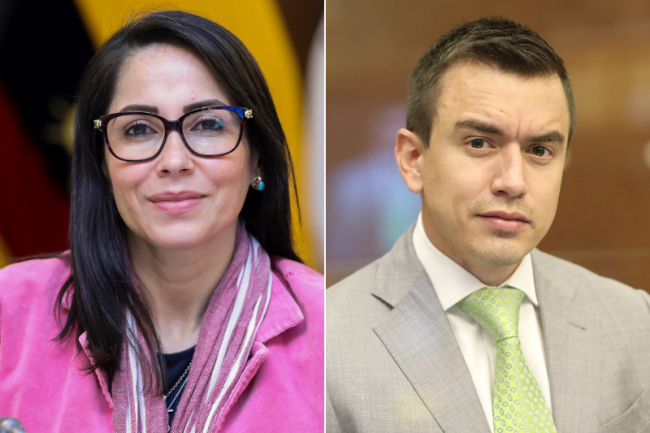
Ecuadorian voters will now choose between two very distinct paths forward: a revival of social programs or more neoliberal economic policy.
Ecuador is headed to a runoff election between two candidates who promise very different visions for the future of the country.
Of the eight candidates competing in the August 20 election, Luisa González of former leftist president Rafael Correa’s Revolución Ciudadana (Citizen’s Revolution) party came out on top. But she will have to face off against right-wing business owner Daniel Noboa in a second round on October 15.
González received 33 percent of the vote—about where pre-election polls had placed her. Noboa, however, won a surprising 24 percent, significantly outperforming expectations that he would not make it to the second round. To have won outright, González would either have needed to reach 50 percent of the vote, or 40 percent with a 10-point lead over the closest competitor.
Like Correa, González is a progressive Keynesian on economic issues, but conservative on social ones. In particular, she is strongly opposed to abortion rights. If elected, González promises to use $2.5 billion from international reserves to shore up the struggling economy and bring back Correa’s social programs that led to plunging rates of poverty and inequality.
Noboa is the son of the conservative and wealthy banana tycoon Álvaro Noboa, who in past decades launched five failed campaigns for the presidency. If elected, Noboa would represent a continuation and perhaps intensification of current conservative president Guillermo Lasso’s neoliberal economic policies—the same ones that Lasso failed to implement in his two years in office and that ultimately led to his ouster.
Noboa’s running mate Verónica Abad is a conservative anti-abortion activist from Cuenca who is a strong supporter of Trump and Bolsonaro. She has appeared on social media wearing a Trump “Make American Great Again” (MAGA) hat
While Correa and his Revolución Ciudadana—and thus by extension González—enjoy the highest levels of popular support in the country, their negatives also make it the hardest for her to win the presidency.
On the campaign trail in 2006 and then in office for 10 years as president, Correa famously tangled badly with Ecuador’s powerful social movements and others to his left. In the 2021 elections, Lasso leveraged this opposition to go from less than 20 percent of the vote in the first round to defeating Revolución Ciudadana’s candidate Andrés Arauz in the second.
Arauz is now running for vice president with González on the Revolución Ciudadana ticket.
The biggest losers in the August 20 race were the Indigenous environmentalist Yaku Pérez and the Indigenous-aligned Pachakutik political movement. Unlike in the 2021 presidential race, this time Pérez did not enjoy the formal backing of Pachakutik or its social movement wing CONAIE.
Pérez scored strong support in the 2021 race—barely missing a second-place finish that would have placed him in the second and definitive round against Arauz. This time, pre-election polling had given him a very viable chance of making the second round, but he ultimately polled less than 4 percent of the vote.
Likewise, Pachakutik surpassed expectations in February’s local elections and became the second or third most potent political force in the country. This time it hardly registered in the congressional races, in which Revolución Ciudadana led voter preferences.
The election comes after the deeply unpopular Lasso dissolved the National Assembly on May 17, triggering early presidential and congressional elections.
Facing certain impeachment over his mishandling of the country’s affairs, Lasso invoked an innovative provision in the 2008 Constitution known as “muerte cruzada” or “mutually assured death” that allows the president to dissolve parliament and rule by decree for six months until new presidential and legislative elections are held.
The winner of the October 15 contest will take office on October 26 and serve the remaining 17 months of Lasso’s mandate. The next regularly scheduled elections in 2025 will select a new president.
The Assassination of Fernando Villavicencio
The presidential race was shaken up on the evening of August 9, only 10 days before Ecuadorians went to the polls, when the candidate Fernando Villavicencio was cut down in a hail of bullets as he exited a campaign event at the Colegio Anderson in the northern part of Quito.
Questions and conspiracies immediately spun around Villavicencio’s assassination, including why he did not have better security protection, who might have ordered the hit, and who would most benefit from his elimination from the race.
Video shows police officers kicking the alleged assassin and dragging him to a police station, rather than a hospital, where he died unattended from his wounds. Two other alleged assailants escaped on a motorcycle. The police quickly arrested six individuals—all Colombians—who they charged as responsible for the murder.
Some conservative pundits immediately pointed the finger at former president Correa, of whom Villavicencio was an ardent critic. But running in the middle of the eight-candidate pack, Villavicencio presented little threat to González, the race’s frontrunner. With conservative opposition to González fragmented between seven rival candidates, Villavicencio was unlikely to advance to the second round.
Instead, Villavicencio’s assassination triggered an outpouring of sympathy for his campaign and granted Christian Zurita, a journalist who stood in for him on the ballot, a level of support that he would not otherwise have enjoyed. Although not enough to push Zurita into the second round, the ticket came in third place with about 16 percent of the vote.
Meanwhile, congressional candidates with Villavicencio’s Movimiento Construye polled much better than expected, making the party the second strongest force (after Revolución Ciudadana) in the new National Assembly.
Villavicencio’s assassination also played into the law-and-order narrative of other conservative candidates that otherwise had trouble gaining traction in the campaign. In particular, it benefited Jan Topic, who presents himself as an Ecuadorian version of El Salvador’s authoritarian president Nayib Bukele. Topic, who had been languishing in the polls, exploited the assassination to increase his calls for hardline mano dura (iron fist) policies against drug smugglers. He came in fourth place with 15 percent—just barely behind Villavicencio/Zurita.
For decades, nestled between Colombia and Peru and their problems of civils wars and drug trafficking, Ecuador had been a relatively peaceful island. Although political assassinations—including of presidential candidates—were all too common in Colombia, they were exceedingly rare in Ecuador.