
by ALEXANDRA ISFAHANI-HAMMOND
Memes galore centered on the “orca revolution” have inundated the online realm. They gleefully depict orcas launching attacks on boats in the Strait of Gibraltar and off the Shetland coast.
One particularly ingenious image showcases an orca posed as a sickle crossed with a hammer. The cheeky caption reads, “Eat the rich,” a nod to the orcas’ penchant for sinking lavish yachts.
A surfboard-snatching sea otter in Santa Cruz, California has also claimed the media spotlight. Headlines dub her an “adorable outlaw” “at large.”
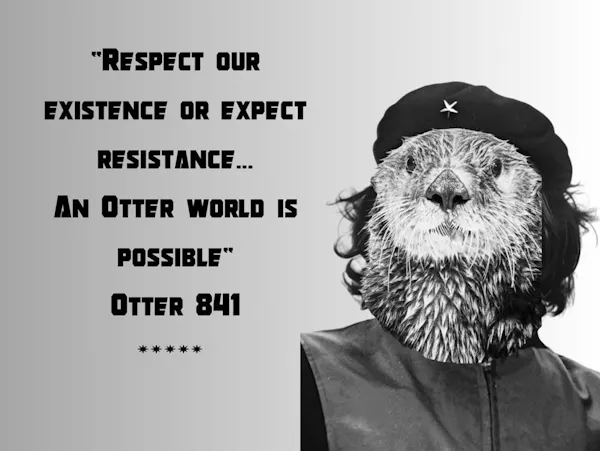
Memes conjure her in a beret like the one donned by socialist revolutionary Ché Guevara. In one caption, she proclaims, “Accept our existence or expect resistance … an otter world is possible.”
My scholarship centers on animal-human relations through the prism of social justice. As I see it, public glee about wrecked surfboards and yachts hints at a certain flavor of schadenfreude. At a time marked by drastic socioeconomic disparities, white supremacy and environmental degradation, casting these marine mammals as revolutionaries seems like a projection of desires for social justice and habitable ecosystems.
A glimpse into the work of some political scientists, philosophers and animal behavior researchers injects weightiness into this jocular public dialogue. The field of critical animal studies analyzes structures of oppression and power and considers pathways to dismantling them. These scholars’ insights challenge the prevailing view of nonhuman animals as passive victims. They also oppose the widespread assumption that nonhuman animals can’t be political actors.
So while meme lovers project emotions and perspectives onto these particular wild animals, scholars of critical animal studies suggest that nonhuman animals do in fact engage in resistance.
Nonhuman animal protest is everywhere
Are nonhuman animals in a constant state of defiance? I’d answer, undoubtedly, that the answer is yes.
The entire architecture of animal agriculture attests to animals’ unyielding resistance against confinement and death. Cages, corrals, pens and tanks would not exist were it not for animals’ tireless revolt.
Even when hung upside down on conveyor hangars, chickens furiously flap their wings and bite, scratch, peck and defecate on line workers at every stage of the process leading to their deaths.
Until the end, hooked tuna resist, gasping and writhing fiercely on ships’ decks. Hooks, nets and snares would not be necessary if fish allowed themselves to be passively harvested.
If they consented to repeated impregnation, female pigs and cows wouldn’t need to be tethered to “rape racks” to prevent them from struggling to get away.
If they didn’t mind having their infants permanently taken from their sides, dairy cows wouldn’t need to be blinded with hoods so they don’t bite and kick as the calves are removed; they wouldn’t bellow for weeks after each instance. I contend that failure to recognize their bellowing as protest reflects “anthropodenial” – what ethologist Frans de Waal calls the rejection of obvious continuities between human and nonhuman animal behavior, cognition and emotion.
The prevalent view of nonhuman animals remains that of René Descartes, the 17th-century philosopher who viewed animals’ actions as purely mechanical, like those of a machine. From this viewpoint, one might dismiss these nonhuman animals’ will to prevail as unintentional or merely instinctual. But political scientist Dinesh Wadiwel argues that “even if their defiance is futile, the will to prefer life over death is a primary act of resistance, perhaps the only act of dissent available to animals who are subject to extreme forms of control.”
Creaturely escape artists
Despite humans’ colossal efforts to repress them, nonhuman animals still manage to escape from slaughterhouses. They also break out of zoos, circuses, aquatic parks, stables and biomedical laboratories. Tilikum, a captive orca at Sea World, famously killed his trainer – an act at least one marine mammal behaviorist characterized as intentional.
Philosopher Fahim Amir suggests that depression among captive animals is likewise a form of emotional rebellion against unbearable conditions, a revolt of the nerves. Dolphins engage in self-harm like thrashing against the tank’s walls or cease to eat and retain their breath until death. Sows whose body-sized cages impede them from turning around to make contact with their piglets repeatedly ram themselves into the metal struts, sometimes succumbing to their injuries.
Critical animal studies scholars contend that all these actions arguably demonstrate nonhuman animals’ yearning for freedom and their aversion to inequity.
The Conversation for moreh