
by TONY WOODS
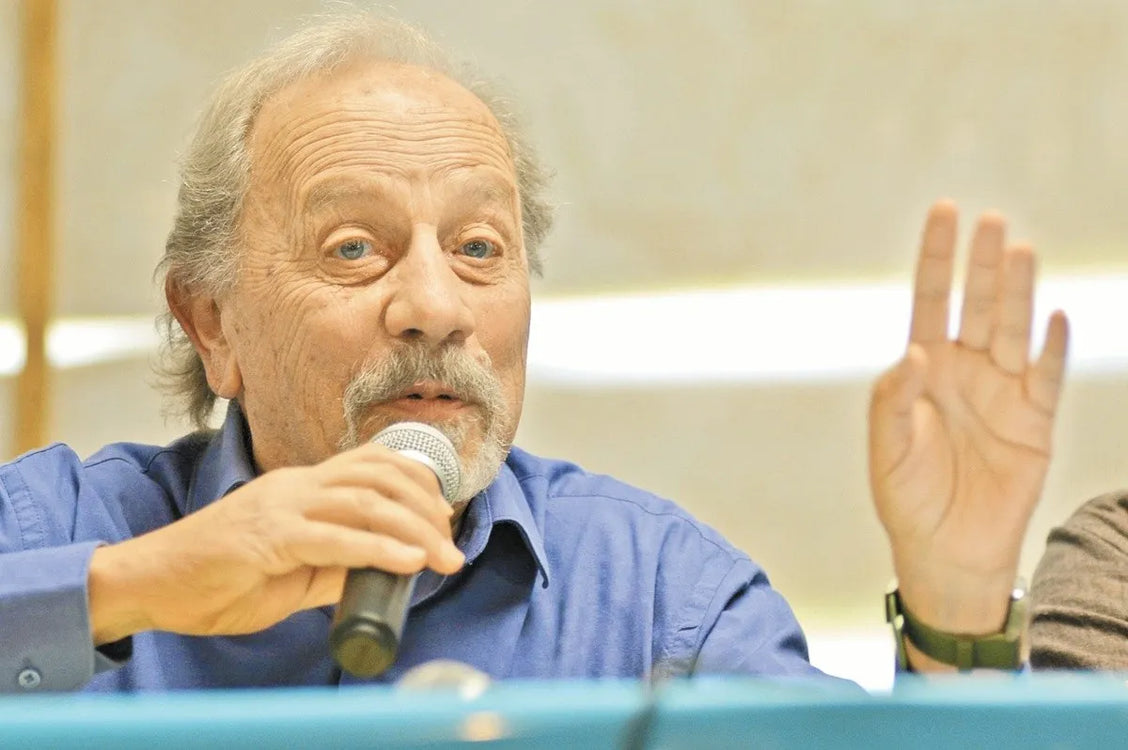
The great historian Adolfo Gilly passed away on July 4, 2023. In his honor, we are publishing an extract of Tony Wood’s introduction to his book, Paths of Revolution.
Adolfo Gilly lived many lives: leftist militant, journalist, political prisoner, public intellectual, historian. At times these roles overlapped, at others they remained distinct. But in each of them, he was a direct observer of key events in Latin American history, from the Cuban Missile Crisis to Central America’s guerrilla movements of the 1960s, and from Mexico’s Zapatista uprising of 1994 to the indigenous and popular mobilizations that swept Evo Morales to power in Bolivia in the early 2000s. In that sense, until his death in July 2023, Gilly provided a living link—across the tumult of several decades—between the post-war generations of the Latin American left and the radical upsurges accompanying the ‘Pink Tide.’
Born Adolfo Malvagni Gilly in Buenos Aires in 1928, he would eventually adopt his mother’s surname. His father, Atilio Malvagni, was a former lieutenant in the Argentine navy and a lawyer. His mother, Delfa Esther Gilly, was from a family of French-descended landowners. Both parents transmitted a love of culture to Adolfo and his two sisters, Delfa and Graciela, taking them to operas and concerts at the Teatro Colón and encouraging them to read widely; Gilly recalled devouring works by Cervantes, Dante, Alexandre Dumas, and Jules Verne in his father’s library. Fittingly, one of his earliest jobs kept him close to the world of print: working at a printshop, he corrected proofs and set type with a Linotype press.
Gilly came to political consciousness in the 1940s. In 1946, the same year Juan Domingo Perón rose to power on the back of mass support from the Argentine working classes, Gilly joined the Juventud Socialista, the youth wing of the Argentine Socialist Party. But the following year, he left the party after the leadership shut down the student newspaper Rebeldía for its ‘leftism’. He and others formed the short-lived Workers’ Revolutionary Movement (Movimiento Obrero Revolucionario, MOR) before gravitating, at the end of the 1940s, towards the Trotskyist Fourth International (FI).
His militancy in the ranks of the Fourth International—his nom de guerre was “Lucero”—would shape the rest of his personal and political trajectory, sending him from Buenos Aires to the Bolivian altiplano and from revolutionary Havana to the jungles of Guatemala. He aligned himself with the current within the FI led by Homero Cristalli, better known under his pseudonym “J. Posadas.” Posadas later gained notoriety for his domineering manner, his sectarian manoeuvring, and his eccentric views (for example on UFOs). But it was Posadas’s reading of Latin American realities that appealed to Gilly. As he recalled in a 2010 interview, other parts of the Argentine left tended to either see Perón as an agent of British imperialism or as “some sort of snake-charmer with a flute” who had bewitched the masses. Posadas, by contrast, had argued that “Peronism was the specific form that the organization of the working class took in our country, and we had to understand it… the workers may have been following a charismatic leader, but they did so for their own reasons.” This early impulse to interpret popular politics on its own terms would recur throughout Gilly’s work.
It was the Latin America Bureau of the FI, controlled by Posadas, that sent Gilly to Bolivia in 1956, in the heady period after the country’s National Revolution of 1952. Trotskyism occupied an unusually prominent place in the Bolivian political landscape compared to the rest of Latin America, with the Revolutionary Workers’ Party (Partido Obrero Revolucionario, POR) acquiring a mass working-class following and exerting a strong influence on the powerful miners’ unions. The four years Gilly spent there introduced him to a world of Andean indigenous traditions and peasant politics that was entirely new to him. It was also in Bolivia that he began writing for the Uruguayan weekly Marcha, for whom he would continue to produce reportage thereafter.
Gilly spent the years 1960–62 in Europe, working as a representative of the FI’s Secretariat and based mostly in Italy. This was a time of significant shifts in the nature of industrial labour. The “hot autumn” of 1969 was still a few years off, but Gilly recalled seeing the beginnings of the workers’ councils and the “autonomist” movement. It was also a contentious time within the FI, as strategic differences over the relative importance of proletarian revolution in Europe versus national and anti-colonial revolutions in the “Third World” led to an internal split. The two currents were led, respectively, by Ernest Mandel and Michel Pablo. Mandel ultimately remained at the head of the FI, but Gilly’s sympathies with the “Pabloite” view clearly informed much of his later work: “as I see it now,” he observed to me in 2010, “it is the revolt of the colonial world that gives the twentieth century its meaning.”
Verso for more