
by TARA ISABELLA BURTON
Reality is different these days. It isn’t just that we have the tools to experience reality differently, or augment reality, by affixing a Meta Quest headset or an Apple Vision Pro to our skulls. It isn’t just that we have the ability to quantifyreality, through smartwatches and heart rate monitors and step counters and sleep trackers, or that we have the ability to manipulate people’s perceptions of reality, through social media filters so ubiquitous that there is now a whole cottage industry of plastic surgery devoted to making people’s fleshly faces match the selfies they post on Instagram. Nor is it just the fact that our social world includes the conversations we have with virtual personal assistants like Siri and Alexa, whose soothing voices greet us when we come home, or remind us of the weather.
All of these, of course, play some role in the seismic reimaging of our selves, and our world, that the Internet — in particular, smartphone-enabled online culture — has engendered. But the shift we’re experiencing is bigger, and more totalizing, than any single phenomenon. It’s a spiritual shift, maybe even a metaphysical one. Reality, now more than ever, is contingent upon our own personal, collective, and sometimes even unconscious desires.
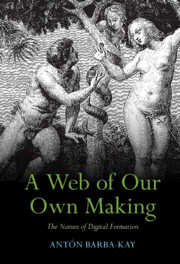
In A Web of Our Own Making, Antón Barba-Kay, a humanities professor at Deep Springs College in California and occasional contributor to this journal, offers a robust and comprehensive account of what, exactly, is going on. In a dense and penetrating book that feels, both in ambitious scope and granular detail, far more magisterial than its three hundred pages might suggest, Barba-Kay has produced both a convincing, citation-rich compendium of our digital experience, and a compelling piece of constructive philosophy. It is a philosophy that takes seriously the Internet’s reshaping of human life — of the new ways we’ve come to understand our bodies, our relationships, our material nature, and our increasingly “data-driven” perspective. And it is a philosophy that offers, if not a cultural-level rejection of the morass, then at least the possibility of a personal way out: an escape Barba-Kay represents not as the breaking of an addiction nor an individualistic move toward wellness, but rather an existential — perhaps even the existential — choice.
“If media are latent with political possibilities,” he writes, “they are also latent with specific metaphysical assumptions.” A Web of Our Own Making may be the single best resource for understanding these specific assumptions — the metaphysics, we might say, of life in the Internet age.
The bookdoes the bulk of its early argumentative work by forcing us to confront the all-encompassing extent of smartphone culture, in every aspect of our lives and relationships, even as Barba-Kay teases out the philosophical links between the different usages.
Some of these observations, though apt, aren’t exactly new — that the possibility of tracking our steps for so-called health reasons distorts our relationship with a simple country walk, that the fundamentally data-driven nature of smartphone culture “is such as to translate larger human questions about how to live into technical puzzles that may be ‘problem-solved,’” that Twitter timelines and Instagram feeds have become a saccharine way of capturing our limited and precious attention by distracting us from the less immediately rewarding elements of being human.
But the fusillade intensity with which Barba-Kay produces these inconvenient truths renders them impossible to ignore; from the details we start to perceive, little by little, the devil. As Barba-Kay writes, “digital technology is training us not simply to a new sense of what is real and really good, but to a new understanding of the contrasts within which we see that reality.” In other words, our awareness of what the virtual world cannot do has made us hungrier for those elements of reality from which we have not yet become alienated.
If reality is changing, it is because, for better and for worse, our lives are increasingly determined by one specific vision of human ingenuity: a vision that valorizes those elements of human life we freely choose (or think we do) over those we once saw as given to us — our bodies, our families, our communities. Digital culture functions today as the Enlightenment cosmopolis once did: as a fantasy in which society reshapes itself along the lines of affinity. “If settled norms, practices, laws, and places are our roots, digital culture is uprooted and uprooting,” Barba-Kay writes.
At the same time, we continue to express allegiance to [digital culture] because digital technology has become our clearest metaphor for universality as such, for humanity, for the global village, for what is always everywhere the case…. By giving us access to new kinds of self-determination, identity, and voluntary power, digital technology is our most vivid instrument of freedom. It offers an experience of time that, by dissolving ties to place and history, allows us to begin again.
At its best, this disembodiment becomes the ground of new and liberatory kinds of communities, which are bonded together in love and mutuality rather than mere circumstance. This in turn offers opportunities to dismantle the old hierarchies of birth and blood. But, as Barba-Kay reveals, the realm of the virtual operates less on human freedom — on our carefully ordered reason, say, or on our virtuously tended affections — than on a different kind of human bondage, one that arises from our own desires.
The New Atlantis for more