
by DAVID HANAN
VIDEO/Old Films Revival Project/Youtube
Since the end of Suharto’s New Order regime there has been considerable growth in overt political activism in Indonesia—including by a cohort of independent filmmakers. Aspects of these developments in Indonesian film culture are documented in this edition of Inside Indonesia. Contemporary filmmakers have the advantage not only of more openness in Indonesia, but of using cheaper and more efficient kinds of technology than was available during the Sukarno and Suharto periods.
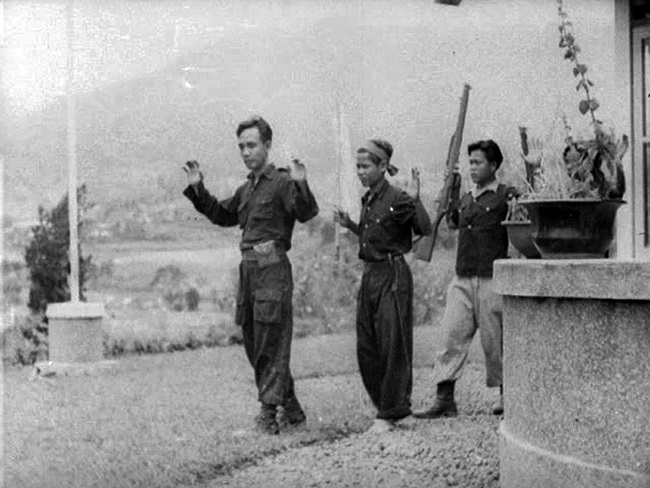
In the nearly five decades of independence prior to President Suharto’s demise, expressions of markedly dissenting political views on film amount to a significant, if small, tradition. How this political commentary was achieved in the midst of authoritarianism was determined by a combination of available commercial frameworks, technology and costs. During these five decades, ‘filmic activism’—or the capacity of film to raise important human rights and social issues—primarily took place within the framework of the commercial film industry.
An early, critical lens
Usmar Ismail is considered the pioneer of Indonesian cinema. The first feature film made by his newly established Perfini Company, in 1950, Darah dan Do’a (‘Blood and Prayer’, aka ‘The Long March’) shows—via a flashback in its first few minutes—members of the Indonesian National Army (TNI) shooting dead young members of the PKI (Indonesian Communist Party). Their hands raised in surrender, the killings took place in the midst of the left wing rebellion that occurred at Madiun in East Java from mid-September to early December 1948, less than 15 months before the film went into production.
In 1948 it was becoming clear that a cold war was developing between the USA and communist nations, not just the USSR, but also China. The stand taken by the Indonesian government against the rebellion in Madiun, including the execution of large numbers of supporters of the left, would be one reason for the USA to support Indonesia in its struggle for independence. Historians see the execution by the TNI of communists and other left wing rebels at Madiun as having political significance at an international level. Darah dan Do’a questions the justice of these executions.
Although key Perfini films were often screened in censored versions on TVRI during the Suharto period and are primarily known for celebrating the years of the Indonesian struggle for independence (using a mode of production influenced by neo-realism), in their uncensored versions they also provide critical perspectives on the period of struggle. A second Perfini film, Lewat Djam Malam (‘After the Curfew’, 1954) at one point shows two Indonesian freedom fighters, at the order of their commander, shooting dead a family of Javanese refugees (parents and children) in order to be able to dispossess them of the goods they are carrying.
Inside Indonesia for more