
by SABINE HOSSENFELDER
After you die, your body’s atoms will disperse and find new venues, making their way into oceans, trees and other bodies. But according to the laws of quantum mechanics, all of the information about your body’s build and function will prevail. The relations between the atoms, the uncountable particulars that made you you, will remain forever preserved, albeit in unrecognisably scrambled form – lost in practice, but immortal in principle.
There is only one apparent exception to this reassuring concept: according to our current physical understanding, information cannot survive an encounter with a black hole. Forty years ago, Stephen Hawking demonstrated that black holes destroy information for good. Whatever falls into a black hole disappears from the rest of the Universe. It eventually reemerges in a wind of particles – ‘Hawking radiation’ – that leaks away from the event horizon, the black hole’s outer physical boundary. In this way, black holes slowly evaporate, but the process erases all knowledge about the black hole’s formation. The radiation merely carries data for the total mass, charge and angular momentum of the matter that collapsed; every other detail about anything that fell into the black hole is irretrievably lost.
Hawking’s discovery of black-hole evaporation has presented theoretical physicists with a huge conundrum: general relativity says that black holes must destroy information; quantum mechanics says it cannot happen because information must live on eternally. Both general relativity and quantum mechanics are extremely well-tested theories, and yet they refuse to combine. The clash reveals something much more fundamental than a seemingly exotic quirk about black holes: the information paradox makes it aptly clear that physicists still do not understand the fundamental laws of nature.
But Gia Dvali, professor of physics at the Ludwig-Maximilians University of Munich, believes he’s found the solution. ‘Black holes are quantum computers,’ he says. ‘We have an explicit information-processing sequence.’ If he is correct, the paradox is no more, and information truly is immortal. Even more startling, perhaps, is that his concept has practical implications. In the future, we might be able to tap black-hole physics to construct quantum computers of our own.
The main reason why recovering information from black holes seems impossible is that they are almost featureless spheroids with essentially no physical attributes on their horizons; they have ‘no hair’, as the late US physicist John Wheeler put it. You cannot store information in something that has no features that could be used to encode it, the standard argument goes. And therein lies the error, Dvali says: ‘All these no-hair theorems are wrong.’ He and his collaborators argue that gravitons – the so-far undiscovered quanta that carry gravity and make up space-time – stretch throughout the black hole and give rise to ‘quantum hair’ which allows storing as well as releasing information.
The new research builds on a counter-intuitive feature of quantum theory: quantum effects are not necessarily microscopically small. True, those effects are fragile, and are destroyed quickly in warm and busy environments, such as those typically found on Earth. This is why we don’t normally witness them. This is also the main challenge in building quantum computers, which process information using the quantum states of particles instead of the on-off logic of traditional transistors. But in a cold and isolated place, quantum behaviour can persist over large distances – large enough to span the tens to billions of kilometres of a black-hole horizon.
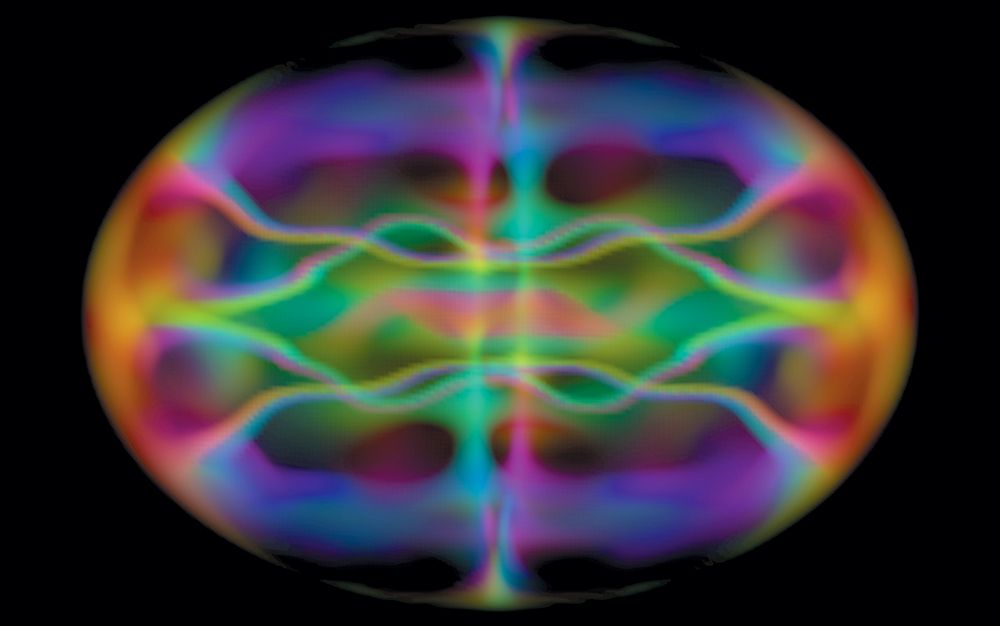
You don’t even need to go to outer space to witness long-range quantum effects. The enormous distances and masses necessary to create black-hole quantum hair might be far beyond our experimental capabilities, but by cooling atoms down to less than one ten-thousandth of a Kelvin (that is, one ten-thousandth of a degree above absolute zero), researchers have condensed up to a billion atoms, spread out over several millimetres, into a single quantum state. That’s huge for collective quantum behaviour.
Aeon for more