
by SHARON SMITH
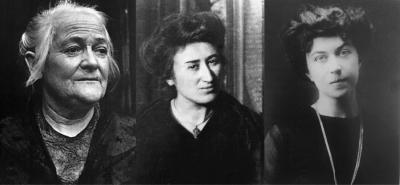
“If women’s liberation is unthinkable without communism, then communism is unthinkable without women’s liberation.”1
—Russian revolutionary Inessa Armand
The classical Marxists of the nineteenth and early twentieth centuries—Karl Marx, Frederick Engels, Clara Zetkin, Rosa Luxemburg, V. I. Lenin, Alexandra Kollontai, and Leon Trotsky—developed a theoretical framework tying the fight for women’s liberation to the struggle for socialism. While their theory requires updating,2 their enormous contributions have too often been dismissed or ignored.
Moreover, the history of those who carried on the Marxist tradition on women’s oppression during the mid-twentieth century has frequently been rendered invisible—yet these activists and theorists provided an indispensible thread that continued between the victory of women’s suffrage in the 1920s (often referred to as US feminism’s “first wave” and the rise of the 1960s movements for women’s liberation (known as its “second wave”).
Marx and Engels located the root of women’s oppression in their role within the nuclear family in class societies. They understood that women’s role as biological “reproducers” results in their subordinate status inside the nuclear family, and consequently throughout society. In capitalist societies, women in property-holding families reproduce heirs; women in working-class families reproduce generations of labor power for the system.
The capitalist class has become dependent on this method of “privatized reproduction” within the working-class family because it lessens its own financial responsibility for the reproduction of labor power, which is instead largely supplied by unpaid domestic labor performed primarily by women. The precondition for women’s liberation thus requires an end to their unpaid labor inside the family. This, in turn, necessitates a socialist transformation of society, which cannot be achieved gradually but only through a process of social revolution, in a decisive battle between classes.
Marx and Engels early on identified the revolutionary agency of the working class, or proletariat, as the only class capable of leading the transformation to a socialist society. In The Communist Manifesto, they stated, “What the bourgeoisie therefore produces, above all, are its own grave-diggers. Its fall and the victory of the proletariat are equally inevitable.”3 As Hal Draper noted,
The classic formulation of the self-emancipation principle by Marx was written down in 1864 as the first premise of the Rules of the First International—in fact, as its first clause:
“CONSIDERING, That the emancipation of the working classes must be conquered by the working classes themselves . . . ”4
This class-based revolutionary strategy did not downplay the importance of combatting women’s oppression among Marxist theorists of the late nineteenth and early twentieth centuries. As Leon Trotsky argued, “In order to change the conditions of life, we must learn to see them through the eyes of women.”5
Like Marx and Engels before them, this generation of Marxists recognized the revolutionary agency of the entire working class—and regarded working-class women as a key component in achieving its revolutionary potential. They emphasized the plight of working-class women and attempted to organize explicitly working-class women’s movements.
European Marxists from Germany to Russia were often at the forefront of the fight for women’s liberation, while advancing Marxist theory on what was then called “the woman question.” They did so not only in an era of growing inter-imperialist conflict leading to World War I but also in the context of rising revolutionary socialist movements. The outbreak of war brought about a whirlwind of patriotism in all the belligerent countries and became the dividing question within the socialist movement itself, as entire socialist parties of the Second International plunged themselves into the war efforts of their “own” ruling classes.
The chasm between revolutionary socialists and those they called “bourgeois feminists” was not due to minor tactical or strategic differences but those of crucial political principles. In the case of Tsarist Russia, for example, ruling-class women threw themselves into the war effort as a trade-off in return for voting rights. The League for Women’s Equality called on Russian women to “devote all our energy, intellect, and knowledge to our country. This is our obligation to our fatherland, and this will give us the right to participate as the equals of men in the new life of a victorious Russia.”6
As socialists Hal Draper and Anne G. Lipow described, revolutionary socialists
. . . gave strong support to all the democratic demands for women’s equal rights. But this movement differed from the bourgeois feminists not only in the programmatic context in which it put these ‘democratic demands’, but also—and consequently—in its choice of immediate demands to emphasize. It viewed itself, in Marxist terms, as a class movement, and this translates into working-women’s movement.7
The self-organization of socialist women
Engels encouraged German socialist August Bebel, who had authored Woman and Socialism
in 1878, to assist with the founding of a socialist working women’s
movement within the Social Democratic Party of Germany (SDP). The result
was the formation of a women-led party bureau in 1891, with Clara
Zetkin—a leading member of the SPD—at its political and organizational
center.
Zetkin led this work until the Second International split over support for World War I, when she left to join a small number of other anti-war revolutionaries, including members of the Russian Bolshevik Party to found a principled international socialist movement against the imperialist war. After that, Zetkin continued her work outside the Second International.
At the time of the founding of the SPD women’s bureau in 1891, women in Prussia were legally barred from attending political meetings or joining political parties. Finally in 1902, as Bebel noted, “the Prussian secretary of state condescended to give women permission to attend the meetings of political clubs, but under the condition that they had to take their seats in a part of the hall specially set aside for them.”8
The achievements of the women’s bureau, viewed in this context, were substantial. Its publication, Gleichheit (“Equality”), reached a circulation of 23,000 by 1905 and 112,000 by 1913. Meanwhile, female membership in the party grew from roughly 4,000 women in the party in 1905 to 141,000 by 1913.9
The German working-women’s movement soon became the epicenter of an international movement of socialist women under the rubric of the Second International, with organizing women workers into trade unions its priority. In 1907, Zetkin organized the first international conference of socialist women in Stuttgart, held in the days leading up to the Second International’s full congress. At that congress, the Second International voted for universal suffrage for all women and men.
International Socialist Review for more