
by DINA EZZAT
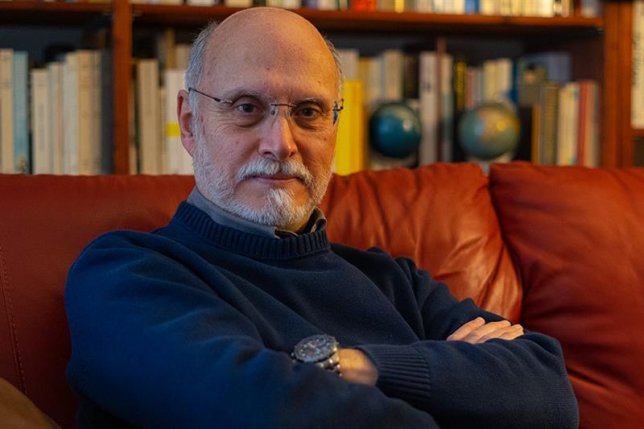
Professor of international relations at SOAS in London Gilbert Achcar explains that it would be simplistic to represent the conflict in Sudan as a proxy war in an interview with Dina Ezzat
On day nine of the conflict that has erupted between the Sudanese Armed Forces (SAF) and the Rapid Support Forces (RSF), Gilbert Achcar, a close observer of the political and military challenges that have come the way of the Arab world for over a decade, reflects on a battle that he believes was inevitable due to the dual nature of military power in Sudan.
A professor of International Relations at the School of Oriental and African Studies (SOAS) at the University of London, Achcar told Al-Ahram Weekly his best and worst-case scenarios for the conflict, which has unfolded “due to the failure of the two military forces to agree over the new framework that was negotiated with international mediation between Sudan’s military government and the Freedom and Change Coalition”.
The agreement was supposed to be signed in the first week of April, when Abdel-Fattah Al-Burhan, leader of the SAF, wanted “a prompt inclusion of the RSF under SAF command.”
He “wanted to end the status of the RSF as a force parallel to the army, whereas [leader of the RSF Mohamed] Dagalo was not willing to bring his troops under army command. It is a classic situation of unavoidable conflict between two armed powers deployed on the same territory: sooner or later, one of the two will try to subdue the other,” Achcar said.
Established by Sudan’s ousted former president Omar Al-Bashir, the RSF was built as an autonomous armed force parallel to the regular army. This was convenient for Al-Bashir’s purposes of playing one power off against the other to shield his personal rule and of using the RSF for missions that the army could not get involved in, Achcar said.
Dagalo is originally the leader of a paramilitary force who was propelled into politics by Al-Bashir during the war waged by the ousted president in Darfur. “So, in essence, Dagalo owed it all to Al-Bashir, but this did not stop him from turning against the latter when he felt that Al-Bashir’s time was over,” Achcar said. The ousting of Al-Bashir was the moment when Dagalo started aiming for a much bigger political role, boosted by the RSF’s decisive role in cooperating with the SAF in removing him, he added.
Al-Burhan was not blind to Dagalo’s ambition, Achcar believes. He was just waiting for the right moment to subdue him. That moment, he argues, was prompted “after the coup of 25 October [2021] when Dagalo distanced himself from the SAF and declared that the coup had been a failure.”
In October 2021, Al-Burhan thought that the split that occurred within the Freedom and Change Coalition would allow him to move successfully towards eliminating the power-sharing agreement between civilians and the military that had existed since 2019 and to reestablish unmitigated military rule.
“However, things did not go the way Al-Burhan hoped because of vigorous opposition in the streets and international, principally Western, economic pressure. He was forced to backtrack to negotiating with the Freedom and Change Coalition that he had ousted from government and, under the pressure of the international mediation, accept a new agreement that is actually more constraining for the military than that of 2019,” Achcar said.
“This was indeed a clear manifestation of the failure of his coup.” Al-Burhan became convinced that he needed to subdue the RSF in order to be able to manœuvre in the new political game in the making. The SAF had to improve their chances to keep control of political power and with it of their economic empire in Sudan, and this required putting an end to the division of the country’s armed forces.
It was no longer possible for the SAF to carry on working with an autonomous RSF, Achcar said. “Even though both Al-Burhan and Dagalo were moulded by the same political regime of Al-Bashir, they became rivals since the ousting of the dictator. Political power is based on the monopoly of force, and no duality is sustainable for long in that respect,” he added.
Al-Burhan tolerated the co-existence with the RSF as long as the latter was working together with the SAF in countering the opposition’s pressure for civilian rule, Achcar said. “But this is now irremediably over. This is why it is wrong to believe that both sides could be reconciled in any manner. It is now a life-and-death battle between them.”
This is a very worrying situation, Achcar agreed. If the battle were to stop tomorrow without either side achieving a decisive victory, it would mean a division of Sudan into separate areas controlled by the SAF and RSF.
A renewed political agreement between these forces, he added, is very unlikely. “It would require that Dagalo accept the integration of the RSF under the wing of the SAF. Today, this seems very much to be out of the question unless some regional force manages to buy Dagalo’s consent to leave the scene.”
CIVIL WAR: According to Achcar, the conflict could turn into a protracted civil war or be frozen into a division of the country under the sway of the two rival powers.
“This is why there is so much worry over the developments in Sudan, especially for a country sharing a past and a border with it such as Egypt and a country fearing regional destabilisation such as the Saudi Kingdom,” he said.
Alternatives International for more
(Thanks to Feroz Mehdi)