
by MURTAZA HUSSAIN
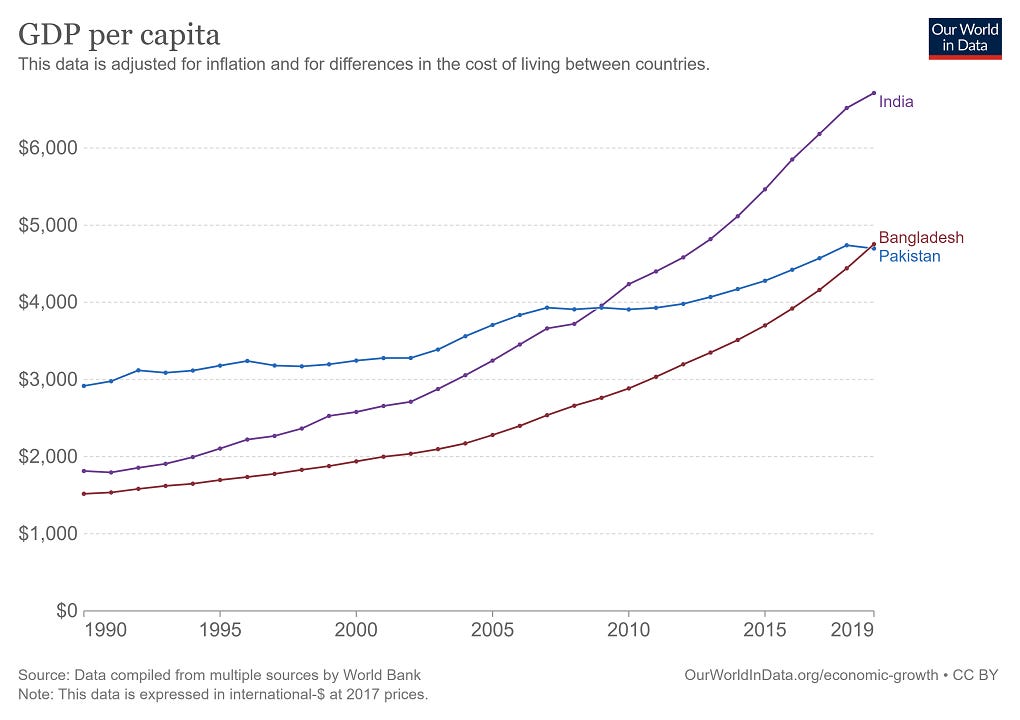
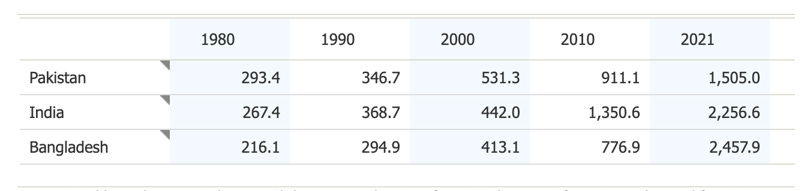
I’ve written very upbeat and optimistic posts about the growth of two giant South Asian countries — India and Bangladesh. I wish I could write a similarly glowing post about the third South Asian giant: Pakistan. But instead, Pakistan seems mired in a low-growth equilibrium, with low investment, low standards of living, and a constant need for financial bailouts by the IMF and/or China. Much of the problem seems political-economic — the country alternates fairly frequently between military and civilization governments, and can never seem to get leaders who are focused on economic development. Pakistan’s quarter of a billion people deserve better than this, especially because the country’s South Asian neighbors are proving that growth is possible:
So I asked Murtaza Hussain, one of my favorite Twitter personalities, and a semi-regular commentator about Pakistani issues, to write me a guest post about how Pakistan could fix its political economy in order to get on the development track. Murtaza is a writer for The Intercept, and he writes his own Substack as well. (Noah Smith)
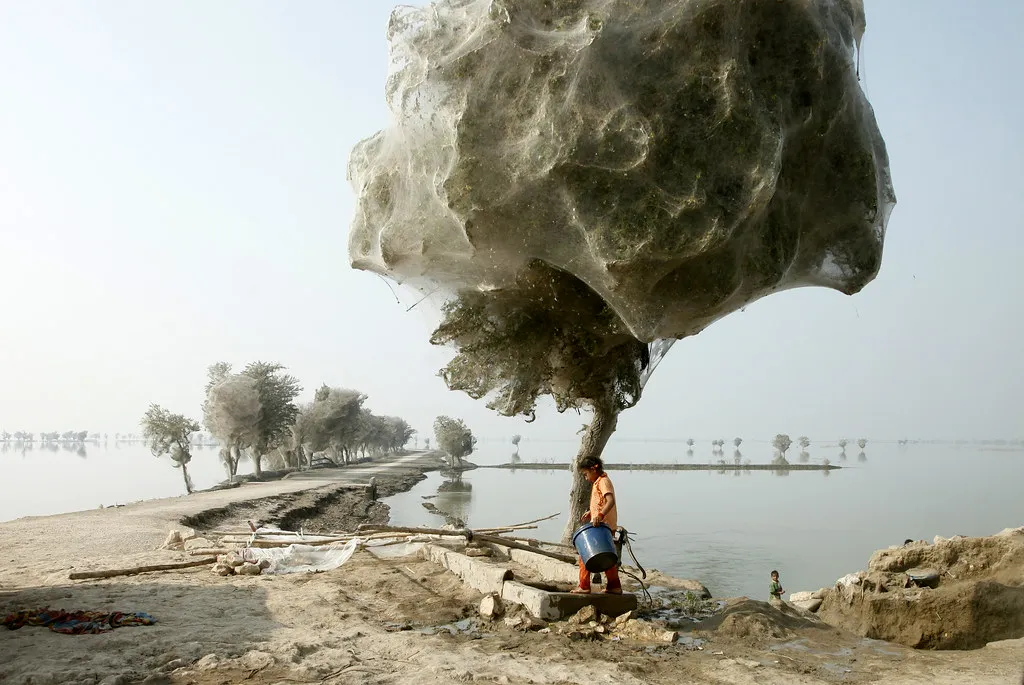
This past week was a happy one for many Indians, who celebrated the milestone of becoming the world’s most populous country at a time when their economic and political fortunes are also on the rise. For their neighbors in Pakistan the news of late has been far less upbeat. The past year has been a disastrous one for Pakistanis, who have faced spiraling inflation, low economic growth, catastrophic floods, terrorist attacks, and blowback from a political standoff that has paralyzed the country’s elite. While a rising economic tide has lifted many boats in Asia this century, Pakistan remains stuck in a cycle of stagnation and crisis.
It is seldom appreciated in the West, but Pakistan is the fifth largest country in the world by population and its roughly 240 million citizens make it a larger country than Nigeria and Brazil. Pakistan is also a young country, with a median age of just 20.4 and a majority of its citizens under the age of 30. By midcentury, Pakistan could have a population greater than 330 million, making it an outsize part of a global population that is generally growing older and more scarce. As such, the fate of Pakistan is important to the fate of Asia and the world generally in the coming decades.
Despite its grave challenges, Pakistan is home to many talented, hardworking, and honest people whose potential cannot be abandoned to poverty and misgovernance. Just as India’s recent post-liberalization economic growth should be a cause for celebration regardless of one’s views on its present BJP government, getting Pakistan onto a constructive track should be a matter of general interest to the world, beyond the vicissitudes of short-term politics. But first it’s important to understand how Pakistan got to the parlous state it is in today.
Getting Sick
Pakistan was originally imagined as a utopian project alongside other 20th century nationalisms created from the wreckage of European empires, in this case, the British Raj. In its early years, the country did benefit from an esprit de corps that allowed it to consolidate a relatively capable state from a fractious population consisting of refugees andeven managing to outperform India economically for many years. This relative economic success, or at least ability to keep pace, helped feed a brash and confident Pakistani nationalism that defined the country’s identity for decades and was symbolized byiconic institutions like its once-proud national airline and armed forces.
Noahpinion for more
(Thanks to Razi Azmi)