
by BILL CHAPPELL
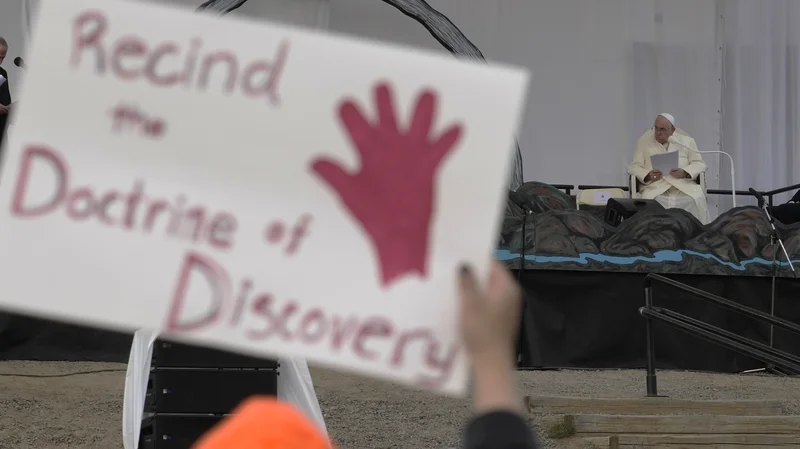
Nearly 500 years after papal decrees were used to rationalize Europe’s colonial conquests, the Vatican repudiated those decrees on Thursday, saying the “Doctrine of Discovery” that was used to justify snuffing out Indigenous people’s culture and livelihoods is not part of the Catholic faith.
The doctrine was invoked as a legal and religious standing by Europeans who “discovered” new lands and violently seized it from people who had been living there for generations. It has been cited in different arenas for centuries, including by the U.S. Supreme Court — as early as 1823 and as recently as 2005.
“The statement repudiates the very mindsets and worldview that gave rise to the original papal bulls,” the Rev. David McCallum, executive director of the Program for Discerning Leadership based in Rome, told NPR.
“It renounces the mindset of cultural or racial superiority which allowed for that objectification or subjection of people, and strongly condemns any attitudes or actions that threaten or damage the dignity of the human person.”
Here’s a brief guide to the Discovery Doctrine, and why the Vatican’s move is historic:
The doctrine came from papal “bulls” in the 15th century
The doctrine was laid out in a series of papal “bulls,” or decrees; the first one was issued in 1452. They authorized colonial powers such as Spain and Portugal to seize lands and subjugate people in Africa and the “New World,” as long as people on the lands were not Christians.
Scholars widely note three bulls: Pope Nicholas V’s Dum diversas (1452) and Romanus Pontifex (1455); and Pope Alexander VI’s Inter caetera (1493).
Later popes revoked the decrees, but the damage was done
The papal bulls “were not considered valid just 30 to 40 years after they were first issued. They were in fact abrogated legally and nullified by the Vatican by the late 1530s,” McCallum told NPR.
The Vatican’s nullification was too late to stop the destructive impact of colonialism, McCallum said, noting that European expansion was fueled by a “sort of missionary sense that the Western monarchies had a right to go to these new lands and to take from them their resources and if necessary to put down people, including enslaving them.”
The doctrine made its way into the U.S. legal system
“Back in the in the 19th century, it was used as a precedent which gave people a sense of title to land that had not been owned with an official title in deed,” McCallum said.
So what began as a religious decree in the 1400s then became the basis for a legal concept in the U.S., when the Doctrine of Discovery was invoked in an 1823 U.S. Supreme Court ruling that Indigenous people had only rights of “occupancy,” not ownership, over lands they had long lived on. The land, then, was open for the taking.
NPR for more
(Thanks to reader)