
EDITORS (Black Agenda Review)
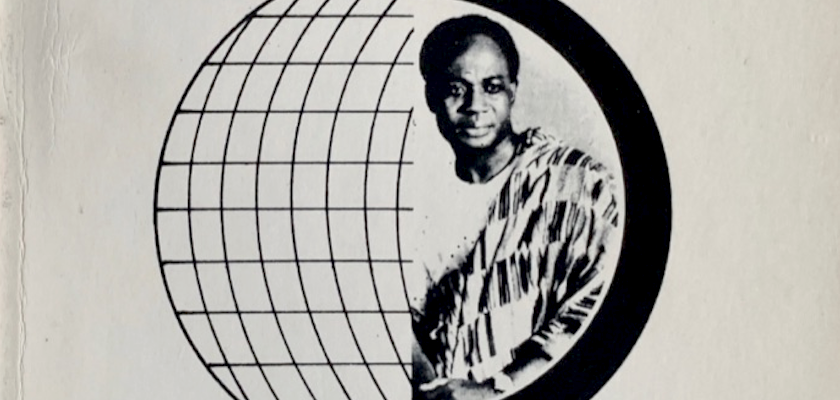
A 1965 article from Kwame Nkrumah’s journal The Spark highlights the role of monetary policy – and the US dollar – as an instrument of imperialism and neocolonial rule.
If it were around today, The Spark would probably carry a warning in the US that it was “state-affiliated media.” Its editors probably wouldn’t care. The Spark was published by Kwame Nkrumah’s Bureau of African Affairs and its explicit mission was to build socialism in Ghana and to aid in fomenting working-class revolution throughout Africa.
The Spark’s content reflected this mission. The weekly paper ran essays articulating the theory of Nkrumaism and published detailed analysis of neocolonialism and imperialism, and of socialism and development. It considered the class struggle in Africa and examined anti-colonial struggles across the continent. In its pages appeared statements of solidarity with Cuba, Algeria, and Black America, and contributions from Amilcar Cabral, Fidel Castro, and Che Guevera. When W.E.B. Du Bois passed away in 1963, an issue appeared in his honor.
For the US State Department, The Spark represented a dangerous tendency within Nkrumah’s Ghana. In January, 1964 the US Central Intelligence Agency issued a classified report titled “The Leftward Trend in Ghana .” The report noted that the US Embassy in Ghana had characterized a recent speech of Nkrumah’s “as perhaps his most extreme anticapitalist and revolutionary performance.” The speech, according to the CIA, “included [Nkrumah’s] first known specific use of such phrases as ‘class interests’ and ‘class politics,’” it criticized the US “as the citadel of reactionary opposition to progressive forces everywhere,” and it aligned Ghana with “the international ‘socialist’ fraternity.” “Subsequently,” the report continued, “[Nkrumah] has increasingly tended to mouth the Communist-derived jargon appearing continually in The Spark.”
In their summary of the situation in Ghana, the CIA concluded that, “Barring a successful coup against his regime, it will probably be increasingly difficult for the West to maintain an effective presence in Ghana.”
Nkrumah was overthrown by a CIA-backed military on February 24, 1966.
Below we reprint an article from The Spark titled “Currency Crisis in the West.” Its author is Hsiang Chung, a Chinese economist of whom, we admit, we know little more than his name. Even so, the essay has a crystalline analysis of how monetary policy has been used as a tool of imperial and neocolonial rule. Moreover, in charting the historical reasons for the rise of the dollar’s global supremacy in the twentieth century, it establishes the historical conditions precipitating the dollar’s imminent twenty-first century fall.
Currency Crisis in the West
Hsiang Chung
The imperialist scramble for world domination is usually marked by a struggle for financial supremacy, for monetary policy is one of the heavy weapons of the imperialist countries in their drive, for expansion–a weapon they use to strangle their rivals and extend their spheres of influence.
In the struggle for monetary supremacy, an imperialist country invariably uses its political and economic power to establish a monetary bloc in which its own currency is made to take a leading position while the currencies of its colonies and dependencies as well as other states associated with it are reduced to a subordinate status.
It has to link to currencies of the monetary bloc members with its own, and at the same time to make them keep their gold and foreign exchange reserves in its central bank to be used by them for “unlimited buying and selling” on foreign exchange market at fixed rates. Consequently, its commodity in capital exports will not have to suffer from the fluctuation of the currency of the monetary bloc members and it will not have to pay more for raw material imports because of the devaluation of its own currency.
Moreover, since the gold and foreign exchange reserves of its monetary bloc members are deposited in its own central exploitation, and this leads to the formation of a financial centre within its own sphere of influence over which it is able to establish its financial supremacy. That is why currency warfare in capitalist international finance is an important means in the imperialist scramble for markets, outlets, for investment and sources for raw materials, as well as an indispensable factor in their constant redivision of the capital of this world.
The Monetary System Crisis Sharpened
The deepening of the general crisis of capitalism, especially the emergence of the crisis in the capitalist monetary system, has intensified the monetary warfare among the imperialist powers. As a result of the world economic crisis of 1929–33, normal financial relations among the capitalist countries were disrupted as never before; the gold standard completely collapsed, and the monetary system of the capitalist countries became chronically unstable.
From that time onwards, in their efforts to maintain currency stability, and to ward off the crisis in the monetary system, monopoly capitalist groups in the imperialist countries were compelled to resort to government intervention on a larger scale than before and adopt such measures in the field of international finance as moratoria on foreign debts currency depreciation, foreign exchange restrictions and control etc., in order to consolidate their position in the better struggle for markets and spheres of influence. However, all the steps, which were designed to shift the crisis onto others failed to extricate the imperialists from their plight, but instead made the struggle still sharper and more complicated.
Following the end of World War II, as a result of the formation of the socialist camp and the upsurge of the national liberation movement the areas dominated or exploited by the imperialist countries have become smaller and smaller. In this predicament, the inter-imperialist struggle for markets and spheres of influence has become more acute and currency has been used on a still larger scale as an instrument in defeating their adversaries. Not only have they subjected the currencies of their colonies and dependencies to their own as in the past; they have also exerted great efforts to make their own currency the dominant one within the shrinking imperialist camp. At the same time, the deepening of the general crisis of capitalism has been accomplished by an intensified crisis in the monetary system, and the imperialist countries have been forced to take further steps to intervene in various forms in the field of international finance. However, whenever they are taken by the strong to bully the weak or the weak to counteract an adversary’s pressure, the steps are bound to aggravate the imperialist monetary struggle, and make it more severe than was the case before World War II.
Domination vs Independence
The characteristic of postwar inter-imperialist relations is that US imperialism has increasingly endeavored to consolidate and extend its dominant position while the other imperialist powers refused to reconcile themselves to US control from which they have done all they can to free themselves. This rivalry between US imperialism and the other imperialist powers struggle between domination and independence— is also reflected in capitalist, world finance.
Black Agenda Report for more