
by GREG SHUPAK
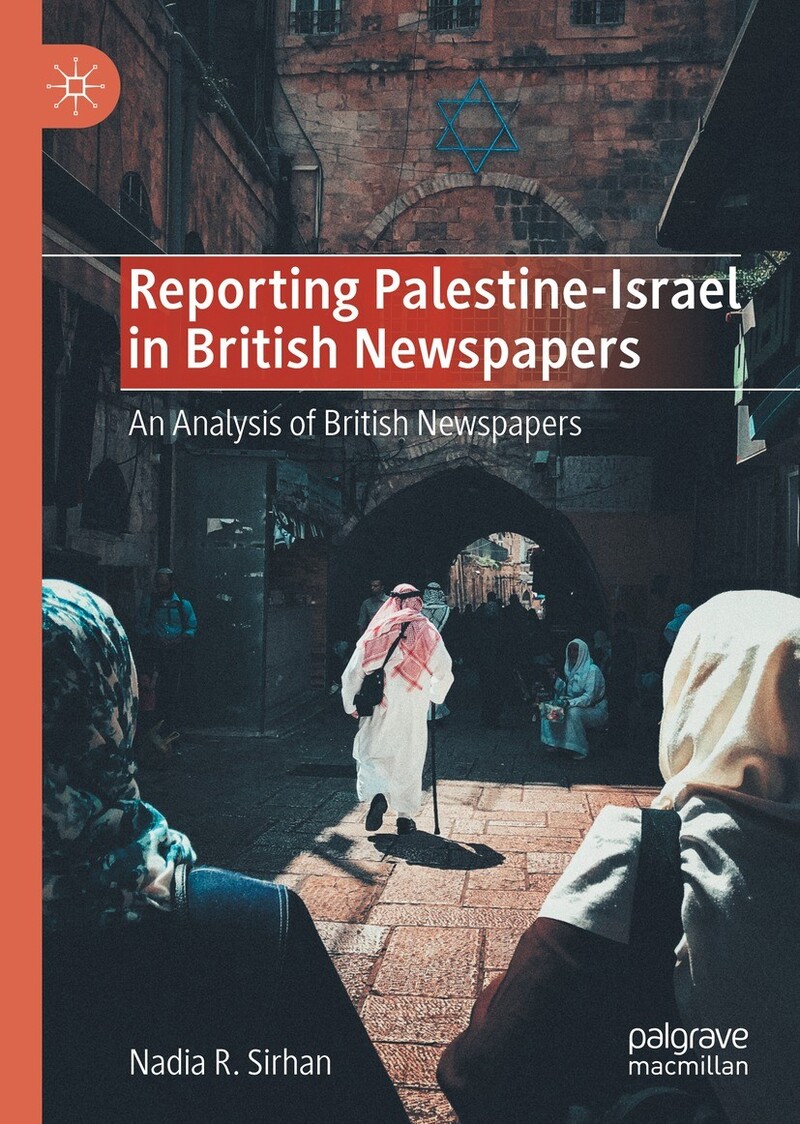
Reporting Palestine-Israel in British Newspapers: An Analysis of British Newspapers by Nadia Sirhan, Palgrave Macmillan (2021)
‘Conflict,’ Nadia Sirhan says in Reporting Palestine-Israel in British Newspapers, is the word most commonly used to describe Palestine-Israel but it should only be used that way if it appears between inverted commas.
The term, she points out, wrongly suggests a power symmetry between the parties, obscuring the realities of apartheid, colonialism and occupation.
“A new lexicon is needed,” she contends, “one that subverts the pervasive propaganda and blatant bias” that consistently favor the nuclear-armed ethnocracy that has dispossessed – and is dispossessing – Palestine’s Indigenous people.
Sirhan has a poetic flare making her work more readable than that of many scholars. She writes, for instance: “The Nakba continues apace. So much has happened since – 1967, the Intifadas, an unrelenting illegal military occupation, an illegal blockade, land theft, human rights abuses, etcetera, etcetera, in an interminable list – innumerable lives lost or destroyed, being lost and being destroyed. Present continuous.”
Yet such literary flourishes do not interfere with her book’s rigor.
Reporting Palestine-Israel in British Newspapers looks at how language is used in media coverage of Palestine and the ways linguistic choices can shape public opinion. Sirhan, a translator with a PhD in Arabic linguistics from SOAS, University of London, dissects word choices and sentence structure while also looking at such issues as Israel’s foundational myths, censorship, agenda setting and sourcing.
Sirhan analyzes approximately 400 articles from five British newspapers: The Daily Mail, The Guardian, The Independent, The Daily Telegraph and The Times.
She focuses on how these outlets have covered five recent events: Operation Cast Lead, Israel’s assault on Gaza in 2008-09; the kidnapping and killing in 2014 of three teenage Israeli settlers (Naftali Frenkel, Gilad Shaar, Eyal Yifrach); an arson attack in 2015 that killed a Palestinian toddler and his parents (the Dawabsha family) while severely burning a young child; the killing in 2017 of an Israeli police officer and two Israeli security guards (Solomon Gavriyah, Youssef Ottman, and Or Arish, respectively) in the illegal Har Adar settlement; and the killing, also in 2017, of unarmed Palestinian paraplegic Ibrahim Abu Thurayya.
The Electronic Intifada for more