
by CLAIRE CONNELLY
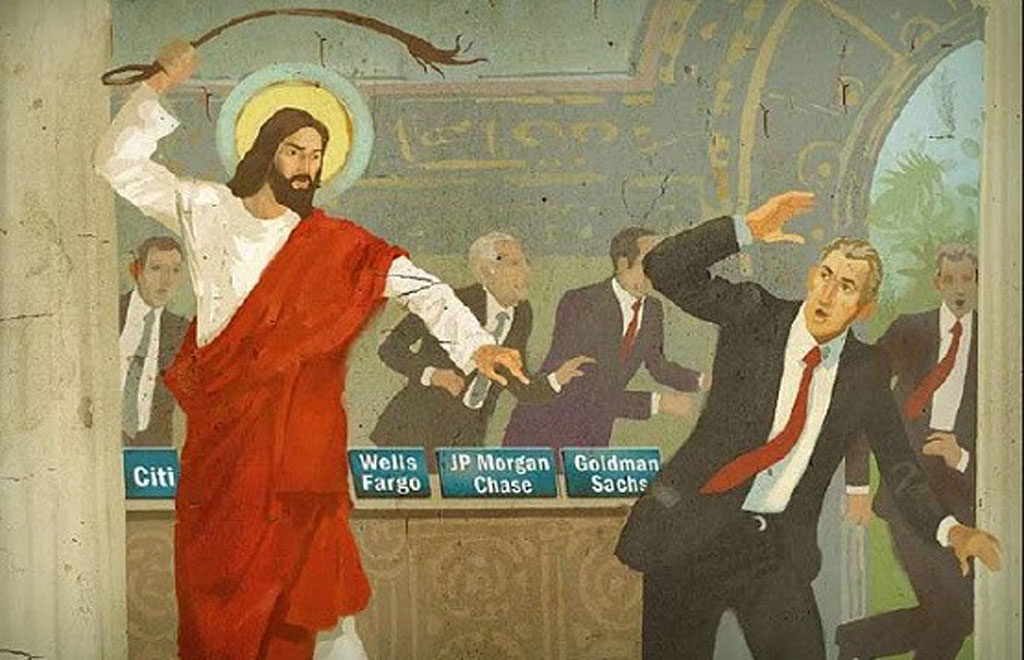
As many people turn towards their Christian and Jewish faiths this Christmas and Hanukkah in an attempt to make sense of the year that was, at least one economist says we have been reading the bible in an anachronistic way.
In fact he has written an entire book on the topic. In ‘…And Forgive them their Debts: Credit and Redemption’ (available this spring on Amazon), Professor Michael Hudson makes the argument that far from being about sex, the bible is actually about economics, and debt in particular.
Indeed the Judaism that we know today is not the Judaism of Jesus either.
The economist told Renegade Inc the Lord’s Prayer, ‘forgive us our sins even as we forgive all who are indebted to us’, refers specifically to debt.
“‘Schuld’, in German, means ‘debt’ as well as ‘offense’ or, ‘sin’. It’s ‘devoir’ in French. It had the same duality in meaning in the Babylonian language of Akkadian.”
The idea harks back to the concept of ‘wergeld’, which existed in parts of Europe and Babylonia, and set the value of a human life based on their rank, paid as compensation to the family of someone who has been injured or killed.
“The payment – the Schuld or obligation – expiates you of the injury caused by the offense,” Dr Hudson said.
The Ten Commandments were about debt
People tend to think of the Commandment ‘do not covet your neighbour’s wife’ in purely sexual terms but actually, the economist says it refers specifically to creditors who would force the wives and daughters of debtors into sex slavery as collateral for unpaid debt.
“This goes all the way back to Sumer in the third millennium,” he said.
Similarly, the Commandment ‘thou shalt not steal’ refers to usury and exploitation by threat for debts owing.
“To understand the crucifixion of Jesus is to understand it was his punishment for his economic views,” says Professor Hudson. “He was a threat to the creditors.”
Jesus Christ was a socialist activist for the continuity of regular debt jubilees that were considered essential to the wellbeing of ancient economies.
Governments can forgive debt. The bible says so.
In Sumer and Babylonia, whenever a new ruler would come to power, the first thing they would do was proclaim a “clean slate”, forgiving the population’s personal debt in what was known as a ‘debt jubilee’.
But classical antiquity’s rulers who cancelled their subjects’ debts tended to be overthrown with disturbing frequency – from the Greek ‘tyrants’ of the 7th century BC who overthrew the aristocracies of Sparta and Corinth, to Sparta’s Kings Agis and Cleomenes in the 3rd century BC who sought to cancel Spartan debts, to Roman politicians advocating debt relief and land redistribution, Julius Caesar among them.
Jesus’ first reported sermon in Luke 4 documents his announcement that he had come to revive the enforcement of the Jubilee Year. The term “gospel” (or ‘good news’) was used specifically to refer to debt cancellation which became the major political fight of the imperial Roman epoch, pitting Jesus against the pro-creditor Pharisees, (a political party and social movement that became the foundation for Rabbinic Judaism around 167 BC).
Renegade Inc. for more