
by ROBERTO SIRVENT
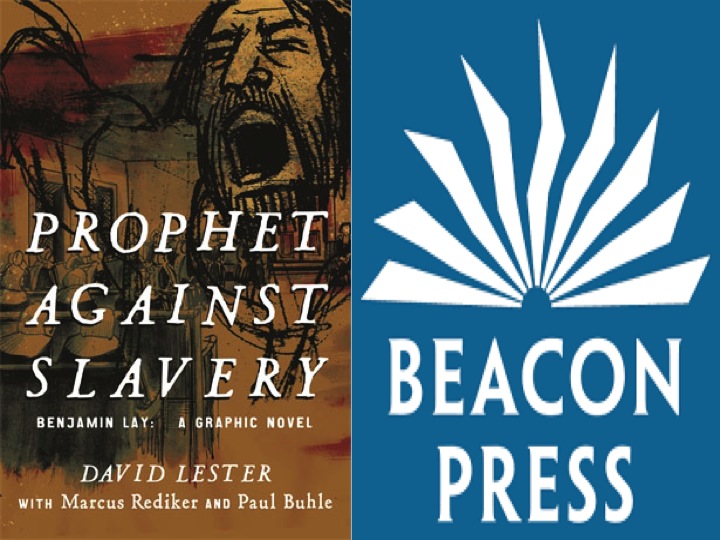
In this series, we ask acclaimed authors to answer five questions about their book. This week’s featured author is David Lester. Lester is the co-creator of the graphic novels The Listener and the award-winning 1919: A Graphic History of the Winnipeg General Strike. His book, edited by Paul Buhle and Marcus Rediker, is Prophet Against Slavery .
Roberto Sirvent: How can your book help BAR readers understand the current political and social climate?
David Lester: One might think that writing and drawing Prophet Against Slavery, a graphic novel about an historical character from 300 years ago, could be tough to make relevant to a modern audience. But the story of Benjamin Lay and his fight for the abolition of all slavery is remarkably contemporary. The lineage of all progressive social movements can be traced back to the anti-slavery movement which was most certainly the very first activist movement in North America.
Benjamin Lay was a dwarf and a hunchback who came from humble origins. He received no education, yet developed into a revolutionary, a radical American Quaker. A vegetarian and animal rights activist, he would not wear clothes made from animals as their production might have caused suffering. His empathy, perhaps shaped by his low social standing in society, is a key factor to his radicalism.
Because of the expressive nature of hands, in Prophet Against Slavery I repeatedly drew a visual motif of clasped or touching hands, all as a way of showing empathy, friendship, love, solidarity, comradeship, and working collectively for a greater good.
Lay focused on stopping the Quaker hierarchy from owning and selling the slaves but he also wanted to end this practice everywhere. In the only book Lay wrote, he warned that if slavery was not ended immediately, the legacy of racism would profoundly haunt America. His prediction was not wrong and it explains where America finds itself in the 21st century.
In the 18th century it was common for Europeans to consider slavery acceptable. This social thought process continues today with the institutional oppression that we see in police departments, political parties and government bodies.
What do you hope activists and community organizers will take away from reading your book?
The battle for social justice is not always a linear narrative. It is far messier, it is far more abstract, and what appears to be defeat at one moment is simply part of a longer struggle on the road to social progress and victory.
Benjamin Lay’s dogged example of speaking truth to power and of using guerrilla theatre in his protests should be a source of great inspiration for activists. Historical graphic novels like Prophet Against Slavery are part of that struggle. The tradition of using art and text in social justice work has a long history. By using the graphic novel form to present Lay’s radical life in an engaging way, Prophet Against Slavery has perhaps demonstrated a way forward for activist art.
Graphic novels have the power to communicate in ways that traditional history books do not. They can remove barriers from potential readers who find politics or history boring, or intimidating. In the case of wordless graphic novels, readers of all backgrounds, education, and language can engage.
A while ago I spoke to high school teachers who said that they are finding students are increasingly unable to read longer texts, like books. Graphic novels are now fundamental tools in the process of education. Remember, these students will be the future activists, the future Benjamin Lays.
In Prophet Against Slavery, I used visual motifs of repetition. I wanted to mirror how repetition is a fundamental part of political activism. The struggle for social change can be a relentless one, often a tiring slog with the sense that the same things are said and done over and over again. But this is the process of change.
We know readers will learn a lot from your book, but what do you hope readers will un-learn? In other words, is there a particular ideology you’re hoping to dismantle?
Black Agenda Report for more