
EDITORS – BLACK AGENDA REPORT
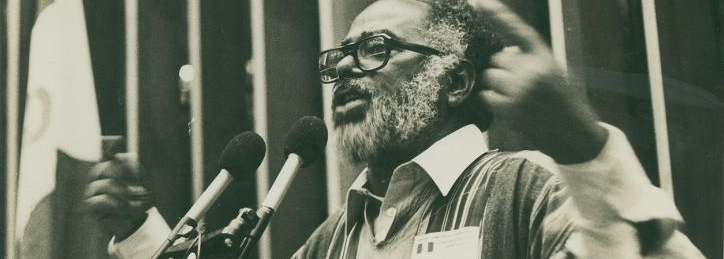
The late Brazilian intellectual, artist, and activist Abdias do Nascimento argues that racial democracy is premised on an idea of racial mixing that not only valorizes whiteness, but is predicated on the dilution and disappearance of the African race — on an annihilationist practice of “genocide.”
A recent issue of the Journal of Black Studies contains a special section dedicated to the life and work of Abdias do Nascimento. Nascimento was a Brazilian pan-Africanist and polymath who passed away in 2011 at the age of ninety-seven. Edited by anthropologist Keisha-Khan Y. Perry and Anani Dzidzienyo, the late Ghanaian scholar of Africa and Brazil, the journal issue provides an excellent introduction to a figure who, as the editors point out, is both a towering intellectual, cultural, and political figure in the Black world, and one who is surprisingly neglected and under-engaged.
The introduction, and the issue in its entirety, is a wonderful, often moving, tribute to Nascimento. Contributors to the issue write of his singular role in the development of Africana philosophy and Pan-African thought worldwide. They describe the impact of Nascimento’s experiences as a soldier in the Brazilian military in the early 1930s and his subsequent incarceration on his political and intellectual development. They discuss Nascimento’s philosophy of quiliombismo , a militant, collectivized practice of Black autonomy inspired by the seventeenth-century insurrectionist communities formed by Africans who escaped slavery on Brazil’s plantations. They survey Nascimento’s immense contribution to the arts and the representation of Africa in Afro-Brazilian culture via painting, theatre, film, and sculpture, from his time working with the Teatro Experimental do Negro to Theatre in the 1940s and 1950s to his time in exile in the United States in the 1970s and 1980s. They also write of Nascimento’s contribution to changing the national discourse in Brazil around race relations, organized resistance, and state policy.
One of Nascimento’s most important political interventions arrives through his dismantling of the benign mythology of Brazil’s “racial democracy.” Nascimento argues that racial democracy is premised on an idea of racial mixing that not only valorizes whiteness, but is predicated on the dilution and disappearance of the African race — on an annihilationist practice of “genocide.” This genocide occurs through sexual violence against Black women, the encouragement of white immigration, and the disportionate use of the law to contain, surveil, and punish Brazil’s African population. Today, the genocide of Brazil’s Afro-descended populations occurs through racist state violence in the form police murders and dispossession. In Rio de Janeiro, police admitted to killing 606 people in the first four months of 2020. Close to six people a day were murdered by police in April of the same year. In May of this year, police killed twenty-eight people during a heavily-militarized attack on a Rio de Janeiro favela. In the past decade, of the 9000 people killed by police, three quarters were Black men.
Black Agenda Report for more